
PolinRider malware has been linked to at least 7,609 GitHub repositories across 2,330 accounts, according to research cited by Apiiro. The North Korea-linked software supply-chain campaign uses compromised developer access to plant malicious code in trusted repositories, with some variants concealing their command infrastructure in blockchain transactions.
The latest findings, reported November 26, 2026, bring together several investigations. SafeDep independently identified a newer Python loader in 375 public repositories belonging to 260 accounts, while OpenSourceMalware traced related payload activity to compromised npm packages published in May 2025.
These are different research datasets, not interchangeable victim counts. A repository containing an injected loader does not automatically mean that the code executed or that every user who cloned the project was compromised.
For developers and security teams, the immediate concern is that seemingly legitimate GitHub projects, build configurations and test files can become malware execution points after a maintainer account or workstation is compromised.
PolinRider Malware: What Researchers Discovered
PolinRider is the name researchers use for a software supply-chain campaign connected to North Korea-linked malicious activity. Its documented techniques include poisoned open-source repositories, stolen GitHub access, malicious developer projects and blockchain-backed payload retrieval.
A November 24 investigation by SafeDep identified a 58-line Python loader planted in public GitHub repositories.
Separately, Apiiro reported a larger campaign footprint involving thousands of repositories and accounts. That broader finding includes malicious modifications associated with Git-history rewriting and other propagation techniques.
| Research Finding | Reported Scope | Important Limitation |
|---|---|---|
| Apiiro campaign estimate | At least 7,609 GitHub repositories across 2,330 accounts | Does not prove every repository’s code executed |
| Recent GitHub propagation | 2,040 repositories received the loader between October 27 and November 6 | Researcher-reported activity, not a count of confirmed infected endpoints |
| SafeDep Python-loader investigation | 375 public repositories across 260 accounts | Specific Python-loader dataset, not the entire campaign |
| Earlier npm compromise | Nine malicious package versions linked to one maintainer in May 2025 | Earlier samples did not demonstrate the later self-spreading behavior |
The distinction matters for incident response. Security teams need to establish whether malicious code was merely present in a repository, executed on a developer machine, or reached downstream builds and environments.
How PolinRider Poisons GitHub Repositories
PolinRider exploits trust in legitimate developer identities and source-code history.
Researchers describe attackers obtaining access to developer accounts or workstations, then modifying repositories those developers are authorized to update.
Rather than always introducing an obvious new malware file, some variants insert malicious code into existing project files or configuration scripts.
Compromised Maintainer Access
Stolen GitHub credentials or a compromised developer workstation can provide legitimate-looking access to source repositories.
When malicious commits arrive through a trusted maintainer identity, ordinary reviewers may be less suspicious than they would be of changes from an unfamiliar external account.
This is an identity and software supply-chain problem. The reports do not establish exploitation of a vulnerability in GitHub’s underlying platform.
Rewritten Commits and Hidden Code
Apiiro and other researchers describe variants that rewrite previously created commits while preserving familiar author names, messages and apparent dates.
Obfuscated payloads have also been concealed after long runs of whitespace in configuration files, making them harder to notice during a quick visual review.
These techniques can create a misleading impression that the repository has not undergone a meaningful security-sensitive change.
For developers, the lesson is to inspect the complete file contents and commit integrity rather than relying only on a familiar contributor name or the latest visible Git diff.
How the PolinRider Python Loader Uses Ethereum
The newer PolinRider malware loader uses blockchain data as part of its payload delivery process.
According to SafeDep, the Python file retrieves information about transactions associated with a specific Ethereum wallet. It then obtains transaction input data, decodes embedded JavaScript and passes the next stage to Node.js.
That JavaScript retrieves information from another wallet to locate the current command-and-control infrastructure.
Ethereum is not being described as compromised. The attackers are abusing publicly accessible blockchain records as a configuration and payload-distribution mechanism.
Why Blockchain-Based Infrastructure Matters
Traditional malicious software may contain a hard-coded command server address. Defenders can sometimes disrupt that infrastructure by blocking the known address or taking down the server.
With blockchain-backed configuration, attackers may update a wallet transaction to change where infected systems retrieve later stages.
That does not make the campaign impossible to detect or disrupt. It does mean a single static domain or IP block may be insufficient if the attacker-controlled configuration changes.
Defenders should correlate unusual process execution, repository modifications, Ethereum API requests and subsequent network connections rather than relying on one indicator alone.
Where the Python Loader Hides
SafeDep identified the loader in Python files using names that could resemble ordinary utility or networking code.
| File Name | Occurrences in SafeDep’s Dataset |
|---|---|
session.py | 183 |
transport.py | 65 |
clients.py | 46 |
http_session.py | 45 |
net.py | 24 |
conftest.py | 12 |
These filenames are not inherently malicious. A legitimate Python application may contain files with exactly the same names.
Attribution requires examination of file contents, associated imports, repository history and the behavioral indicators documented by researchers.
Why conftest.py Is Important
Python’s pytest framework automatically discovers relevant conftest.py files when collecting tests.
A malicious loader placed in that file may therefore execute during a test run without a developer explicitly opening or invoking a suspiciously named script.
Other observed variants rely on imports from planted utility packages.
However, SafeDep found that several tested examples failed to load because their Python module paths were incorrect. Therefore, it would be inaccurate to claim every poisoned repository executes its loader whenever opened or started.
Execution depends on the particular payload, project layout, development tool and command being run.
Why VS Code, Build Scripts and Test Workflows Are Relevant
PolinRider’s broader campaign includes techniques that target familiar development workflows.
Researchers have documented malicious modifications involving JavaScript build files, Jest configuration, project imports and VS Code-related execution paths.
In certain cases, running a project build or test can trigger malicious code. Apiiro also reported a newer variant in which opening an affected project folder in VS Code could activate the loader.
These findings should not be generalized to every repository or every PolinRider variant.
The broader security risk is that developers often execute scripts supplied by repositories they expect to be safe, including coding exercises, open-source contributions and dependencies.
How PolinRider Relates to North Korean Fake Job Campaigns
Researchers link PolinRider activity to a wider ecosystem of campaigns that use developer recruitment and coding assignments as initial access opportunities.
Some campaigns present targets with fake job offers, interview portals or take-home coding assessments.
The candidate may be asked to clone a repository, install an extension or execute software presented as part of a technical evaluation.
Once a development machine is compromised, attackers can potentially obtain credentials that give access to other repositories and services.
PolinRider overlaps with techniques associated with the broader Contagious Interview ecosystem, but researchers treat its repository-poisoning and self-propagation behavior as a distinct activity cluster.
For related North Korea-linked developer targeting, read our Jade Sleet DevOps workstation compromise analysis. That report concerns another documented incident and should not be treated as proof that the same operator controlled every PolinRider deployment.
For broader context on North Korea-linked developer targeting, cryptocurrency-related operations, and state-sponsored intrusion techniques, see our Nation-State and APT Threats guide. PolinRider’s attribution is based on published security research and does not establish that every related campaign was operated by the same threat actor.
What Malware Can PolinRider Deliver?
Research into earlier activity connects PolinRider-related payloads to JADESNOW and InvisibleFerret, together with remote-access and credential-stealing components.
OpenSourceMalware linked malicious npm packages from May 2025 to a chain that could expose browser information, developer credentials, wallet data and other sensitive material.
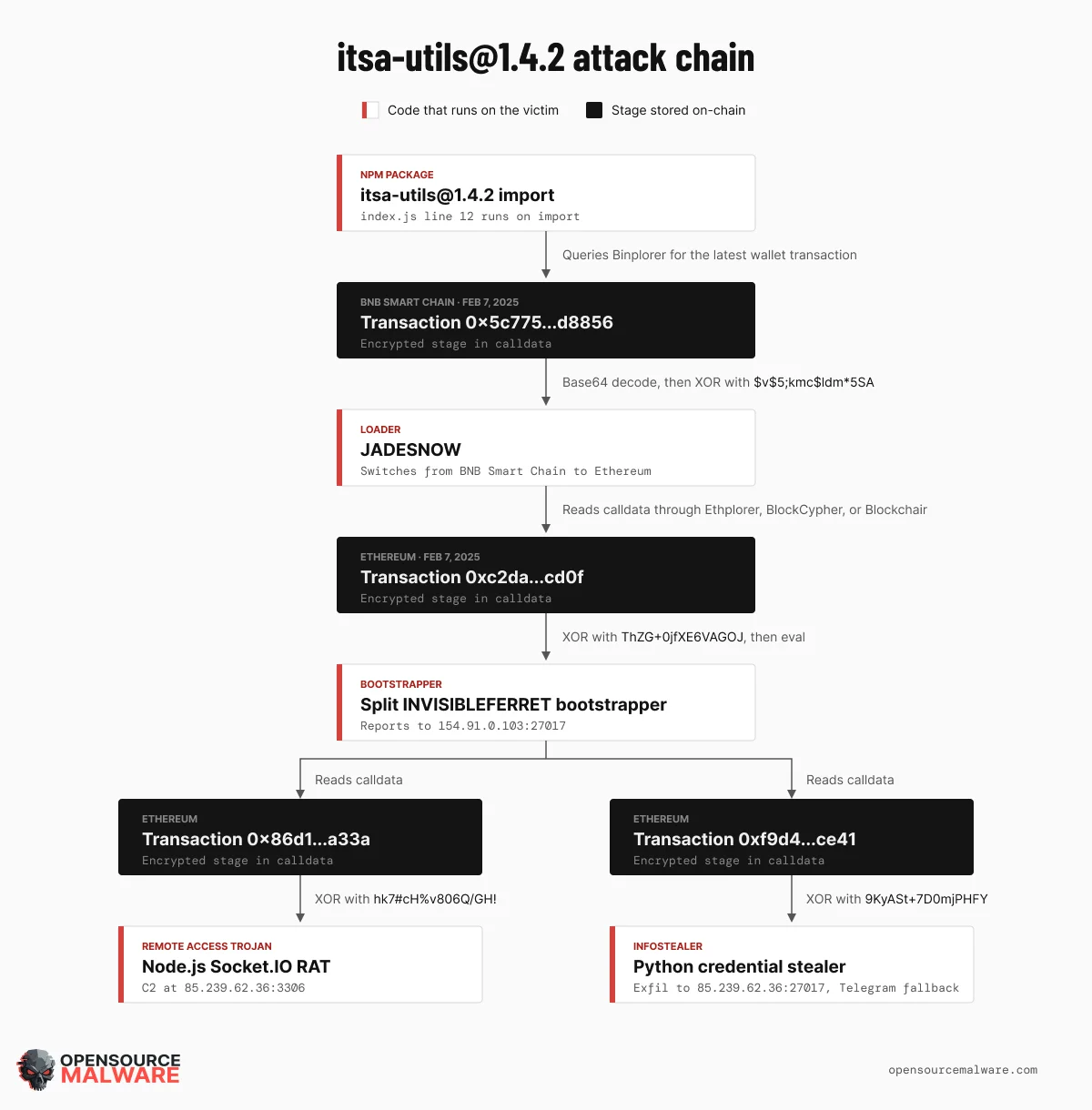
The newer Python loader investigated by SafeDep was linked to later-stage retrieval infrastructure, but the researchers did not independently establish the complete behavior of every newly retrieved payload.
It would therefore be misleading to claim that every repository containing the Python loader definitely installed every previously observed malware family.
How Developers Can Check for PolinRider Malware
If your organization develops or builds software from public GitHub repositories, investigate the specific artifacts and execution paths identified by the researchers.
Start with a trusted, isolated investigation environment rather than opening or running suspicious repository content on a production workstation.
1. Search for the Documented Python-Loader Indicators
SafeDep published read-only searches for the Ethereum wallet address and API strings associated with the Python loader.
grep -rniE '0x3b1574417524c11a7403c4b232cacbb320ccebc6|getAddressTransactions|eth_getTransactionByHash' --include='*.py' .

grep -rnE '^import utils\.(net|clients|http_session|transport|session)\b' --include='*.py' .
The first command searches Python files for a documented wallet and relevant transaction-retrieval API strings. The second searches for a group of suspicious imports observed in some affected repositories.
A positive result requires manual review. These indicators may be absent from other PolinRider variants, and some matching code patterns can occur in legitimate software.
2. Review Test Configuration Files
Inspect unexpected changes to conftest.py, jest.config.js, build scripts and newly introduced utility packages.
Pay particular attention to unexpected subprocess execution, network requests during imports, and configuration changes unrelated to the stated purpose of a commit.
Do not execute suspicious tests merely to confirm whether they run the loader.
3. Inspect Repository History
Because some PolinRider variants rewrite and force-push commits, examine repository audit events, unexpected history changes and discrepancies between locally verified commits and remote branches.
SafeDep also recommends searching Git history for known loader indicators, not only inspecting the current repository files.
Where available, compare suspicious changes with protected branches, previously verified release commits and trusted code-review records.
4. Investigate Developer Workstations
If a suspicious repository was built, tested or opened under conditions associated with known execution triggers, investigate the developer endpoint.
Look for unexpected Node.js processes, suspicious access to credentials, unusual Git operations and outbound connections associated with the documented campaign.
If compromise is suspected, isolate the affected system according to your organization’s incident-response procedures and preserve relevant evidence.
5. Rotate Credentials Potentially Exposed
Repository cleanup alone may not be sufficient when malicious code has executed on a workstation with access to GitHub tokens, cloud accounts or package registries.
Identify which credentials were accessible during the suspected execution window and revoke or rotate them from a trusted environment.
Review connected GitHub accounts, repository permissions, package-publishing access, CI/CD secrets and recent cloud authentication activity.
Our GhostAction GitHub attack investigation explains a separate campaign in which compromised developer credentials and trusted repository permissions created similar supply-chain exposure.
What DevSecOps Teams Should Change After This Campaign
PolinRider illustrates why a conventional dependency vulnerability scanner cannot serve as the only control protecting a development pipeline.
The malicious content can be inserted directly into repository files, can exploit trusted maintainer identities and may execute before an application is deployed.
Security teams should prioritize:
- Developer endpoint protection: Monitor unexpected scripting activity and credential access on workstations used for trusted builds.
- GitHub identity controls: Use phishing-resistant MFA, least-privilege permissions and strong protection for privileged maintainer accounts.
- Repository integrity: Require review for sensitive changes, restrict force-pushes where appropriate and monitor altered commit histories.
- Build isolation: Run untrusted projects in disposable environments without production credentials or broad network access.
- Secret management: Prefer short-lived credentials and reduce persistent tokens stored on developer machines.
- Runtime monitoring: Investigate unexpected process chains and outbound requests during test and build operations.
- Incident response: Treat suspicious repository changes as potentially connected to a compromised developer machine or identity.
None of these controls guarantees complete protection individually. Their value comes from reducing execution opportunities and limiting what attackers can access if one safeguard fails.
CyberUpdates365 Analysis: Why Trust in Git History Is Not Enough
The most important security lesson is not simply that malware can hide inside a GitHub repository. That is a known software supply-chain risk.
What makes PolinRider notable is the combination of trusted developer access, potentially misleading commit history, normal development execution paths and externally changeable payload configuration.
These mechanisms target different assumptions that development teams may rely on:
- A familiar maintainer identity means the modification is trustworthy.
- An ordinary-looking commit message means the underlying content was not maliciously changed.
- A routine build or test operation cannot execute attacker-controlled code.
- Blocking one malware command server permanently disrupts the campaign.
The research shows why each assumption needs independent verification.
For organizations with valuable source code or deployment credentials, a compromised development workstation can be more consequential than a single malicious package. It can allow attackers to modify code distributed under legitimate identities and potentially reach additional development environments.
That is an operational implication drawn from the published research, not a claim that CyberUpdates365 independently tested PolinRider malware or observed compromises in customer environments.
Frequently Asked Questions
What is PolinRider malware?
PolinRider is a North Korea-linked software supply-chain malware campaign documented by security researchers. It targets developer environments and repositories through malicious code, stolen access and multiple payload-delivery techniques.
How many GitHub repositories were affected?
Apiiro estimated at least 7,609 repositories across 2,330 accounts. SafeDep separately confirmed a particular Python loader in 375 repositories across 260 accounts. The figures cover different datasets and do not establish that every repository executed malware.
Was GitHub itself hacked?
The reported activity involves compromised developer identities, workstations and repository modifications. The evidence reviewed does not establish a vulnerability or compromise of GitHub’s underlying service as the cause.
Can PolinRider infect a computer when a repository is opened?
Researchers documented some variants with VS Code-related execution paths. Other variants require particular Python imports, test collection or build commands. Merely opening every affected repository does not necessarily execute its loader.
Is PolinRider spread through PyPI or npm?
SafeDep found no evidence that its November Python-loader variant was distributed through either registry. Separate OpenSourceMalware research documented earlier PolinRider-linked payloads in compromised npm package releases from May 2025.
What should an organization do if it finds an injected loader?
Preserve the suspicious files, investigate whether they executed, check the relevant developer workstation and repository access, and revoke or rotate credentials that may have been exposed. Follow a documented incident-response process before restoring trusted builds.
Final Takeaway
PolinRider malware is a significant threat to software-development supply chains because attackers can turn legitimate repository access into a distribution mechanism for malicious code.
Recent investigations describe thousands of potentially poisoned repositories, a newer Python loader, blockchain-based payload retrieval and historical links to malicious npm releases.
The key defensive response is to verify repository integrity, examine suspicious development execution paths, protect maintainer accounts and investigate potentially compromised developer workstations.
Developers should not assume that a familiar GitHub account, a normal-looking commit or an unchanged dependency manifest means a repository is safe to execute.
Original Research and Technical Sources
- SafeDep — PolinRider Moves to Python with an Ethereum Calldata Loader, November 24, 2026
- Apiiro — PolinRider North Korea-Linked Worm and Forged GitHub Commits
- OpenSourceMalware — Earliest Known PolinRider Malware Found in 2025 npm Packages
- The Hacker News — North Korea-Linked PolinRider Poisons Over 7,600 GitHub Repositories, November 26, 2026