By CyberUpdates365 Enterprise Security Desk | Last Updated: September 12, 2026
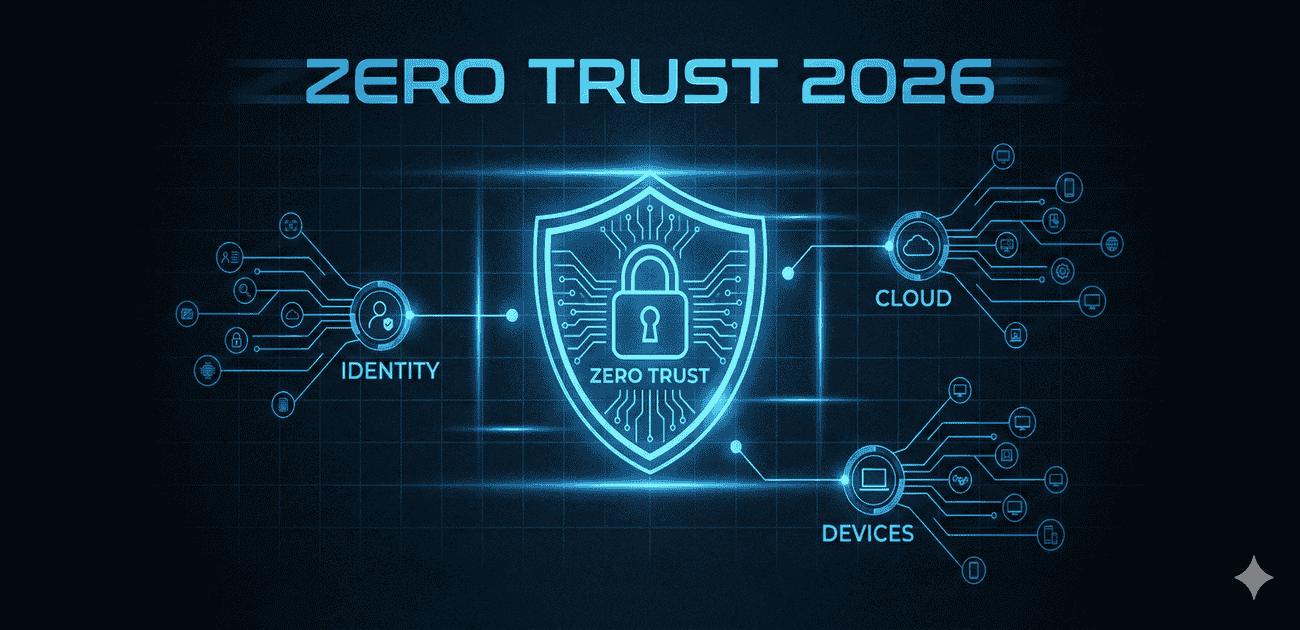
Executive Summary: Deploying an enterprise Zero Trust Architecture 2026 framework has become mandatory as legacy perimeter defenses fail against distributed cloud workloads and AI-assisted credential attacks. Modern Zero Trust mandates continuous identity verification, granular microsegmentation, and automated threat mitigation based on NIST SP 800-207 baselines.
The strategic deployment of a Zero Trust Architecture 2026 framework is no longer an optional security project; it is the fundamental baseline for modern enterprise resilience. Traditional “castle-and-moat” security architectures trusted any user or device situated inside the internal corporate boundary. In 2026, with distributed remote workforces and sophisticated cloud-native infrastructure, trusting an internal connection allows adversaries to execute lateral movement unhindered.
Zero Trust operates on one non-negotiable principle: Never trust, always verify. To safeguard corporate identities, organizations are establishing zero trust security model controls that evaluate risk at every transaction layer.
Part 1: What is Zero Trust Architecture? Core Principles
Zero Trust is not a single software product or appliance; it is an overarching architectural strategy. Designed around the authoritative specifications of NIST SP 800-207 Architecture Standards, the architecture enforces three fundamental tenants:
- Verify Explicitly: Authenticate and authorize every access request utilizing all available telemetry points, including user identity, device health state, geographical context, and anomalous behavior.
- Enforce Least Privilege Access: Restrict user access using Just-In-Time (JIT) and Just-Enough-Access (JEA) governance. Limit lateral reach so compromised accounts cannot traverse between business silos.
- Assume Breach: Operate under the assumption that adversaries already possess an internal foothold. Minimize the blast radius through end-to-end payload encryption and rapid continuous monitoring.
Part 2: Traditional Corporate VPN vs Zero Trust Network Access (ZTNA)
A primary driver for modern infrastructure upgrades is replacing obsolete virtual private networks with comprehensive ZTNA implementation solutions.
| Security Dimension | Legacy Enterprise VPN | Zero Trust Network Access (ZTNA) |
|---|---|---|
| Access Scope | Broad network subnet access | Granular, per-application micro-tunnels |
| Network Visibility | Full network reconnaissance possible | Internal subnets remain completely dark |
| Lateral Movement | Permissive across shared segments | Strictly prevented via microsegmentation |
| Session Validation | One-time authentication at login | Continuous contextual trust verification |
Part 3: The Five Foundational Pillars of Zero Trust Strategy
Building a unified defense across complex multi-cloud ecosystems requires hardening each of the primary architectural pillars defined in the federal CISA Zero Trust Maturity Model:
- 1. Identity Management: Identity serves as the primary security perimeter. Organizations must eliminate legacy password systems in favor of phishing-resistant FIDO2 hardware credentials and adaptive Single Sign-On (SSO).
- 2. Endpoint Compliance: Validate device integrity before permitting network sessions. Managed endpoints must prove active EDR telemetry and verified OS patch baselines before receiving session tokens.
- 3. Network Microsegmentation: Eliminate flat routing topologies. Divide internal subnets into isolated micro-segments to trap threat operators if an initial node is compromised.
- 4. Application Governance: Protect application program interfaces (APIs) and enforce strict cloud access security brokers (CASB) to eliminate shadow cloud services.
- 5. Data Security & Encryption: Classify corporate data assets by sensitivity and implement automated encryption across data in transit and data at rest.
Part 4: Enterprise Implementation Roadmap (3-Phase Execution)
Achieving mature zero trust architecture is an iterative journey. Organizations should follow this structured deployment strategy:
- Phase 1: Identity & Inventory Visibility (Months 1-3): Map all enterprise identities, service accounts, and managed endpoints. Mandate universal MFA and enforce strict conditional access policies across all identity providers.
- Phase 2: Network Segmentation & Device Hardening (Months 3-6): Implement microsegmentation rules isolating mission-critical databases and immutable backups to prevent lateral extortion incidents, as documented in our ransomware critical infrastructure defense guide.
- Phase 3: Automated Telemetry & AI Defense (Months 6+): Integrate Security Orchestration, Automation, and Response (SOAR) workflows to instantly revoke session tokens whenever anomalous behavioral deviations occur.
Why Zero Trust Strategy Is Essential Against Advanced Attacks
Adversaries increasingly weaponize automated tooling and identity theft vectors to penetrate business networks. As detailed in our enterprise investigation into modern supply chain source code leaks, relying on static perimeter firewalls cannot prevent compromised credentials from exfiltrating sensitive IP.
Furthermore, regulatory requirements have accelerated adoption. Discover why zero-trust compliance is now being mandated at the highest executive levels in our report on Zero Trust Architecture compulsory adoption for Fortune 500 enterprises.
Frequently Asked Questions
What is Zero Trust Architecture 2026?
Zero Trust Architecture 2026 is an enterprise cybersecurity framework that assumes breach and requires continuous explicit verification of identity, device health, and context before granting access to specific applications.
How does ZTNA replace traditional enterprise VPNs?
ZTNA establishes direct, encrypted micro-tunnels to individual authorized applications rather than placing the user onto the entire corporate network, eliminating lateral movement risks entirely.
What are the core NIST principles of Zero Trust?
The NIST SP 800-207 guidelines mandate three foundational principles: Verify explicitly, use least privileged access, and assume breach.
Is Zero Trust Architecture difficult to deploy for legacy IT environments?
While complete transformation takes time, enterprises can adopt an iterative approach starting with Identity Provider modernization, MFA enforcement, and phased application-level microsegmentation.
Reported by CyberUpdates365 Enterprise Security Desk. Dedicated to delivering technical security blueprints, zero trust architecture implementations, and regulatory compliance analysis.