
OpenAI and Cisco have launched Shirudo, an open-source security project designed to help protect running Linux systems from exploitation while administrators prepare permanent software patches. Announced on November 23, 2026, the project combines artificial intelligence-assisted security engineering with runtime controls, including eBPF-based safeguards.
In a controlled demonstration, a safeguard generated using OpenAI’s Codex blocked a Java4Shell exploit attempt against an Elasticsearch service without restarting the application.
The result demonstrates a potential way to reduce exposure during the period between discovering a vulnerability and deploying its permanent fix. However, Shirudo remains a pre-release project, and the demonstrated protection does not establish that it can automatically stop every exploit in production environments.
For Linux administrators, DevOps engineers, and security teams, the most important questions are how Shirudo works, what its testing actually proved, and what infrastructure is required to use it safely.
What Is Shirudo? OpenAI and Cisco Explain the Project
According to OpenAI’s official November 23 announcement, Shirudo is intended to help infrastructure operators protect vulnerable workloads while testing and deploying permanent security updates.
Cisco’s official newsroom announcement describes the project as part of a broader effort to create infrastructure capable of responding more quickly to emerging cyber threats.
The name Shirudo means “shield” in Japanese.
Its core idea is to deploy a narrowly targeted safeguard that prevents an attacker from reaching or successfully exploiting a vulnerable operation, without immediately requiring the affected application or operating system to restart.
Traditional patch deployment can require administrators to test updates, obtain change approvals, schedule maintenance windows, and restart services.
Shirudo aims to provide an additional defensive option during that interval, particularly when immediately stopping or upgrading a business-critical application is impractical.
The project is being developed openly, allowing researchers, developers, and infrastructure operators to review its implementation and contribute improvements.
How Shirudo Protects Linux Systems Using eBPF
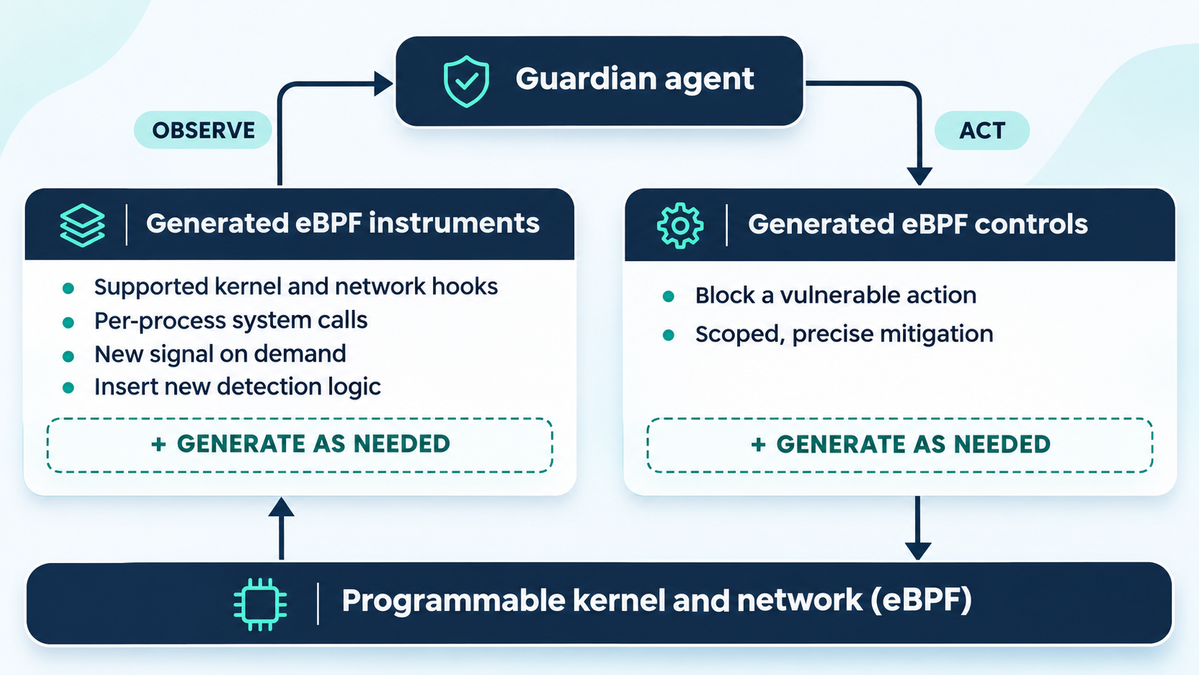
Shirudo draws on eBPF, a Linux technology that enables specially structured programs to execute at selected points inside the operating system.
Depending on the attachment point and the program’s privileges, eBPF can support system observability, policy enforcement, and targeted runtime security controls.
Shirudo uses this capability to help operators build safeguards known as shields, or upatches, that can be applied to running systems.
The technology also supports application-level protections, including Java bytecode modifications in cases where a kernel-level eBPF program is not the most appropriate mitigation.
Four Core Capabilities
| Capability | Purpose |
|---|---|
| Live protection | Apply narrowly targeted safeguards while supported workloads remain running. |
| AI-assisted mitigation | Help identify vulnerabilities, develop protection code, and test it against relevant exploit behavior. |
| Signed deployment | Verify that security protections originate from trusted, authorized signers. |
| Hardware-backed verification | Use TPM measurements to help verify which protections have been loaded or removed. |
These capabilities are intended to make temporary mitigation more controlled and auditable. They do not eliminate the need to validate how a particular shield affects an application.
How an AI-Generated Shirudo Shield Works
The project’s design allows an AI-assisted control plane to help develop mitigations using information about a known vulnerability and the behavior needed to exploit it.
In the technical demonstration published by Cisco’s Isovalent team, the workflow involved generating and evaluating protection code before applying it to a running workload.
- Identify the vulnerability: Gather technical information about an affected application or software component.
- Develop a reproducer: Establish a way to test the behavior associated with the vulnerability.
- Generate a mitigation: Create a targeted safeguard at an appropriate enforcement point, such as an eBPF hook or an application runtime.
- Test the safeguard: Determine whether the proposed protection blocks the tested exploit while preserving expected application behavior.
- Sign and deploy: Deliver the approved mitigation through the project’s trusted deployment process.
- Monitor and verify: Check runtime behavior and the recorded protection state.
The intended workflow retains an important security boundary: operators decide which protections are authorized for deployment.
An AI-generated safeguard should not be treated as inherently safe merely because it passed one automated test.
Shirudo Blocks Java4Shell Exploit in Elasticsearch Test
One of the strongest pieces of publicly described evidence for Shirudo comes from a controlled test involving the Java4Shell vulnerability.
OpenAI and Isovalent reported that Codex generated a safeguard targeting vulnerable behavior in Java’s Base64 decoder.
The researchers attached the protection to a running Elasticsearch 9.5.5 process, then attempted the exploit.
The safeguard rejected the malicious input, and the Elasticsearch service continued operating without a restart during the test.
Why the Java4Shell Demonstration Matters
The demonstration is notable because the safeguard was implemented using Java bytecode rather than an eBPF program attached directly to a kernel function.
That distinction shows why Shirudo’s design is broader than simply installing eBPF filters.
Some vulnerabilities are best addressed through a check inside the application or its runtime, particularly where blocking a shared kernel operation would also interrupt legitimate activity.
The researchers’ goal was to prevent the tested malicious input from triggering the vulnerable behavior without stopping the running Elasticsearch workload.
However, the test does not prove that the generated shield blocks every possible exploit variation or remains compatible with every Java application.
The permanent vendor update remains the appropriate long-term remediation.
Can Shirudo Replace Traditional Security Patches?
No. Shirudo is designed to provide temporary or supplemental protection, not eliminate the need for vendor security updates.
A conventional software patch corrects the underlying vulnerable implementation. A runtime shield may instead restrict the conditions under which an attacker can exploit it.
These approaches solve related but different problems.
| Security Measure | Primary Purpose | Limitation |
|---|---|---|
| Vendor patch | Fix the underlying vulnerability. | May require testing, deployment coordination, and restarts. |
| Shirudo shield | Block specific exploit behavior while the affected workload remains running. | Protection depends on the tested exploit path, shield design, and system compatibility. |
| Network restriction | Reduce access to vulnerable interfaces. | May not stop exploitation through permitted network paths or local access. |
| Monitoring | Identify suspicious activity and provide investigative evidence. | Observation alone does not necessarily prevent exploitation. |
For security teams, Shirudo may eventually become an additional option within a vulnerability-management program, particularly for workloads that cannot be restarted immediately.
That does not make it a universal substitute for patching, isolation, or other security controls.
Shirudo Uses Cryptographic Signing and TPM Verification
Security tools that modify runtime behavior must themselves be protected against unauthorized use.
Shirudo’s design includes cryptographic signing, trusted loader controls, and hardware-backed measurement.
According to the official Shirudo GitHub repository, operators distribute signed protection packages, while the runtime restricts loading to authorized components.
Linux’s eBPF verifier checks supported eBPF programs against relevant safety requirements.
The system also uses a Trusted Platform Module, or TPM, to record changes in the protections loaded on a target.
Operators can use TPM-signed evidence to compare a system’s recorded state with the protections they expected to be deployed.
These mechanisms help establish trust in the deployment process and provide evidence about runtime configuration.
They do not independently prove that every shield is free of logic errors, that every exploit is blocked, or that a workload will remain unaffected under all operating conditions.
Is Shirudo Ready for Production Linux Servers?
As of November 24, 2026, the official GitHub repository identifies Shirudo as pre-release.
The project also documents specific system requirements for production targets.
| Requirement | Current Project Guidance |
|---|---|
| Operating system | Linux with the required project-specific kernel support. |
| Kernel integration | Signed-loader ABI and Shirudo kernel patches. |
| Hardware trust | TPM 2.0 for production targets. |
| Testing environment | Official VM quickstart supports a software TPM for evaluation. |
| Deployment maturity | Pre-release; production readiness requires additional evaluation. |
Administrators should not assume that Shirudo can be installed on any existing Linux server without preparation.
Its ability to apply shields without restarting a service also should not be confused with a guarantee that initial platform setup requires no system changes or reboot.
OpenAI and Cisco provide a virtual-machine quickstart for evaluating the project’s signing, loading, verification, and removal processes.
For most organizations, an isolated test environment is a more appropriate starting point than deploying experimental runtime safeguards directly to critical production infrastructure.
Why Shirudo Matters for DevOps and Security Teams
The gap between vulnerability disclosure and permanent remediation remains a difficult operational problem.
Even when a vendor releases a fix quickly, enterprises may need to evaluate compatibility across applications, containers, libraries, and dependencies before completing deployment.
During that time, attackers can investigate newly disclosed flaws and attempt exploitation against systems that remain exposed.
CyberUpdates365 previously examined the growing role of automated vulnerability research in its Google AI Threat Tracker 2026 report, which discussed how agentic tools can accelerate parts of offensive cybersecurity workflows.
Shirudo represents a different use of automation: developing and validating defensive controls more quickly.
For DevOps and site reliability engineering teams, this could eventually help reduce the operational tradeoff between maintaining service availability and limiting vulnerability exposure.
However, a temporary safeguard still requires clear ownership, deployment approval, observability, rollback procedures, and a permanent remediation plan.
How Shirudo Differs From AI Vulnerability Discovery
AI-powered security research tools increasingly demonstrate the ability to identify and exploit vulnerabilities under controlled testing conditions.
For example, CyberUpdates365 recently covered GPT-6.2 Astra’s zero-day vulnerability discovery evaluations, in which researchers assessed offensive cybersecurity capabilities.
Shirudo focuses on a different stage of the security process.
Rather than simply detecting or demonstrating a vulnerability, the project aims to help engineers generate, evaluate, and distribute a protection that can reduce exposure while a permanent fix is prepared.
The distinction is important: discovering a weakness, demonstrating exploitation, blocking one exploit path, and permanently correcting vulnerable code are separate technical achievements.
For background on those wider security challenges, see CyberUpdates365’s AI Cyber Threats and Agentic Security Guide.
What Linux Administrators Should Do Before Testing Shirudo
Security teams interested in the project should begin with a controlled evaluation rather than treating the announcement as a recommendation for immediate fleet-wide deployment.
- Read the official documentation: Review project requirements, supported architectures, and deployment procedures.
- Start in an isolated VM: Use the documented quickstart environment to understand signing, shield loading, and TPM-backed verification.
- Confirm kernel compatibility: Determine whether the target environment supports the required signed-loader interface and project kernel changes.
- Test a defined vulnerability scenario: Establish a reproducible attack condition before assessing a proposed mitigation.
- Verify legitimate workloads: Check application functionality, performance, logging, and expected user operations while the shield is active.
- Plan rollback: Document who can remove a shield and how unexpected behavior will be handled.
- Continue normal patching: Maintain vendor update schedules and vulnerability-management processes.
The official quickstart demonstrates how to work with a test protection; it should not be interpreted as evidence that all enterprise applications are compatible.
CyberUpdates365 Analysis: A New Option for the Patching Gap
Shirudo addresses a recognizable weakness in enterprise security operations: detecting a vulnerability is often faster than safely deploying its permanent fix across a large environment.
Its potential value lies in combining narrow runtime safeguards with automated development and validation workflows.
The Java4Shell demonstration illustrates what that approach can achieve in a specific controlled environment. A generated Java bytecode guard blocked the tested exploit attempt while Elasticsearch remained running.
However, the project’s current pre-release status, kernel requirements, and dependence on correctly designed mitigations are meaningful limitations.
Organizations should evaluate Shirudo as an emerging defensive engineering capability, not an established universal solution to unpatched vulnerabilities.
Over time, broader testing across Linux distributions, workloads, attack scenarios, and failure conditions will be important in assessing its practical reliability.
Frequently Asked Questions
What is Shirudo?
Shirudo is an open-source runtime security project announced by OpenAI and Cisco on November 23, 2026. It is designed to help teams deploy targeted protections against vulnerabilities while preparing permanent software patches.
Does Shirudo use artificial intelligence to block attacks?
The project supports AI-assisted development and validation of security safeguards. Operators retain control over deployment. Its protections can include eBPF programs and application-level modifications.
Can Shirudo protect Linux servers without restarting them?
Its design allows supported safeguards to be applied to running workloads without requiring a service restart. Initial platform setup and kernel integration have separate requirements, and the no-restart benefit should not be assumed for every deployment.
Is Shirudo production-ready?
The project’s public GitHub repository identifies it as pre-release as of November 24, 2026. Production targets require specific kernel support and TPM 2.0, and organizations should validate compatibility and operational safety before adoption.
Does Shirudo eliminate the need for security patches?
No. Shirudo shields are intended to reduce exposure to specific exploit behaviors while permanent fixes are tested and deployed. Vendor updates remain necessary.
Final Takeaway
OpenAI and Cisco’s Shirudo project introduces a promising approach to protecting Linux workloads during the period between vulnerability discovery and permanent patch deployment.
Its controlled Java4Shell demonstration showed that an AI-generated protection could block a tested exploit attempt without restarting a running Elasticsearch service.
Nevertheless, Shirudo is still pre-release, has specific infrastructure requirements, and has not been demonstrated as a universal defense against exploitation.
For Linux operators and security teams, the practical next step is to evaluate the open-source project in a controlled environment while continuing established vulnerability-management and patching practices.