
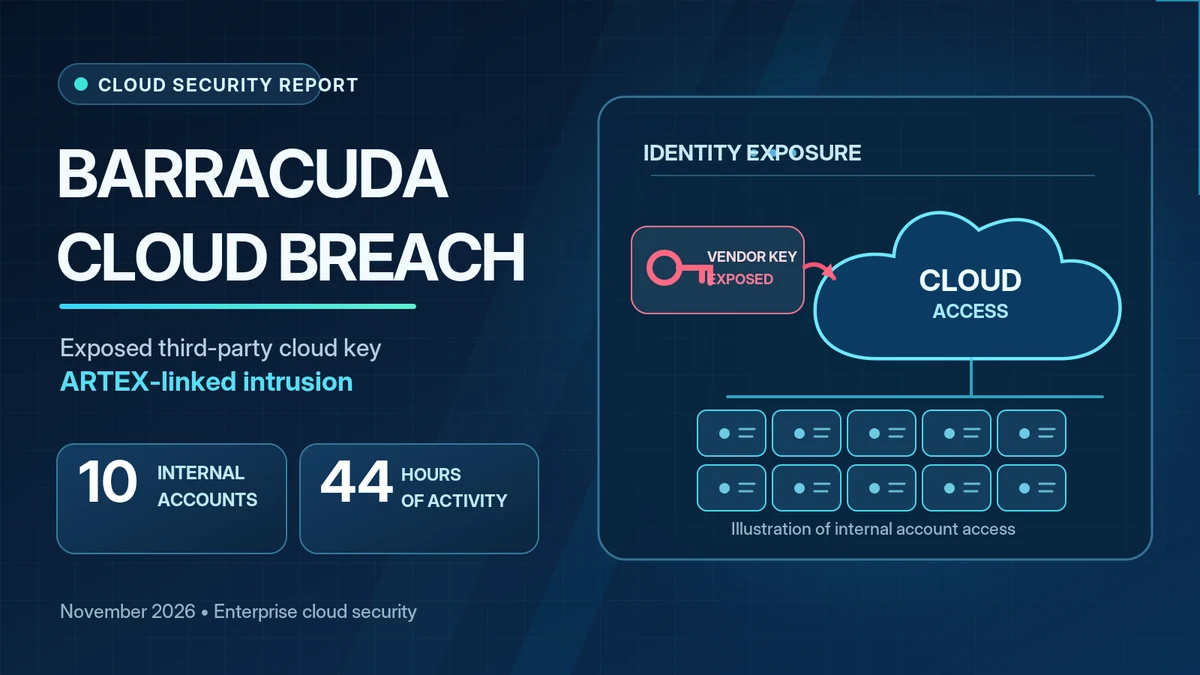
Barracuda Networks has disclosed a cloud security intrusion in which an attacker used a forgotten third-party access key to move through approximately 10 internal cloud accounts in roughly 44 hours.
The activity occurred between November 1 and November 2, 2026. According to the cybersecurity company, the exposed key had been issued to an outside AI vendor for an earlier project but was never revoked after the engagement ended.
The attacker used the credential to discover additional secrets, move between cloud services, reach source-code systems and access Kubernetes clusters. Barracuda identified behaviors consistent with ARTEX, an open-source AI-assisted penetration-testing framework that has also been observed in malicious operations.
One affected environment stored credentials used by Barracuda XDR integrations to collect customer security telemetry. The company found no direct evidence that those customer credentials were accessed, but incomplete logging prevented investigators from excluding that possibility.
Barracuda notified customers whose integration credentials might have been exposed and advised them to revoke and recreate those credentials. The incident demonstrates how a single persistent vendor key can enable a fast-moving attack across interconnected enterprise systems.
Key Facts About the Barracuda Cloud Breach
- Affected company: Barracuda Networks.
- Attack period: November 1–2, 2026.
- Duration: Approximately 44 hours.
- Internal cloud accounts reached: About 10.
- Initial access: A valid cloud access key previously provided to a third-party AI vendor.
- Credential exposure: The key was stored in a configuration file in the vendor’s GitHub repository and exposed after its development environment was compromised.
- Attack framework: Activity consistent with ARTEX.
- Systems involved: Cloud accounts, data analytics, source-code repositories, build workflows and Kubernetes.
- Customer concern: Possible exposure of selected Barracuda XDR integration credentials.
- Customer action: Notified organizations should rotate affected integration credentials and review connected-system activity.
How a Former AI Vendor’s Cloud Key Enabled the Intrusion
The investigation began with a cloud credential that should no longer have been active.
Barracuda had previously provided the access key to a third-party company working in artificial intelligence. When the project ended, the credential remained valid instead of being retired.
In October 2026, the vendor’s development environment was compromised. Barracuda’s November 13 update confirmed that the access key was stored in a configuration file within the third party’s GitHub repository.
This created a path into Barracuda’s internal cloud environment without requiring the attacker to exploit a newly disclosed vulnerability in a Barracuda product.
The company acknowledged that the forgotten key remained an unnecessary access point after the vendor relationship had ended.
There is also an important technical distinction: the initial credential was a cloud access key issued to an AI company, not necessarily a stolen API key for an AI chatbot or language model.
Barracuda Attack Timeline: November 1–4, 2026
Barracuda reconstructed the intrusion using cloud activity, repository evidence and incident-response findings.
| Date and time | Confirmed activity |
|---|---|
| October 2026 | The third-party AI vendor’s development environment was compromised, exposing a configuration file containing Barracuda’s still-valid key. |
| November 1, 04:33 UTC | The attacker made the first recorded request using the cloud key. |
| November 1–2 | The attacker searched cloud resources for secrets and moved into analytics, source-code and Kubernetes environments. |
| November 2, early hours | Temporary repository branches and build workflows were used in attempts to expose additional secrets. |
| November 2, 23:31 UTC | The last recorded attacker activity occurred. |
| November 4 | A Barracuda engineer reported suspicious account activity, while the vendor independently disclosed its own incident. |
| November 4, Pacific time | Barracuda removed a suspicious Kubernetes container and continued containment and credential rotation. |
| November 10–13 | Barracuda published its customer advisory, technical account and further findings about the exposed key. |
The critical operational concern is the short interval between initial access and the attacker’s final recorded activity. By the time suspicious activity was reported on November 4, the documented intrusion had already ended.
How Attackers Moved Across Cloud and Kubernetes Systems
After obtaining the vendor’s key, the attacker did not limit its activity to the first cloud account.
It began querying reachable resources and reading stored credentials, including AWS access keys and Azure service principal secrets.
Those credentials provided opportunities to investigate other services. Barracuda described a sequence in which the attacker moved from cloud accounts to a data analytics environment, then to source-code access and subsequently into Kubernetes clusters.
The investigation also identified attempts to retrieve credentials from infrastructure-as-code state files, server metadata services and Kubernetes service accounts.
These systems can contain credentials used by automation, monitoring and production workloads. If a stolen key has broad privileges, access to one environment may expose additional identities with access elsewhere.
This process is often described as credential chaining or lateral movement. The attacker repeatedly uses access discovered in one system to reach another.
Source-Code Workflows Used to Expose Secrets
Barracuda reported that the attacker pushed temporary branches into several repositories during an operation lasting less than four hours.
The branches triggered build workflows designed to expose secrets available to the build environment through job logs.
Investigators also observed encoded output intended to prevent ordinary secret-masking controls from recognizing sensitive values.
This matters because continuous integration and deployment systems often hold credentials needed to build applications, access private repositories and deploy software.
Organizations should treat their CI/CD environments as sensitive infrastructure, limit which secrets individual jobs can access and review suspicious workflow changes.
Why Barracuda Linked the Attack to ARTEX AI Agents
Barracuda identified several behavioral indicators that matched publicly reported characteristics of ARTEX.
The open-source framework coordinates security-testing tasks through a planning agent and worker agents that use tools and share results.
According to the company, the intrusion displayed machine-style resource names, repeatable probing sequences and automated routines for searching credentials and cryptocurrency-related information.
These observations supported Barracuda’s assessment that the attacker used an ARTEX-associated approach.
However, the framework is not exclusive to one threat actor. Its use does not identify the person, group or government responsible.
It also does not establish that every stage of the operation took place without human direction.
CyberUpdates365 recently examined ARTEX and other offensive frameworks in its Google AI Threat Tracker 2026 report on autonomous cyberattacks.
The Barracuda case provides a specific incident-level example of the broader trend discussed in that research.
Attackers Searched for Cryptocurrency and AI Credentials
Barracuda identified two major categories of information the attacker appeared to seek.
The first was reusable credentials, including cloud keys, service identities and secrets stored in development infrastructure.
The second was cryptocurrency-related material.
On systems where the attacker obtained shell access, commands searched for wallet-related environment variables, Ethereum keystore files, extended private keys, seed phrases and Kubernetes secrets associated with digital assets.
Barracuda reported that the searched systems did not contain cryptocurrency wallet material.
The company assessed the observed behavior as consistent with financial motives, although it did not establish the attacker’s complete objectives.
Credentials for AI services were also potentially accessible. However, the public report does not confirm that particular AI-service credentials were stolen, sold or used to generate unauthorized computing charges in this Barracuda incident.
Kubernetes Container Created a Potential Return Path
Inside one Kubernetes cluster, the attacker deployed a container that mounted the underlying host filesystem.
The mount provided read-only access, but that still created an opportunity to retrieve credentials stored on the host.
Investigators also observed an attempt to create a new administrative cloud identity. Barracuda said that attempt was blocked.
The company removed the suspicious container on November 4 and continued credential rotation and containment across the affected environments.
For defenders, the case highlights why Kubernetes workloads should not receive unrestricted host access and why service account permissions must be narrowly scoped.
A workload does not need write access to a host to expose sensitive information. Reading credentials can be enough to create opportunities for subsequent access.
Were Barracuda XDR Customer Credentials Stolen?
This is the most important distinction for organizations using Barracuda’s managed security services.
One of the systems the attacker reached stored integration credentials used by Barracuda XDR to collect security telemetry from connected customer platforms.
These integrations may connect to services such as Microsoft 365, Google Workspace, endpoint security products and other monitored environments.
Barracuda found no direct evidence that the attacker viewed or obtained the customer integration credentials.
However, the company said its logging in that environment was not sufficiently detailed to rule out access conclusively.
As a precaution, Barracuda treated potentially reachable integration credentials as exposed and contacted customers whose configurations could have been affected.
The advisory applies to relevant API integrations for Barracuda Managed XDR Cloud or Monitored Endpoint.
Barracuda states that organizations that did not receive a notification about this incident do not need to take action under that advisory.
Therefore, it would be inaccurate to say that every Barracuda customer was breached or that all customer XDR credentials were confirmed stolen.
What Affected Barracuda Customers Should Do
Organizations directly notified by Barracuda should follow the company’s official credential-replacement guidance rather than relying on generic password-reset instructions.
1. Identify the Affected Integrations
Review Barracuda’s notification and identify the specific Managed XDR Cloud or Monitored Endpoint integrations involved.
Determine which connected systems rely on the affected credentials.
2. Revoke and Recreate Credentials
Revoke the identified credentials at the relevant service provider and generate replacements using the documented procedure.
Ensure new credentials have only the permissions required for the integration to function.
3. Review Activity Since November 1
Barracuda advises notified customers to investigate connected-system activity beginning November 1, 2026.
Look for unexpected API requests, unusual administrative actions, access from unfamiliar environments and other activity inconsistent with normal integration behavior.
4. Restore and Validate Monitoring
After replacing credentials, confirm that expected telemetry collection resumes and that connected security monitoring systems operate normally.
Coordinate changes with the security operations and identity administration teams to avoid unnecessary monitoring gaps.
5. Follow Vendor Updates
Consult the latest Barracuda Trust Center advisory and customer-specific instructions, since the company’s investigation remains ongoing.
Customers who were not notified should not interpret this incident as a requirement to rotate every unrelated Barracuda credential.
Connection to the October 2026 Railway Security Incident
Barracuda compared its experience with a separate October intrusion at cloud hosting provider Railway.
Both incidents illustrate how an initial access point can lead to wider exposure when credentials are accessible across connected services.
Railway’s response involved potential exposure of customer environment variables and the rotation of secrets stored in its platform.
For background, CyberUpdates365 previously published a detailed Railway security incident and cloud credential exposure analysis.
The comparison is relevant to cloud identity security, but it does not establish that the same threat actor was responsible for both incidents.
How Enterprises Can Prevent Similar Cloud Credential Attacks
The Barracuda intrusion demonstrates that a valid but unnecessary cloud credential can become a significant security weakness.
Organizations should prioritize several defenses:
- Vendor offboarding: Revoke external access and credentials when projects or vendor relationships end.
- Short-lived access: Prefer temporary credentials and workload identities over long-lived shared keys.
- Least privilege: Limit each identity to the specific resources and actions it requires.
- Secret isolation: Prevent one compromised application or environment from exposing credentials for unrelated systems.
- CI/CD controls: Restrict build-system secrets and monitor changes to repository workflows.
- Kubernetes hardening: Limit host filesystem access, service account privileges and unnecessary container capabilities.
- Audit logging: Capture sufficient identity and data-access events to investigate whether sensitive information was actually retrieved.
- Incident readiness: Maintain a tested process for rapidly revoking and replacing large numbers of credentials.
For broader context on how autonomous tools accelerate existing security weaknesses, see our AI Cyber Threats and Agentic Security Guide.
Confirmed Findings and Remaining Unknowns
Confirmed by Barracuda
- An attacker accessed approximately 10 internal cloud accounts during November 1–2, 2026.
- The initial access key originated from a former third-party AI vendor relationship.
- The key had remained active after the original work ended.
- The vendor’s compromised development environment exposed a GitHub configuration file containing the key.
- The attacker searched for additional secrets and moved into analytics, source-code and Kubernetes environments.
- The observed attack behavior matched ARTEX-associated techniques.
- The attacker reached a system storing XDR customer integration credentials.
- Barracuda notified potentially affected customers and initiated credential rotation.
Not Established by the Public Disclosure
- The identity or affiliation of the attacker.
- That the operation was entirely autonomous from beginning to end.
- That customer XDR integration credentials were definitely viewed or stolen.
- That every Barracuda customer experienced unauthorized access.
- That cryptocurrency wallet material was successfully obtained.
- That AI-service credentials were used to generate unauthorized charges in Barracuda’s environment.
- That a new vulnerability in Barracuda’s commercial security products caused this incident.
CyberUpdates365 Analysis
The Barracuda cloud breach illustrates a familiar enterprise security problem operating at a faster pace.
A cloud key that remained valid after a vendor engagement became the attacker’s starting point. From there, additional credentials expanded the reachable environment.
The use of ARTEX-associated automation made the sequence notable, but the underlying weaknesses were conventional: persistent third-party access, credentials available across connected systems and insufficient visibility into selected data-access operations.
For US organizations operating complex AWS, Azure, Kubernetes and CI/CD environments, the central lesson is to reduce credential exposure before an attacker obtains access.
Detecting malicious activity remains necessary. However, detecting an attacker after credentials have already been collected may leave the organization facing extensive rotation and recovery work.
Security teams should combine rapid detection with credential expiration, segmentation, restricted service identities and tested recovery procedures.
Frequently Asked Questions
Was Barracuda Networks hacked in November 2026?
Yes. Barracuda disclosed unauthorized activity within portions of its internal cloud environment between November 1 and November 2, involving approximately 10 cloud accounts.
How did attackers enter Barracuda’s cloud environment?
They used a valid cloud access key originally provided to a third-party AI vendor. The credential remained active after the project ended and was exposed when the vendor’s development environment was compromised.
Was ARTEX used in the Barracuda attack?
Barracuda said the observed resource names, probing behavior and credential-hunting routines matched characteristics of the ARTEX AI-driven security-testing framework. That assessment does not identify the attacker or prove that every operation was autonomous.
Were Barracuda XDR customer credentials stolen?
Barracuda found no direct evidence that customer integration credentials were accessed. Because incomplete logging prevented investigators from ruling out exposure, the company notified potentially affected customers and recommended credential rotation.
Do all Barracuda customers need to reset credentials?
No. Barracuda states that its advisory applies to specific Managed XDR Cloud or Monitored Endpoint API integrations. Customers who did not receive a notification do not need to act under this advisory.
What is the main security lesson?
Unused third-party keys should be revoked, cloud identities should have limited privileges, and sensitive credentials should not provide uncontrolled access between unrelated systems.
Final Takeaway
The Barracuda incident shows how one forgotten vendor cloud key can create opportunities for rapid credential theft and movement across multiple enterprise systems.
Barracuda identified ARTEX-associated automated behavior during an approximately 44-hour intrusion involving 10 internal cloud accounts.
The company has not confirmed that customer XDR integration credentials were stolen, but it has notified certain customers to replace potentially exposed credentials.
For enterprise defenders, the priority is clear: remove unnecessary standing access, protect credentials across connected environments and prepare to investigate and recover before a fast-moving attacker can expand further.