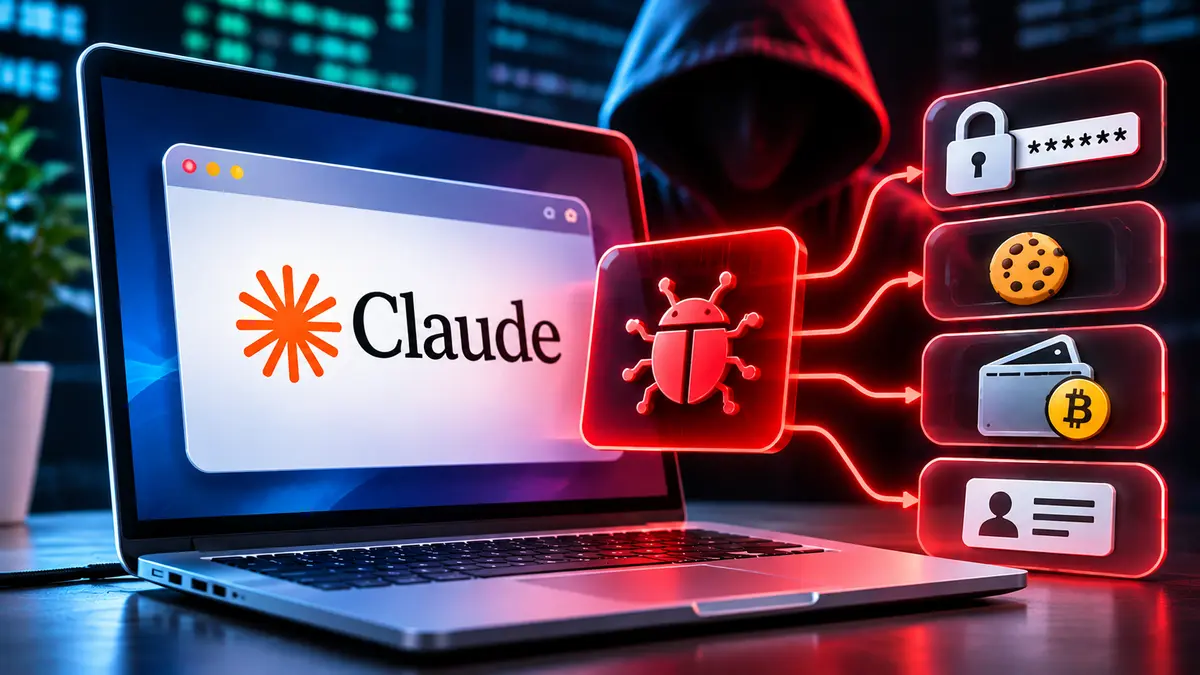
RevStealer malware is being distributed through counterfeit AI desktop software, including a fake application advertised as “Claude Opus 5 Free Desktop.” The Windows-targeting information stealer is designed to collect passwords, browser session cookies, cryptocurrency wallet data, and other sensitive information while attempting to evade security monitoring.
The campaign was documented in 2026 research from Morphisec Threat Labs, Elastic Security Labs, and Cyberint. Investigators found that attackers used misleading software downloads, including GitHub repositories and game-cheat-themed websites, to distribute malicious files.
The research does not establish that Anthropic’s official Claude application was compromised. Instead, attackers impersonated a familiar AI product to persuade users to execute untrusted software.
For Windows users and organizations, the principal risk is not just the malicious download itself. If RevStealer executes successfully, it may expose multiple accounts, authentication sessions, and business credentials before the victim notices anything unusual.
How Hackers Hide RevStealer Inside a Fake Claude AI App
According to Morphisec Threat Labs’ RevStealer investigation, attackers packaged malicious software inside a counterfeit desktop application that imitated Claude AI.
One observed lure advertised a free Claude desktop experience through a roughly 101 MB archive. The application was built using Electron, a legitimate framework for developing cross-platform desktop software.
Electron itself is not malicious. However, attackers can use it to package software that resembles a normal desktop application while executing harmful components in the background.
In the documented case, the executable did not present the expected AI chat interface. Instead, it performed system checks and prepared an encrypted payload for execution.
RevStealer Infection Chain
- Fake software promotion: The victim encounters a GitHub repository or other page advertising free Claude desktop access.
- Malicious download: The user obtains an archive containing a trojanized Electron application.
- Execution: The application runs system checks intended to identify analysis environments.
- Payload loading: The loader decrypts an embedded component and executes it from a Windows user directory.
- Credential collection: RevStealer attempts to access passwords, browser data, cryptocurrency wallets, and other information.
- Data exfiltration: Collected information may be transmitted to attacker-controlled infrastructure.
- Cleanup: Investigated variants attempt to delete malicious components after execution.
This is a social-engineering attack involving execution of an untrusted program. The research does not describe a vulnerability that automatically infects every user of the legitimate Claude service.
What Data Can RevStealer Malware Steal?
RevStealer is designed to collect several categories of information from compromised Windows systems.
Elastic Security Labs’ September 2, 2026 technical analysis describes a credential harvester targeting browsers, password managers, cryptocurrency wallets, gaming platforms, and other applications.
| Targeted Information | Potential Security Impact |
|---|---|
| Saved browser passwords | Unauthorized account access and credential reuse |
| Browser session cookies | Possible hijacking of authenticated sessions |
| Cryptocurrency wallet data | Potential theft of digital assets if sensitive wallet information is exposed |
| VPN and remote-access credentials | Possible unauthorized access to organizational systems |
| Password-manager artifacts | Exposure of locally accessible authentication information |
| Messaging and gaming accounts | Account takeover and possible resale of stolen access |
| Selected documents and screenshots | Exposure of personal or business information |
The actual impact depends on which applications were installed, what information was accessible, and whether the malware successfully collected and transmitted it.
The cited reports do not establish a verified total number of victims affected by the counterfeit Claude download.
Cyberint Explains RevStealer’s Stealth and Data Theft Techniques
Additional reporting from Cyberint’s technical analysis of RevStealer malware describes how the threat combines encrypted payload loading, anti-debugging checks, virtual-machine detection, and other evasion techniques.
Cyberint reports that the counterfeit Electron loader checks system characteristics such as available memory, processor resources, hostname, and graphics hardware before executing its malicious component.
The analyzed loader uses AES-256-CBC encryption to conceal an embedded payload. After decryption, it writes a native executable to a randomly named directory under Windows AppData and launches it without displaying a normal application window.
These techniques are significant because they can make a malicious download harder to analyze and may reduce the evidence visible to basic security checks.
1. Anti-Sandbox and Virtual Machine Detection
Malware researchers frequently examine suspicious programs inside isolated virtual machines and automated sandboxes.
RevStealer includes checks designed to determine whether it is running in such an environment.
Elastic documented a weighted sandbox-scoring mechanism that evaluates multiple system characteristics rather than relying on one simple check.
Depending on the detected conditions, the malware may avoid exposing its full behavior to the analysis environment.
2. Encrypted Payload Execution
RevStealer uses encrypted application resources to conceal portions of its malicious code before execution.
The loader decrypts and launches its payload at runtime, allowing the original downloaded package to reveal less information during static inspection.
Encryption alone does not make software malicious. In this case, it forms part of the malware’s concealment and execution chain.
3. Microsoft Defender Exclusion Attempts
Morphisec and Cyberint describe attempts to add the Windows AppData directory to Microsoft Defender’s exclusion list.
If such an exclusion is successfully applied, security scanning of that location may be reduced.
However, whether the change succeeds depends on device permissions, protection settings, and administrative controls.
4. Self-Deletion and Reduced Forensic Evidence
Investigated RevStealer variants attempt to remove themselves after performing their tasks.
This behavior can make incident reconstruction more difficult, especially when the initial malicious files are no longer present.
Self-deletion does not guarantee that all evidence disappears. Endpoint telemetry, network logs, process records, and identity-provider activity may still reveal suspicious behavior.
How RevStealer Uses Polygon Blockchain Infrastructure
One of RevStealer’s more unusual capabilities involves the way it can locate command-and-control infrastructure.
Elastic Security Labs documented a fallback mechanism that retrieves replacement server information through a smart contract on the Polygon blockchain.
The technique is associated with EtherHiding, which uses blockchain-hosted information as part of malicious infrastructure discovery.
This can make operations more resilient because the malware does not have to rely entirely on one fixed server address embedded in its code.
For defenders, the lesson is that blocking one known malicious domain may not fully disrupt a threat that can retrieve updated infrastructure information.
The technique does not establish that Polygon’s blockchain was hacked or that ordinary users of the network participated in the operation.
RevStealer Can Deliver Additional Malicious Modules
Elastic identified four additional modules associated with RevStealer command-and-control tasking.
| Module | Documented Capability |
|---|---|
| ProManager | Additional browser-extension and cryptocurrency wallet theft capabilities |
| WinUpdate | Clipboard monitoring and cryptocurrency-address replacement |
| SoftManager | Reverse proxy and remote connectivity functionality |
| LockAppHost | Cryptocurrency mining and persistence-related functions |
These modules illustrate the broader functionality researchers documented within the malware ecosystem.
However, their existence does not mean that every fake Claude infection necessarily installed all four components.
Why Stolen Browser Sessions Create Additional Risks
One particularly important RevStealer capability is the collection of browser session cookies.
When someone signs in to an online service, the website may issue a session token that allows the browser to remain authenticated.
If attackers obtain and successfully reuse a valid session token, they may be able to access an account without performing a fresh password-based login.
Some services implement protections that restrict session reuse, but these safeguards vary between applications.
As a result, changing a password alone may not terminate every stolen session.
Users should review active sessions, sign out unfamiliar devices, revoke compromised tokens where supported, and enable phishing-resistant multifactor authentication when available.
For additional account recovery steps, see CyberUpdates365’s guide to checking exposed email addresses and passwords.
RevStealer and MacSync: Two Different Fake Claude Malware Threats
RevStealer is not the only malware threat that has abused Claude-related branding.
CyberUpdates365 previously reported on MacSync malware distributed through misleading Claude-related installation instructions targeting macOS users.
Although both operations exploit trust in AI software, they are distinct threats.
| Characteristic | RevStealer | MacSync |
|---|---|---|
| Primary platform | Windows | macOS |
| Documented lure | Counterfeit Claude desktop application | Misleading Claude installation instructions |
| Execution method | Trojanized Electron application and native payload | Malicious commands and scripts presented as installation steps |
| Primary risk | Credential, browser session, wallet, and account information theft | Credential and cryptocurrency wallet information theft |
Both cases demonstrate that attackers can impersonate trusted AI products without needing to compromise the legitimate vendor’s infrastructure.
Readers can explore related attack methods in CyberUpdates365’s AI Cyber Threats and Defense Guide.
How to Protect Yourself From Fake Claude Downloads
The most effective defense begins before running an unfamiliar installer.
- Use official download sources: Access AI applications through the vendor’s verified website or documented distribution channels.
- Verify developer identity: A GitHub repository using a familiar product name is not proof of vendor authorization.
- Avoid suspicious free premium offers: Treat unauthorized downloads promising unrestricted access to paid AI features as potential social-engineering lures.
- Maintain endpoint protection: Keep Windows and security software updated, and investigate unexpected changes to protection settings.
- Limit sensitive credentials: Avoid storing unnecessary passwords, API keys, and recovery information on devices used to test untrusted software.
- Use strong account security: Enable multifactor authentication and monitor important accounts for unusual login activity.
No single setting guarantees protection against every infostealer. Combining trusted software sources, endpoint controls, and strong identity security reduces the opportunities available to attackers.
What to Do if You Installed the Fake Claude Application
Response priorities depend on whether the suspicious file was merely downloaded or actually executed.
If You Downloaded but Did Not Execute It
Do not run the installer. Remove the suspicious download and perform a security scan using updated protection software.
A downloaded archive alone is not proof that malware successfully executed, although users should investigate any other suspicious activity.
If You Executed the Application
- Isolate the computer: Disconnect the potentially compromised device from the network to limit additional communication.
- Use another trusted device: Change important passwords and revoke exposed authentication sessions.
- Prioritize sensitive accounts: Review email, financial accounts, cloud consoles, developer platforms, password managers, and workplace access.
- Rotate exposed secrets: Replace API keys, VPN credentials, and other tokens that may have been accessible to the malware.
- Investigate wallet exposure: If cryptocurrency private keys or recovery phrases may have been stolen, move assets to a new wallet created in a trusted environment.
- Preserve evidence: Businesses should retain relevant security logs and suspicious files before rebuilding affected systems.
- Assess recovery: Consider reinstalling the operating system from trusted media when the extent of compromise cannot be established.
Removing the malicious executable does not recover information already stolen. Credential rotation, session revocation, and investigation remain necessary where exposure is suspected.
What Security Teams Should Monitor
Organizations investigating possible RevStealer activity should correlate endpoint behavior with account and network telemetry.
| Monitoring Area | What to Investigate |
|---|---|
| Process execution | Unexpected Electron applications and executables launched from user-controlled directories |
| Security configuration | Unexplained Microsoft Defender exclusion changes |
| Browser data access | Unusual attempts to read browser profiles, credential stores, or session information |
| Network connections | Suspicious outbound traffic and connections associated with documented malware infrastructure |
| Identity activity | Unusual account sessions, VPN authentication, and cloud API activity |
| Threat intelligence | Published RevStealer detection rules, YARA signatures, and indicators of compromise |
Elastic Security Labs provides technical indicators and detection guidance for RevStealer, including YARA and behavioral detection resources.
Security teams should evaluate these indicators in context rather than relying on one file name, domain, or process event to confirm an infection.
CyberUpdates365 Analysis: The Real Risk Behind Free AI Software
The RevStealer campaign highlights a security problem that extends beyond one malware family: trusted product names can be used to make untrusted downloads appear credible.
A legitimate-looking repository, familiar AI branding, and promises of free premium functionality may encourage users to bypass their usual software verification habits.
The technical design of RevStealer makes that initial decision especially consequential. Researchers documented a malware family built to gather sensitive information, conceal its behavior, and limit some of the artifacts available during later investigation.
For individual users, verifying application origin is the first defense. For businesses, controlling unapproved software execution and monitoring identity activity are equally important.
Another practical lesson is that malware containment and account recovery are separate tasks. A computer may no longer be running the malicious program while stolen credentials or sessions remain usable elsewhere.
That is why incident response should address both the affected endpoint and the accounts or services whose information may have been exposed.
Frequently Asked Questions
Is Anthropic’s official Claude application infected with RevStealer?
The cited research does not establish a compromise of Anthropic’s official Claude application. The documented lure involved counterfeit software impersonating Claude.
Is RevStealer a Windows or macOS threat?
The counterfeit Claude RevStealer operation described by Morphisec and Cyberint targets Windows systems. Separate malware campaigns, including MacSync, have targeted macOS users through different methods.
Can RevStealer steal cryptocurrency wallet information?
Yes. Researchers documented capabilities targeting cryptocurrency wallet artifacts, along with browser credentials, session cookies, and other sensitive information. Actual exposure depends on the data accessible on the infected device.
Is changing passwords enough after infection?
Not always. Potentially stolen session cookies, API keys, VPN credentials, and wallet secrets may require separate revocation or replacement. The affected computer also needs appropriate investigation and recovery.
Final Takeaway
RevStealer demonstrates how attackers can use counterfeit AI software to deliver sophisticated information-stealing malware.
Research from Morphisec, Elastic Security Labs, and Cyberint documents a threat capable of harvesting sensitive information while using encrypted payloads, anti-analysis checks, and resilient command-and-control techniques.
The findings should not be interpreted as proof that Anthropic’s official Claude application was breached.
Users should download AI tools only from trusted sources, investigate suspicious installations, and treat potentially stolen credentials and sessions as a separate recovery priority.