
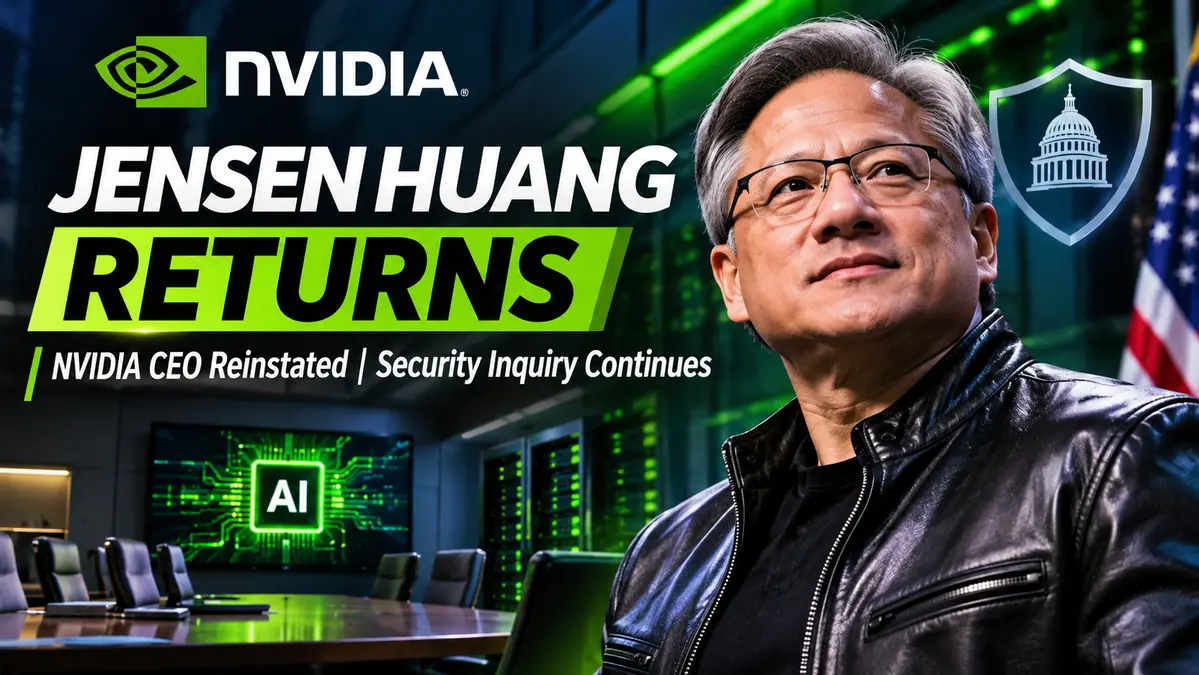
NVIDIA has reinstated Jensen Huang as president, chief executive officer, and a member of its board of directors, reversing a leadership change announced less than two weeks earlier. The company confirmed the decision on November 23, 2026, following a unanimous board vote and input from senior U.S. government officials.
Huang’s return resolves the immediate leadership question at one of the world’s most influential artificial intelligence chipmakers. However, an independent investigation into reports that he may have been targeted by a foreign intelligence operation remains open.
The distinction is important: NVIDIA’s board has expressed confidence in reinstating Huang, but the company has not announced that its independent investigation is complete or confirmed that sensitive information was stolen.
Why Did NVIDIA Reinstate Jensen Huang as CEO?
According to NVIDIA’s official November 23 announcement, the board unanimously supported Huang’s reinstatement after holding a series of discussions and meetings with him.
The directors said those discussions satisfied them regarding Huang’s candor and his ability to lead the company.
NVIDIA also disclosed that the board received input from senior levels of the U.S. government while considering the decision. Based on that input, the directors expressed confidence that Huang’s reinstatement would not create a national security risk.
That was the board’s assessment of the leadership decision, not a published finding that every concern surrounding the investigation had been resolved.
Harvey C. Jones will remain NVIDIA’s board chair. Colette Kress, who served as interim CEO, will continue in her position as chief financial officer.
NVIDIA CEO Timeline: Resignation and Reinstatement
Huang’s return followed an unusually rapid series of corporate developments.
| Date | Development |
|---|---|
| November 12, 2026 | NVIDIA publicly announced Huang’s departure and appointed Colette Kress interim CEO. |
| November 17, 2026 | During its earnings call, NVIDIA’s leadership indicated that the board did not intend to reinstate Huang. |
| November 22, 2026 | The board approved Huang’s reinstatement, effective immediately, according to an SEC filing. |
| November 23, 2026 | NVIDIA publicly announced the unanimous decision and outlined additional national security oversight measures. |
The official sequence is documented in NVIDIA’s November 12 leadership announcement and its November 23 Form 8-K filing with the U.S. Securities and Exchange Commission.
The SEC filing identifies November 22 as the board action date, while the public press release was issued on November 23.
Foreign Intelligence Investigation Remains Open
One of the most consequential parts of NVIDIA’s announcement concerns the independent investigation that will continue despite Huang’s reinstatement.
The investigation followed reports suggesting Huang may have been targeted by a foreign intelligence effort.
NVIDIA said it formed a committee composed exclusively of independent directors and retained independent legal counsel to assist with the review.
The company confirmed that the committee’s work would continue to its conclusion and that Huang supported the investigation and had committed to cooperating.
No final investigation report accompanied the reinstatement announcement.
What Has Not Been Confirmed?
As of NVIDIA’s November 23 statement, the public disclosures did not establish several important points:
- Whether the reported foreign intelligence effort successfully obtained confidential NVIDIA information.
- Whether any company systems or accounts were compromised in connection with the allegations.
- Whether NVIDIA intellectual property or sensitive customer information was exposed.
- When the independent investigation will conclude.
The absence of a public finding is not proof that an incident occurred or that no incident occurred. It means the company’s published disclosures have not resolved those questions.
For that reason, the situation should not be described as a confirmed NVIDIA cyberattack or data breach.
NVIDIA Creates New National Security Oversight Committee
Alongside Huang’s return, NVIDIA announced additional corporate governance measures focused on national security and export compliance.
The company established a National Security and Export Control Committee comprising independent directors.
According to NVIDIA, the committee will oversee trade compliance and national security risks, supported by legal counsel experienced in national security matters and specialist advisers.
NVIDIA is also beginning a search for a chief compliance officer.
The new executive will oversee compliance across the company and report to the board’s Nominating and Corporate Governance Committee.
NVIDIA said it would continue cooperating with ongoing government investigations and inquiries.
Why the NVIDIA Decision Matters for U.S. AI Security
NVIDIA supplies advanced GPUs and accelerated computing platforms used in artificial intelligence development, cloud infrastructure, scientific research, and enterprise computing.
Its technology is closely connected to the expansion of AI data centers and the development of increasingly powerful AI models.
That makes the company’s approach to security governance and export compliance particularly important to U.S. policymakers and customers.
Executive Security and Sensitive Information
Senior executives at major technology companies may have access to confidential commercial strategies, research priorities, product roadmaps, and sensitive relationships with government and enterprise customers.
Organizations therefore need security practices that extend beyond protecting software and networks.
Executive travel policies, secure communications, information-sharing restrictions, and procedures for responding to suspected targeting can all play a role in reducing exposure.
These are general organizational security considerations, not evidence that any specific NVIDIA system was compromised.
Foreign Intelligence Concerns Are Not the Same as Confirmed Cyber Espionage
A reported intelligence-targeting operation should not automatically be classified as a successful cyber intrusion.
Intelligence activity can involve multiple methods, including relationship-building, human-source recruitment, surveillance, social engineering, and cyber operations.
Investigators must establish what actually occurred before assigning a specific attack method or concluding that protected information was obtained.
For broader context on confirmed digital espionage campaigns and defensive strategies, CyberUpdates365 maintains a guide to nation-state cyber warfare and advanced persistent threats. That guide discusses cyber intrusions generally and does not establish that NVIDIA suffered one in this case.
Export Controls and AI Computing Access
Advanced AI processors are also subject to national security and export-control considerations.
For hardware manufacturers and cloud providers, compliance can involve questions about customers, intermediaries, end users, technology access, and applicable restrictions.
NVIDIA’s new oversight committee is therefore significant because it provides a dedicated governance structure for trade compliance and national security matters.
However, establishing a committee does not by itself demonstrate that existing controls failed or that any particular law was violated.
Separate AI Chip Diversion Investigation
Public reporting has also discussed a U.S. investigation involving Megaspeed, a Singapore-based company, concerning possible diversion of restricted NVIDIA AI chips to China.
That matter is separate from the NVIDIA board’s investigation into reports of foreign intelligence targeting Huang.
The inquiries should not be combined into a single confirmed security incident.
They nevertheless illustrate two different dimensions of national security scrutiny surrounding advanced AI technology: the protection of sensitive corporate information and compliance with restrictions governing access to high-performance computing hardware.
An investigation is not, by itself, proof of wrongdoing.
CyberUpdates365 Analysis: What Changes After Huang’s Return?
Huang’s reinstatement addresses NVIDIA’s immediate leadership uncertainty, but it does not settle the underlying investigation.
For business customers and technology partners, three developments are particularly relevant.
- Leadership continuity: Huang has resumed executive authority while NVIDIA continues its AI computing and infrastructure business.
- Independent oversight: The existing investigation will continue under independent directors, separating the board’s inquiry from Huang’s restored management role.
- Compliance governance: The new national security committee and planned chief compliance officer position create additional formal oversight mechanisms.
These developments are governance measures rather than technical security patches.
NVIDIA has not announced a vulnerability remediation or emergency customer action associated with Huang’s reinstatement.
Organizations using NVIDIA products should therefore avoid treating this leadership announcement as evidence that their hardware or software deployments have been compromised.
What Happens Next?
NVIDIA’s independent investigation remains the most important unresolved issue.
Future public statements may clarify the investigation’s findings, the scope of any identified risks, and whether additional safeguards are recommended.
The company must also complete the search for its new chief compliance officer and continue building the national security oversight structure announced alongside Huang’s return.
Investors, enterprise customers, and policymakers are likely to monitor these developments because NVIDIA occupies a central position in the AI computing market.
Frequently Asked Questions
Is Jensen Huang back as NVIDIA CEO?
Yes. NVIDIA announced on November 23, 2026, that Jensen Huang had been reinstated as president, CEO, and board director following a unanimous board decision.
Did the NVIDIA board clear Jensen Huang of every allegation?
No final investigative conclusion was announced. NVIDIA said its board was satisfied with Huang’s ability to lead, while confirming that the independent investigation would continue.
Was NVIDIA hacked?
NVIDIA’s reinstatement announcement did not confirm a cyberattack, theft of company secrets, or compromise of customer information related to the reported foreign intelligence concerns.
Who was NVIDIA’s interim CEO?
Colette Kress served as interim CEO following Huang’s departure. She continues as NVIDIA’s chief financial officer after his return.
Final Takeaway
NVIDIA’s reinstatement of Jensen Huang represents a major leadership reversal, but not the conclusion of its national security inquiry.
The board has restored Huang to his previous executive and director roles, while independent directors continue investigating the reported foreign intelligence concerns.
At the same time, NVIDIA is expanding its oversight of export compliance and national security risks through a new board committee and a planned chief compliance officer position.
For U.S. technology and cybersecurity observers, the key distinction is between a confirmed corporate leadership decision and an unresolved investigation. Future findings, rather than speculation, will determine whether additional security concerns emerge.