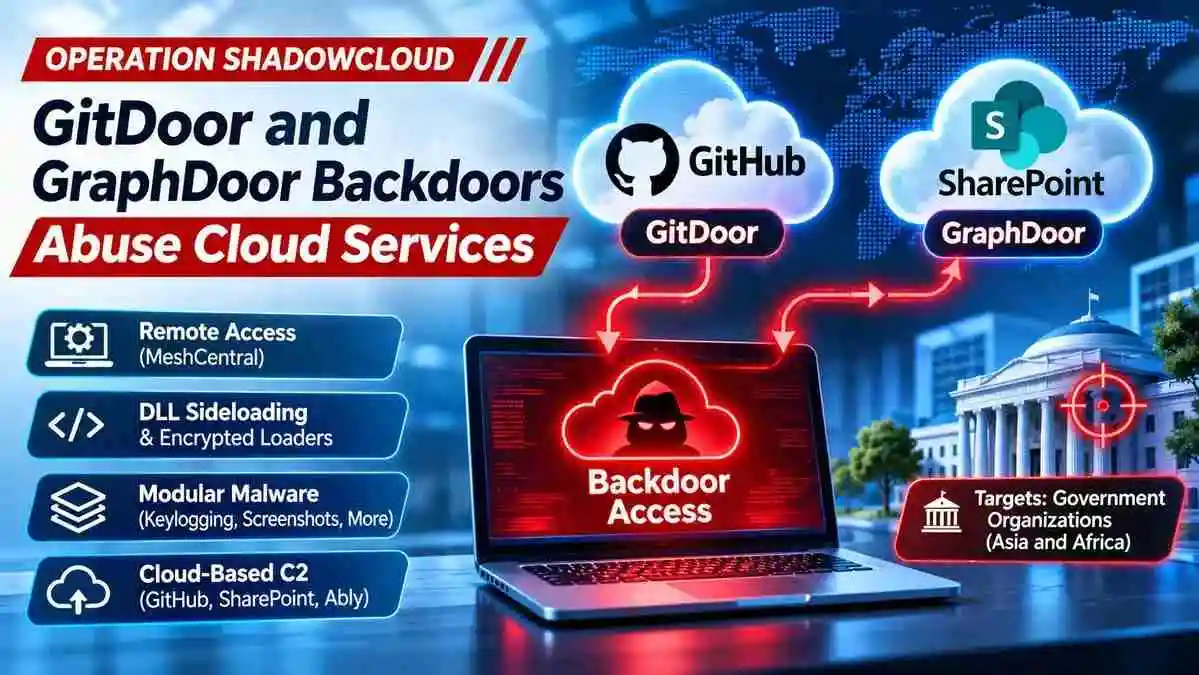
Security researchers have uncovered two previously undocumented Windows backdoors that use legitimate cloud platforms to conceal cyberespionage activity against government organizations in Asia and Africa.
The malware families, named GitDoor and GraphDoor, form part of Operation ShadowCloud, an active intrusion campaign identified by Kaspersky in early 2026 and detailed in research published on November 17, 2026.
Instead of relying only on conventional attacker-controlled command-and-control servers, the backdoors communicate through services including GitHub, Microsoft SharePoint and Ably. This allows malicious activity to appear alongside ordinary cloud traffic commonly permitted within enterprise networks.
Kaspersky found the attackers abusing a legitimate remote administration utility, deploying encrypted malware through DLL sideloading, and using modular components to gather intelligence from compromised Windows systems.
Researchers identified tactical overlaps with Chinese-speaking threat groups, but they have not conclusively attributed Operation ShadowCloud to a specific organization or government.
Key Findings: Operation ShadowCloud
- Campaign: Operation ShadowCloud.
- Research published: November 17, 2026.
- Research team: Kaspersky Global Research and Analysis Team.
- Malware families: GitDoor and GraphDoor.
- Primary targets: Government-sector organizations in Asia and Africa.
- Documented victim environment: An organization in Taiwan.
- Cloud services abused: GitHub, Microsoft SharePoint and Ably.
- Initial tool observed: MeshCentral Agent.
- Execution technique: DLL sideloading with encrypted payloads.
- Capabilities: Remote commands, system reconnaissance, keylogging, screenshots and additional plugin execution.
- Attribution: Unknown; overlaps with previously reported Chinese-speaking threat activity.
How Operation ShadowCloud Infects Windows Systems
Kaspersky’s investigation identified a staged intrusion sequence that begins with the misuse of MeshCentral Agent, a legitimate remote management tool.
MeshCentral is designed to provide remote desktop control, file management and command-line access. These are useful administrative functions, but they can also give an intruder substantial control when deployed without authorization.
Researchers discovered two instances of the agent executing within a Taiwanese organization.
The initial method used to install the agent remains unknown. Kaspersky believes the attackers may have reused access from an earlier compromise, but the available evidence does not establish the original entry point.
Once the agent established remote communication, the operators delivered three types of files:
- A legitimate executable used to trigger the next stage.
- A malicious DLL that acts as a loader.
- An encrypted file containing the backdoor payload.
When the legitimate program starts, the Windows library-loading process can cause it to load the malicious DLL placed nearby.
This technique is called DLL sideloading. It allows an attacker to use a trusted executable as a vehicle for loading malicious code.
CyberUpdates365 previously examined DLL sideloading in a separate China-nexus espionage campaign. Although both investigations involve abuse of legitimate Windows software, they do not establish that the same attacker was responsible.
Encrypted Loaders Make Malware Analysis More Difficult
Kaspersky identified multiple loader variants within Operation ShadowCloud.
Some loaders used RC4 encryption combined with XOR operations, while others relied on XOR-based decoding to recover the encrypted malware.
The purpose was to conceal the next-stage payload until execution.
Researchers also observed legitimate programs such as Java, Python-related executables, Sandboxie components and ZoomIt being used in different sideloading arrangements.
These applications are not inherently malicious. Their presence becomes suspicious when combined with unauthorized loader DLLs, encrypted payload files and unexplained remote-control activity.
Following payload decoding, the backdoors can operate in memory and retrieve additional components when requested by the attacker.
Because several stages are modular, operators can expand the malware’s capabilities without replacing the entire initial implant.
GitDoor Uses GitHub Repositories for Command-and-Control
GitDoor communicates with the attacker’s infrastructure through GitHub’s API.
According to Kaspersky, the malware uses separate repositories to retrieve commands and return information collected from compromised systems.
The backdoor can register an infected host, transmit information about the system, retrieve additional modules and report the results of executed operations.
Rather than relying on an unusual standalone malware domain for every communication, GitDoor can interact with GitHub over ordinary HTTPS connections.
This creates a detection challenge for organizations that routinely use GitHub for software development and automation.
Blocking all GitHub traffic would disrupt legitimate activity in many environments. At the same time, allowing every GitHub API request without examining its origin or behavior may leave room for abuse.
What Information Can GitDoor Collect?
Kaspersky documented the malware collecting details about compromised hosts, including:
- Public and internal IP addresses.
- Windows version and system architecture.
- Computer name and domain information.
- Logged-in username.
- Current working directory.
- Running processes and process identifiers.
GitDoor also supports additional commands and modules that can perform file operations, inspect Windows services, execute commands, capture screenshots and collect information from the operating system.
Some analyzed modules support credential-related activity, including attempts to obtain browser information and Windows authentication material.
These capabilities demonstrate the potential impact of a successful compromise. They do not prove that every function was used against every identified victim.
GraphDoor Hides Communications Inside Microsoft SharePoint
GraphDoor uses a different cloud communication mechanism.
The malware authenticates an application through Microsoft’s identity infrastructure, obtains an access token and communicates with SharePoint through the Microsoft Graph API.
Kaspersky observed the backdoor creating a local staging directory named Intel_Log and collecting information about the infected Windows environment.
Collected information is encrypted before being transmitted through the cloud communication channel.
The malware can also store data in SharePoint document libraries using filenames resembling JavaScript source-map files.
This makes the activity potentially harder to identify through basic network destination filtering alone, because the communications involve legitimate Microsoft cloud endpoints.
Important distinction: The research does not establish that Microsoft SharePoint or GitHub infrastructure was compromised. The attackers abused access to legitimate services for malicious communications.
GraphDoor’s Modular Plugins
GraphDoor can load additional components from its remote infrastructure. Kaspersky documented several modules with different functions.
| Module | Reported function |
|---|---|
| kl.ts | Record keyboard activity. |
| pr.ts | Collect information about running processes. |
| scr.ts | Capture desktop or application-window screenshots. |
| moveDir.ts | Relocate malware components to another directory. |
| channel.ts | Support proxied communications. |
| abchannel.ts | Use Ably messaging for traffic relay. |
| ab2channel.ts | Provide SOCKS5-related tunneling through the messaging infrastructure. |
The modular architecture allows operators to retrieve specific functionality when needed rather than embedding every capability inside one executable.
Why GitHub, SharePoint and Ably Make Detection Harder
Cloud-based command-and-control is particularly challenging because legitimate enterprise applications use the same services every day.
Software development teams depend on GitHub, employees share documents through Microsoft 365, and applications may use real-time messaging services such as Ably.
When malicious software uses these providers, the destination domain alone may not clearly separate expected business traffic from attacker-controlled activity.
Security analysts must therefore consider the application generating the request, the identity being used, the requested resources and the surrounding endpoint behavior.
Cloud-service abuse is not unique to Operation ShadowCloud. CyberUpdates365 previously covered BlackX espionage malware and its use of cloud-based command-and-control mechanisms. That is a separate malware campaign, but it illustrates why trusted cloud destinations cannot be treated as automatic evidence of benign activity.
Is Operation ShadowCloud Linked to Chinese Hackers?
Kaspersky identified overlaps between Operation ShadowCloud and previously documented activity associated with Chinese-speaking threat groups.
The researchers referenced similarities involving FamousSparrow and CopperTurtle, including malware deployment in closely related staging directories and activity occurring within a short period.
These observations can help investigators identify possible relationships between campaigns.
However, shared infrastructure, directories or techniques do not independently establish common ownership or government sponsorship.
Kaspersky explicitly states that the evidence is insufficient for definitive attribution.
Accordingly, Operation ShadowCloud should be described as a cyberespionage campaign with possible links to Chinese-speaking threat activity, not as a confirmed Chinese government operation.
For wider context on espionage campaigns and persistent malware, see CyberUpdates365’s Nation-State Cyber Warfare and APT Threats Guide.
Indicators of Compromise: What Defenders Can Investigate
Kaspersky published technical indicators that security teams can use when investigating potentially affected Windows endpoints.
Selected malware sample MD5 hashes from the investigation include:
| Component | Reported MD5 hash |
|---|---|
| MeshCentral Agent sample | 74b025084026d8d9a64661bf995d835b |
| GitDoor sample | 552f0a9cc5fc3755721fa49be05e8035 |
| GraphDoor sample | 14ec33ea808e697870d00c5e434c2952 |
Other investigation leads include unusual execution of legitimate remote administration tools, suspicious DLL files loaded from unexpected locations, unexplained Intel_Log directories and unauthorized cloud API activity.
Hashes identify specific observed files, not every possible version of a malware family. A different sample can have a different hash while exhibiting similar malicious behavior.
Likewise, an unfamiliar DLL filename or a connection to Microsoft Graph is not proof of infection by itself.
Defenders should correlate relevant indicators with digital signatures, file locations, parent processes, command-line activity, endpoint detections, authentication records and cloud audit logs.
Kaspersky’s original reports contain additional technical indicators and supporting evidence for incident responders.
How Organizations Can Defend Against Cloud-Based Backdoors
1. Monitor Unauthorized Remote Administration Tools
Maintain an inventory of approved remote access products and the administrators authorized to use them.
Investigate unexpected MeshCentral Agent deployments, unknown management servers or remote administration sessions inconsistent with established IT operations.
2. Detect Suspicious DLL Sideloading
Use endpoint detection and response tools to identify unusual DLL loading behavior, particularly when legitimate executables launch from unexpected directories.
Pay attention to suspicious relationships between trusted applications, newly created loader DLLs and encrypted files.
3. Monitor Microsoft Graph and GitHub Activity
Review cloud audit logs and identity activity for unfamiliar application registrations, unexpected API permissions and unusual automated access patterns.
Investigate traffic generated by processes that have no legitimate business reason to communicate with cloud collaboration platforms.
4. Restrict Unnecessary Application Permissions
Apply least-privilege access to cloud applications, service accounts and automation tokens.
Where supported, establish approval procedures for sensitive application permissions and monitor changes to cloud identity configurations.
5. Correlate Endpoint and Cloud Evidence
Correlate process execution, file modifications, network connections, service creation and cloud API logs within a centralized security monitoring system.
This is especially important when malicious activity is embedded within otherwise legitimate HTTPS communications.
6. Follow an Incident Response Process
If indicators suggest a compromise, preserve relevant logs, contain affected systems according to organizational procedures and investigate possible credential exposure.
Do not delete suspicious files or revoke broad production access indiscriminately before assessing the operational consequences and preserving evidence needed for investigation.
Confirmed Findings vs. Unknowns
Confirmed by Kaspersky
- Operation ShadowCloud involved GitDoor and GraphDoor malware.
- Researchers identified targeting primarily within government sectors in Asia and Africa.
- MeshCentral Agent was abused during observed intrusion activity.
- GitDoor used GitHub repositories for command-and-control operations.
- GraphDoor communicated through Microsoft Graph and SharePoint.
- Both malware families supported modular functionality and additional payload execution.
- Researchers found tactical overlaps with previously documented espionage activity.
Not Established by the Public Research
- The exact initial compromise method used in every intrusion.
- The total number of compromised organizations worldwide.
- Confirmed responsibility by a particular government or threat group.
- That GitHub, Microsoft or Ably suffered a platform-wide security breach.
- That every identified malware capability was executed on every victim system.
- That organizations in the United States were confirmed victims of this particular operation.
CyberUpdates365 Analysis
Operation ShadowCloud demonstrates how attackers can combine legitimate remote administration software, trusted executables and mainstream cloud services into a persistent espionage toolchain.
The security issue is not simply that malware contacts GitHub or SharePoint. It is that attacker-controlled activity can be carried through infrastructure that many organizations reasonably depend on for normal operations.
For US enterprises, the findings offer an important defensive lesson even though Kaspersky’s published victim observations focus on Asia and Africa.
Organizations should not assume that ordinary cloud traffic is automatically trustworthy. Security monitoring must consider the process, identity, permissions and purpose behind each connection.
Attribution also requires caution. Technical similarities can support further investigation, but they should not be presented as definitive proof that two campaigns share the same operator.
Frequently Asked Questions
What are GitDoor and GraphDoor backdoors?
GitDoor and GraphDoor are modular Windows backdoors identified by Kaspersky during Operation ShadowCloud. They support remote commands, information collection and additional malware functionality while using legitimate cloud services for communications.
How does GitDoor use GitHub?
GitDoor uses GitHub repositories and APIs to retrieve commands and return information from infected systems.
Does GraphDoor exploit a Microsoft SharePoint vulnerability?
Kaspersky describes GraphDoor abusing Microsoft Graph and SharePoint as communication infrastructure. Its findings do not establish that the campaign required exploitation of a newly disclosed SharePoint software vulnerability.
Who is responsible for Operation ShadowCloud?
The operator remains unidentified. Kaspersky observed similarities with Chinese-speaking threat activity but did not establish definitive attribution.
Can antivirus software detect these backdoors?
Security tools may detect relevant malware samples or suspicious behavior, but successful detection depends on the product, available telemetry, malware variant and environment. Organizations should combine endpoint monitoring with cloud identity and network analysis.
Are US companies confirmed targets?
The November 17, 2026 public research focuses on victims in Asia and Africa, primarily government organizations. It does not confirm US victims of this particular operation.
Final Takeaway
Kaspersky’s investigation into Operation ShadowCloud reveals two previously undocumented backdoors that turn GitHub, SharePoint and messaging infrastructure into channels for covert cyberespionage.
GitDoor and GraphDoor illustrate the risks of trusting network destinations without examining endpoint behavior and cloud access patterns.
Organizations should monitor unauthorized remote administration tools, unusual DLL sideloading, suspicious cloud application permissions and unexpected API communications while following updated threat intelligence and incident response procedures.