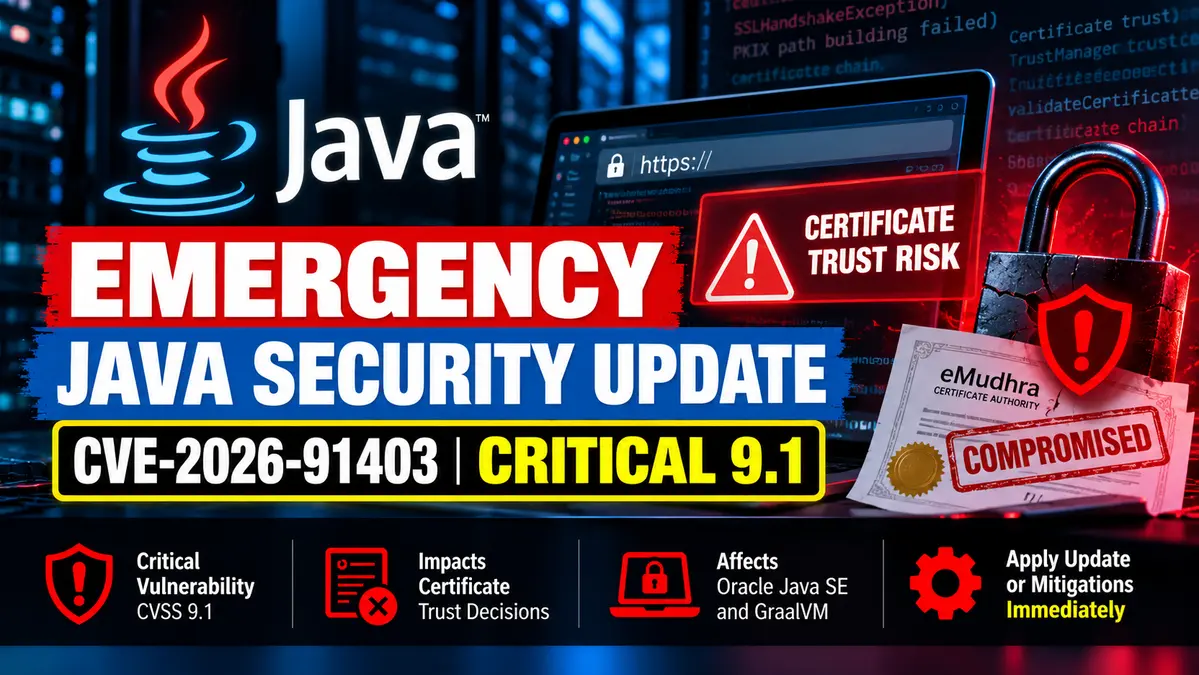
An emergency Java update released by Oracle on October 21, 2026, addresses CVE-2026-91403, a Critical vulnerability rated CVSS 9.1 that could allow attackers to undermine HTTPS certificate trust in affected Java applications.
The issue affects Oracle Java SE, Oracle GraalVM for JDK and Oracle GraalVM Enterprise Edition. It involves compromised intermediate certificate authority certificates associated with eMudhra that Java could continue accepting during certificate validation.
An attacker possessing the compromised signing keys and positioned to intercept relevant network traffic could potentially present a fraudulent certificate that an affected Java client trusts. This could expose or alter sensitive information exchanged over what appears to be a secure connection.
The timing makes the alert particularly important. Oracle published its regular October Critical Patch Update on October 20, but several Java builds released during that cycle are themselves listed as affected by the new October 21 security alert.
Administrators should therefore not assume that installing the previous day’s Java update fully addresses this certificate-trust problem. Oracle recommends applying the latest emergency fix or following its specific mitigation guidance.
For broader vulnerability assessment and enterprise patching guidance, explore our Enterprise CVE and Vulnerability Security Hub.
Key Findings From Oracle’s Emergency Java Update
- Emergency alert: October 21, 2026.
- Vulnerability: CVE-2026-91403, CVSS 9.1 Critical.
- Affected component: Java Secure Socket Extension (JSSE).
- Underlying issue: Trust in compromised eMudhra intermediate CA certificates.
- Potential impact: Fraudulent HTTPS certificate acceptance, with risks to confidentiality and integrity.
- Affected products: Oracle Java SE and supported GraalVM variants, including versions updated on October 20.
- Recommended response: Apply the latest Java security fix or Oracle’s certificate-blocking and revocation-checking mitigations.
Emergency Java Update: What Happened on October 21?
Oracle’s October 21 advisory is an out-of-band security alert rather than an ordinary quarterly patch announcement.
It responds to the discovery that certain intermediate certificate authorities associated with eMudhra could no longer be treated as trustworthy.
Intermediate certificate authorities sit between trusted root certificate authorities and the certificates used by websites, applications and services.
When a Java application connects to an HTTPS endpoint, its certificate-validation components evaluate whether the presented certificate chains to an accepted trust anchor and satisfies relevant security checks.
The compromise of a certificate-signing key can undermine that process if the affected certificates remain trusted.
Oracle’s response is to distrust the relevant eMudhra intermediate CA certificates, preventing affected Java runtimes from accepting certificate chains that depend on them.
The problem is particularly significant because applications may use Java’s own certificate trust configuration instead of relying entirely on the certificate decisions made by a web browser or operating system.
Organizations should therefore check actual Java runtimes, including those embedded in applications, containers and managed services.
CVE-2026-91403: How the Critical HTTPS Trust Vulnerability Works
CVE-2026-91403 affects Java Secure Socket Extension, commonly known as JSSE.
JSSE provides Java applications with security functionality used for TLS connections and related cryptographic operations.
When a Java client establishes an HTTPS connection, it must verify that the remote server’s certificate is valid for the intended destination and chains to a trusted authority.
Compromised intermediate CA private keys create a risk because a party possessing those keys may be able to issue fraudulent certificates that appear to have a legitimate chain of trust.
An attacker in a suitable network position could attempt to present such a certificate to a Java client.
If the runtime continues trusting the affected certificate authority chain, the attacker may be able to impersonate the intended destination.
That could allow interception or modification of sensitive information passing through the connection.
However, this is not evidence that an attacker can decrypt arbitrary HTTPS traffic captured elsewhere or remotely take over every Java application.
Relevant prerequisites include the compromised signing material, an exploitable trust configuration and a network scenario in which the fraudulent certificate can be presented.
Oracle assigns the vulnerability a CVSS 3.1 base score of 9.1, with High confidentiality and integrity impact but no availability impact in its published risk matrix.
The advisory identifies network-based exploitation, low attack complexity, no privileges required and no user interaction.
Why the eMudhra Certificate Compromise Matters
The emergency update is linked to compromised intermediate certificate authority credentials associated with eMudhra.
Red Hat separately disclosed that multiple affected certificates were signed by certificate authorities represented in system trust stores.
The company warned that possession of compromised signing keys could permit fraudulent TLS certificates for arbitrary domains under suitable conditions.
This can create a man-in-the-middle risk in environments that still trust those certificate chains.
A man-in-the-middle attack occurs when an attacker places themselves between communicating systems and attempts to intercept or manipulate the exchange.
Strong encryption remains valuable, but encryption alone cannot establish the identity of the remote service.
If a client trusts a fraudulent certificate, it may establish an encrypted connection to the wrong endpoint.
Oracle’s fix addresses that trust decision by blocking affected intermediate certificates.
This differs from replacing TLS entirely, disabling HTTPS or correcting a weakness in the underlying encryption algorithm.
Which Oracle Java and GraalVM Versions Are Affected?
Oracle’s October 21 alert identifies affected products and supported releases.
| Product | Affected Versions Listed by Oracle |
|---|---|
| Oracle Java SE | 8u511, 8u511-perf, 11.0.33, 17.0.21, 21.0.13, 25.0.5, 27.0.1 |
| Oracle GraalVM for JDK | 17.0.21, 21.0.13 |
| Oracle GraalVM Enterprise Edition | 21.3.20 |
Oracle notes that earlier unsupported versions may also be affected, although the company did not test all releases outside the relevant support periods.
Administrators should avoid treating a release that is absent from the supported-version table as automatically safe.
They should also check the patch availability documentation and the actual build distributed for their operating system and Java distribution.
Other Java distributions may have different remediation mechanisms and release schedules.
Why the October 20 Java Patch Is Not Enough
Oracle released its regular October 2026 Critical Patch Update on October 20.
The following day, it issued the separate CVE-2026-91403 Security Alert.
Several versions included in the regular October update appear on the new emergency advisory’s affected list.
For example, Oracle lists Java 21.0.13, Java 17.0.21 and Java 27.0.1 among the affected supported releases.
Consequently, administrators who installed those versions during the normal patch cycle still need to assess the emergency certificate distrust update.
Our earlier Oracle October 2026 Critical Patch Update report covers the broader quarterly release across Oracle’s product portfolio. This emergency Java alert is a separate development requiring additional attention.
The distinction is particularly important for automated vulnerability management systems that may mark a server compliant based only on its major Java version or quarterly release number.
Confirming the applicable emergency build or mitigation is more reliable than assuming all installations carrying a particular base version have identical certificate trust behavior.
How to Check Java Versions Across Servers and Applications
Begin by identifying where Java is installed and which applications use each runtime.
On a system with Java available in the current command path, run:
java -versionThen identify the executable used by the shell:
command -v javaThese commands are useful for identifying a Java installation but do not prove that every installed runtime is patched.
A server may contain several JDKs or JREs, including copies bundled with business applications.
Separate Java installations may have independent certificate trust files.
Inventory Java runtimes used by application servers, scheduled jobs, integration services, CI runners and desktop applications.
Check Java Inside a Running Container
For an authorized Docker environment, inspect the runtime inside the application container:
docker exec <container_name> java -versionReplace the placeholder with the actual container identifier or name.
For Kubernetes, use the supported operational procedure to inspect the runtime inside each relevant workload.
Remember that a patched host operating system does not necessarily update an independent JDK packaged inside a container image.
Rebuild and redeploy affected images using trusted distribution updates.
How to Apply Oracle’s Emergency Java Mitigation
Oracle recommends applying the latest security patches for the affected Java runtimes as the preferred response.
Its emergency guidance also describes alternatives for environments that cannot immediately install the updated JDK.
Option 1: Install the Latest Applicable Java Security Fix
Use Oracle’s official Java distribution or your supported vendor’s security update channel.
Check the security alert’s patch availability documentation for the exact required build and platform.
Do not assume that the regular October 20 build alone includes the October 21 emergency certificate distrust change.
After deployment, verify that each running application uses the expected updated runtime and certificate configuration.
Option 2: Replace the Affected Certificate Blocklist
Oracle provides an updated blocked.certs file for supported systems.
Its instructions direct administrators to locate the following file within the relevant Java installation:
[JDK_HOME]/lib/security/blocked.certsDownload the replacement only from Oracle’s official mitigation page, selecting the correct file for the operating system.
If local custom entries exist, back them up and preserve those entries when applying the replacement.
For Java 8, Oracle instructs administrators to use the filename:
blacklisted.certsApply the procedure separately to every affected runtime installation.
This is an emergency mitigation method, not a reason to postpone supported JDK security updates indefinitely.
Option 3: Enable Certificate Revocation Checking
Oracle also recommends enabling certificate revocation checks where applicable.
For Java TLS applications, its guidance provides these JVM options:
-Dcom.sun.net.ssl.checkRevocation=true
-Dcom.sun.security.enableCRLDP=true
These flags should be applied through the application’s approved runtime configuration, followed by testing and verification.
Administrators should understand the application’s certificate-validation behavior and network access to revocation information before deploying changes broadly.
The options do not replace the need to maintain a supported Java runtime and appropriate trust configuration.
Option 4: Check Signed JAR Revocation
Oracle provides separate guidance for checking signed Java archives.
For JDK 17 and later, its published example uses:
jarsigner -verify -revcheck [SIGNED_JAR]Replace the placeholder with the file being verified.
This procedure is relevant to signed JAR verification; it is not a universal test showing that every Java HTTPS connection is protected.
Oracle describes these approaches as remediation alternatives depending on the environment, not a requirement to apply every option simultaneously.
Java Patch Verification Checklist for DevOps Teams
After applying the emergency fix, verify the actual trust behavior and runtime deployment.
- Runtime inventory: Identify every installed Java runtime, including application-bundled copies.
- Vendor fix: Confirm the correct emergency security release or mitigation was applied.
- Certificate blocklist: Verify that the official updated file is present where required.
- Configuration: Review certificate revocation settings when used as mitigation.
- Containers: Rebuild affected application images and confirm running workloads were replaced.
- HTTPS connectivity: Test legitimate outbound TLS connections after the changes.
- Custom trust stores: Review applications that override standard Java trust settings.
- Audit evidence: Record runtime paths, build details and validation results.
Ordinary HTTPS connectivity tests can confirm that legitimate services still work, but they do not independently demonstrate that every compromised intermediate certificate has been distrusted.
Use the applicable vendor’s security documentation and approved validation procedures when verifying the emergency remediation.
How the Java Emergency Alert Differs From the GoDaddy Certificate Revocation
The Java alert and the recent GoDaddy certificate incident both involve certificate trust, but their causes and required responses differ.
The eMudhra-related emergency concerns compromised certificate authority material and the need for Java runtimes to distrust affected intermediate certificates.
The GoDaddy incident involved certificate policy noncompliance and the replacement of a large number of issued certificates.
Website administrators investigating TLS availability problems can also consult our GoDaddy SSL certificate revocation guide for guidance on checking which certificate a server presents and verifying replacements.
That procedure is useful for server-side certificate operations, but it does not replace the specific Java trust-store remediation required for CVE-2026-91403.
Is CVE-2026-91403 Being Actively Exploited?
Oracle’s October 21 advisory does not report confirmed exploitation of this specific Java vulnerability.
The compromised certificate authority material presents a serious potential impersonation risk, but it does not establish that every affected Java installation has already experienced an attack.
Red Hat similarly explains that exploitation of the compromised CA keys requires appropriate network interception conditions.
Organizations should prioritize patching while investigating any credible evidence of unexpected TLS interception, suspicious certificate chains or unexplained changes in application traffic.
No publicly confirmed victim count or exploitation campaign is established by the cited Oracle alert.
Confirmed vs Unknown: Oracle’s October Java Security Alert
Confirmed
- Oracle issued Security Alert CVE-2026-91403 on October 21, 2026.
- The vulnerability carries a CVSS 3.1 score of 9.1.
- The affected Oracle component is JSSE.
- The update distrusts intermediate CA certificates associated with eMudhra.
- Supported Oracle Java SE and GraalVM releases are listed as affected.
- The regular October 20 Java builds include versions listed in the emergency alert.
- Oracle recommends applying security updates or following its published mitigations.
Unknown or Not Established
- A confirmed widespread exploitation campaign targeting CVE-2026-91403.
- The number of Java installations successfully attacked.
- That all HTTPS connections on an affected system were intercepted.
- That Java’s underlying TLS encryption algorithms were broken.
- That every Java distribution requires the exact same package or configuration change.
- That running the October 20 quarterly update alone fixes the emergency issue.
CyberUpdates365 Analysis
Oracle’s emergency Java update illustrates a critical distinction between cryptographic security and certificate trust.
An application can use strong encryption but still communicate with the wrong endpoint if it accepts a fraudulent certificate.
That makes certificate authority trust decisions part of the security boundary for Java-based services.
The situation is also operationally challenging because Java installations are often distributed across multiple layers of infrastructure.
Organizations may patch the operating system while leaving independent JDKs untouched inside application packages or container images.
Some applications also use custom trust stores or override default certificate validation behavior.
Those differences can create inconsistent protection even when administrators believe all systems are using the same Java version.
The timing of CVE-2026-91403 adds another lesson.
A security release published immediately after the normal quarterly cycle can leave otherwise well-maintained environments needing a second urgent update.
Security compliance checks therefore need to capture the precise build and mitigation state rather than looking only at a base version number.
For DevOps and security teams, the best response combines an accurate Java inventory, vendor-specific emergency updates, controlled rollout and validation of production trust configurations.
The central lesson is that secure HTTPS depends not only on encryption and certificates, but on maintaining the software and trust stores that decide which certificates can be accepted.
Research Evidence
- Vendor: Oracle.
- Security alert date: October 21, 2026.
- CVE: CVE-2026-91403.
- Severity: Critical, CVSS 9.1.
- Component: Java Secure Socket Extension (JSSE).
- Root issue: Trust in affected eMudhra intermediate CA certificates.
- Potential effect: Fraudulent TLS server impersonation and interception or modification of traffic.
- Affected Oracle products: Java SE, GraalVM for JDK and GraalVM Enterprise Edition.
- Previous regular update: October 20, 2026.
- Emergency action: Updated Java security fix or vendor-supported certificate-blocking and revocation mitigations.
- Confirmed exploitation: Not established by Oracle’s advisory.
Frequently Asked Questions
What is CVE-2026-91403?
CVE-2026-91403 is a Critical Java certificate trust issue involving compromised eMudhra intermediate certificate authorities. Oracle assigns it CVSS 9.1.
Why did Oracle release an emergency Java update?
Oracle needed to make affected Java runtimes distrust compromised intermediate CA certificates rather than waiting for the next regular security cycle.
Does the flaw break HTTPS encryption?
No. The central risk involves accepting a fraudulent certificate and connecting to an attacker-controlled endpoint, not a demonstrated break in TLS encryption algorithms.
Which Java versions are affected?
Oracle lists Java SE 8u511, 11.0.33, 17.0.21, 21.0.13, 25.0.5 and 27.0.1, along with the 8u511 performance-pack variant and specific GraalVM releases.
Is the October 20 Java update enough?
Not necessarily. Several versions from that release appear in Oracle’s October 21 affected-product list. Administrators must check the emergency advisory and applicable remediation.
Can organizations mitigate the issue without immediately replacing Java?
Oracle provides instructions for updated certificate blocklists and certificate revocation checking. Use the official guidance for the relevant runtime and application.
Are Docker and Kubernetes applications affected?
They may be if their images contain affected Java runtimes or trust configurations. Administrators should review the actual runtime and vendor security fixes inside each workload.
Has Oracle confirmed attacks exploiting CVE-2026-91403?
The cited Oracle advisory does not establish a confirmed exploitation campaign or number of compromised systems.
Final Takeaway
Oracle’s October 21 emergency Java update addresses a Critical HTTPS certificate trust problem linked to compromised eMudhra intermediate CA certificates.
The issue affects several supported Oracle Java SE and GraalVM releases, including Java builds distributed during the regular October 20 patch cycle.
Administrators should inventory affected runtimes, apply the latest applicable emergency fixes or vendor-supported mitigations, and verify their production trust configurations.
The priority is to ensure Java applications no longer trust the compromised certificates—not merely confirm that an earlier quarterly update was installed.
Already applied Oracle’s October security updates?
The Java emergency fix is a separate development following Oracle’s broader quarterly release. Our earlier report explains the enterprise-wide security patches issued across Oracle products on October 20.
Read: Oracle October 2026 Critical Patch Update →