

A PwC data breach claim has emerged after the Everest ransomware group reportedly listed the global professional services firm on its leak site on October 22, 2026.
Public ransomware-monitoring records identify a new listing naming PwC, but a threat actor’s claim is not proof that an organization has suffered a successful intrusion. The available information does not independently confirm stolen PwC files, encrypted systems or disruption to the company’s operations.
The alleged incident is attracting attention because PwC provides audit, tax and consulting services to organizations across numerous industries, making the potential security of professional-services information a significant concern.
However, the scope of any incident, the authenticity of alleged stolen material and the attacker’s claimed access remain unverified. No confirmed initial-access vulnerability or compromised system has been identified in the evidence reviewed.
The new Everest allegation also should not be confused with PwC’s documented involvement in the 2023 MOVEit Transfer attacks, which affected a limited number of client engagements.
For more guidance on distinguishing confirmed breaches from unverified criminal claims, see our Data Breach Coverage and Response Guide.
Key Findings From the PwC Data Breach Claim
- Reported listing date: October 22, 2026.
- Named organization: PwC, the global professional services network.
- Claiming group: Everest ransomware and data-extortion operation.
- Available evidence: Third-party ransomware-monitoring records reporting a leak-site listing.
- Confirmed new breach: Not independently established.
- Stolen data or operational impact: No verified scope or victim count identified.
- Historical distinction: PwC’s 2023 MOVEit incident involved a different threat actor and should not be treated as part of this allegation.
PwC Data Breach Claim: What Everest Allegedly Announced
Everest reportedly added PwC to its ransomware victim-listing infrastructure on October 22.
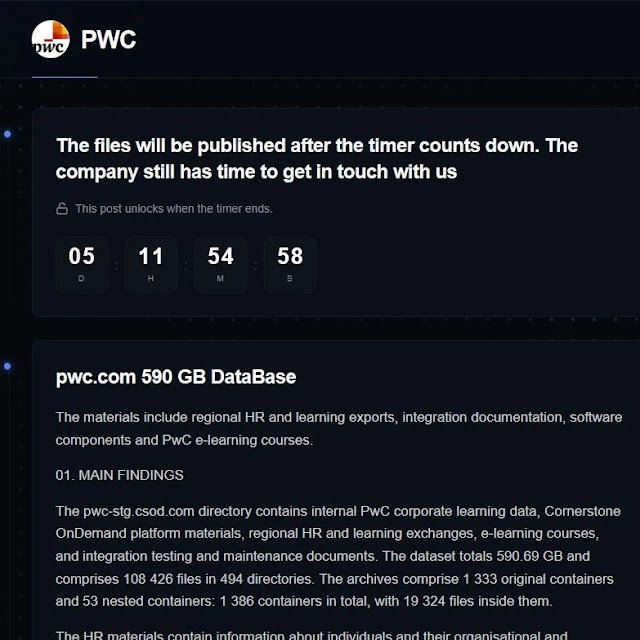
Ransomware tracking services monitor criminal leak sites to record organizations publicly named by extortion operators.
These listings can provide an early indication that a threat group is attempting to exert pressure on an organization.
However, they are not independently verified incident reports.
Threat actors can exaggerate access, overstate the value of files or publish misleading information to attract attention and increase pressure on their alleged targets.
The October 22 ransomware-monitoring entry reports a PwC listing attributed to Everest.
It does not, by itself, demonstrate that the group entered PwC’s internal network or obtained legitimate confidential records.
At the time of this review, independently authenticated samples of newly stolen PwC data were not available in the evidence examined.
There was also no confirmed public description of the initial compromise, affected systems or operational disruption associated with the new claim.
The appropriate headline therefore describes a ransomware group’s allegation rather than declaring a confirmed company breach.
What Is the Everest Ransomware Group?
Everest is a cybercriminal operation tracked by security researchers for ransomware activity and data-extortion claims.
The group has appeared in public reporting for several years and has targeted organizations across multiple sectors.
Its activity has included the use of victim listings and threats involving allegedly stolen information.
Such operations can involve encryption, data theft or extortion without encryption, depending on the specific incident.
Researchers have also documented differences between what Everest operators claimed in some campaigns and what their analyzed malware samples could actually perform.
That history reinforces the need to verify each new allegation independently.
It does not prove that the new PwC listing is false, nor does it establish that the claim is accurate.
For this reported event, the public evidence examined supports attribution of the listing to Everest but not a confirmed technical intrusion into PwC.
Does Everest’s PwC Listing Prove That Data Was Stolen?
No. A ransomware leak-site listing is evidence of a public claim, not automatically evidence of data theft.
To establish that an organization suffered a new data breach, investigators typically need additional information.
That may include an official company disclosure, regulator notification, authenticated forensic evidence or independently validated files linked to a newly identified intrusion.
Even when a criminal group publishes screenshots or sample documents, their authenticity, origin and freshness still require examination.
Old records, previously leaked information and files obtained from unrelated third parties can be presented misleadingly as evidence of a new compromise.
In the reported PwC allegation, the available monitoring record does not establish a verified volume of stolen information.
There is also no independently confirmed list of affected customers, employees or business systems.
Until additional evidence becomes available, readers should avoid treating the allegation as confirmation that confidential PwC client records have been exposed.
Why a PwC Security Claim Matters to Business Clients
PwC is a major professional services network whose member firms provide auditing, taxation, consulting and other business services.
Professional services organizations may handle commercially sensitive material as part of authorized client engagements.
Depending on the engagement, such information can include business records, financial documentation and confidential project materials.
That makes security allegations involving large professional services networks important to monitor.
However, the potential sensitivity of information a company may handle should not be confused with proof that any particular data category was stolen.
The October Everest claim does not independently establish that PwC client information, audit records, tax files or employee details were accessed.
Business clients should rely on authenticated communications from their relevant PwC member firm and official notifications rather than unsupported online claims.
Organizations should also remain alert to phishing messages that use breach headlines to impersonate security teams or demand urgent account verification.
How the October 2026 Claim Differs From PwC’s 2023 MOVEit Incident
PwC previously acknowledged a separate security incident involving the MOVEit Transfer file-transfer platform in June 2023.
That campaign was associated with the Clop cybercriminal group and exploitation of a vulnerability in the MOVEit software.
PwC said the issue affected a limited number of client engagements and that its own internal IT network was not compromised in that incident.
The organization also said it contacted the small number of clients whose files were affected.
The 2023 disclosure is a historically documented event.
By contrast, the October 2026 Everest listing is a newer, unverified allegation involving a different threat group.
No evidence reviewed establishes that the Everest claim represents a continuation of the MOVEit campaign, reuse of the same stolen files or another intrusion using the same software vulnerability.
The historical incident provides useful background but cannot substitute for evidence about what may have happened in October 2026.
How Ransomware Groups Use Leak Sites for Extortion
Leak sites are part of the public-pressure tactics employed by numerous ransomware and cyber-extortion operations.
After claiming access to an organization’s systems or files, an attacker may publish the organization’s name and threaten to release information.
The intended effect is often to increase urgency around a payment demand or force public attention toward the alleged victim.
But a leak-site post does not reveal how the alleged access occurred.
It also does not demonstrate that ransomware encrypted the organization’s servers.
Some extortion incidents involve stolen data without any encryption, while others involve both data theft and deployment of malware.
The public PwC allegation does not establish which, if any, of these technical scenarios occurred.
Security reporting should therefore avoid using phrases such as “systems encrypted,” “internal network taken over” or “millions of records stolen” without specific evidence.
What Evidence Would Confirm a New PwC Breach?
A reliable assessment requires more than repeating the text of an extortion post.
Investigators would look for an official incident statement, validated forensic information or independently authenticated data samples.
The following distinctions are particularly important:
- Claimed access: A threat actor says it entered a system.
- Verified access: Credible evidence demonstrates an unauthorized entry.
- Claimed data theft: An actor alleges that information was copied.
- Verified data exposure: An organization or independent investigation establishes what information was accessed or removed.
- Ransomware deployment: Evidence confirms malicious encryption or another ransomware payload executed.
- Operational impact: Verified disruption to systems, services or business processes.
For the October 2026 PwC claim, only the first level of public evidence—a reported criminal listing—has been established by the accessible sources reviewed.
More definitive conclusions require further information.
Could PwC Clients or Employees Be Affected?
The available evidence does not establish that any particular PwC customer, employee or business partner was affected by a new October 2026 compromise.
It would therefore be premature to advise every PwC client that its confidential documents have been stolen.
However, clients concerned about the allegation can monitor authenticated communications from their PwC contacts and review their existing third-party security procedures.
Organizations with sensitive data shared through professional-services engagements should maintain an inventory of relevant data-sharing channels and access permissions.
Such inventories can help security teams respond if an actual incident notice is later received.
Employees and clients should also be cautious about messages claiming that they must immediately submit passwords, identification documents or financial information to verify whether they were affected.
Those requests should be independently verified through known company contacts.
What Security Teams Should Do When a Vendor Is Named on a Leak Site
An unverified ransomware allegation should be treated as a threat-intelligence lead rather than automatic confirmation of a third-party breach.
Security teams can take several proportionate steps while avoiding unnecessary disruption.
1. Verify the Original Claim
Record the reported listing date, named organization and attribution source.
Check whether the company has released a statement or incident notification.
Avoid opening suspicious downloads or executing files advertised by criminals as proof of access.
2. Identify Business Relationships
Determine whether the organization is a current service provider, professional adviser or recipient of sensitive business data.
Record the relevant data-sharing arrangements and approved access methods.
3. Review Third-Party Access
Check whether any vendor-managed identities or integrations have access to internal systems.
Apply the organization’s normal access review process.
An unverified listing alone does not justify assuming all associated credentials are compromised.
4. Monitor for Impersonation
Watch for phishing campaigns that reference the alleged breach or impersonate the named organization.
Verify unexpected security instructions through previously established contact channels.
5. Prepare for Confirmed Notifications
If a verified incident notice arrives, determine whether company information was involved and follow established incident-response procedures.
Those may include identifying exposed records, assessing contractual obligations and investigating unusual access involving affected accounts.
Confirmed vs Unknown: PwC and Everest in October 2026
Confirmed or Supported by Available Records
- Ransomware-monitoring records report an Everest listing naming PwC on October 22, 2026.
- Everest is a previously documented ransomware and extortion operation.
- PwC was affected by a separate MOVEit-related incident in 2023.
- The available October listing is an allegation, not an independently validated forensic report.
Unknown or Not Independently Established
- Whether Everest successfully accessed PwC systems in October 2026.
- Whether any newly stolen PwC data exists.
- The type, sensitivity or volume of potentially affected records.
- The identity of any affected PwC member firm or client engagement.
- The method of initial access or a related CVE.
- Whether ransomware encryption occurred.
- Whether PwC experienced service disruption.
- Whether the claim relates to previously exposed data.
- Whether PwC will confirm or dispute the allegation.
CyberUpdates365 Analysis
The most significant feature of the October PwC story is the difference between a public criminal allegation and a verified security incident.
Ransomware groups often use public attention as an additional source of leverage.
When a major organization is named, the resulting headlines may spread before customers, regulators or independent researchers can establish what actually occurred.
That creates an information-security problem in addition to any possible technical threat.
Organizations may face questions from clients and business partners even when the available evidence is incomplete.
The correct response is neither to dismiss the allegation automatically nor to repeat it as confirmed fact.
Security teams should preserve the available evidence, assess relevant business exposure and monitor authenticated updates.
The 2023 MOVEit incident is also a reminder that historical events can complicate the interpretation of new claims.
Previously exposed information should not be relabeled as evidence of a new breach without proof of a separate intrusion.
The same principle applies to technical attribution.
Everest’s documented methods in other incidents do not identify the intrusion vector, if any, in the new PwC allegation.
For organizations relying on professional-services partners, the practical security lesson is to maintain visibility into shared data, vendor access and incident-notification channels.
That preparation helps businesses respond proportionately when new evidence emerges.
The defining principle is straightforward: a ransomware group’s public claim should trigger verification, not be presented as a confirmed breach.
Research Evidence
- Organization named: PwC.
- Threat group: Everest.
- Reported leak-site listing: October 22, 2026.
- Source type: Public ransomware-monitoring records.
- Verified new network intrusion: Not established.
- Verified stolen-data volume: Not established.
- Publicly confirmed encryption: Not established.
- Known initial-access CVE: None established for the claim.
- Historical comparison: PwC’s separate MOVEit incident in 2023.
- Important reporting rule: Treat the new claim as unverified pending independent confirmation.
Frequently Asked Questions
Was PwC hacked in October 2026?
Everest reportedly named PwC on its leak site, but the available evidence does not independently confirm a new intrusion into PwC’s systems.
Who is claiming the PwC data breach?
The claim is attributed to Everest, a ransomware and data-extortion operation.
Did Everest steal PwC customer data?
No independently validated stolen-data scope or customer exposure has been established in the sources reviewed.
Was ransomware deployed against PwC?
The available evidence does not confirm ransomware encryption or another malware deployment associated with the new allegation.
When did the PwC claim appear?
Public ransomware-monitoring records list the allegation on October 22, 2026.
Is this related to the 2023 PwC MOVEit breach?
No connection has been established. The earlier incident involved the MOVEit Transfer campaign associated with Clop, whereas the new allegation names Everest.
Should PwC clients change their passwords?
The unverified listing alone does not establish that client credentials were exposed. Clients should follow authenticated incident notifications and maintain their normal account-security precautions.
How can a ransomware breach claim be verified?
Confirmation may come from an official company disclosure, regulatory notification, validated forensic investigation or independently authenticated evidence showing what occurred.
Final Takeaway
PwC has reportedly been named in an October 22, 2026 ransomware leak-site listing attributed to Everest.
While the allegation warrants attention, publicly accessible evidence does not yet independently confirm a new compromise, data theft or operational disruption.
The incident should also remain separate from PwC’s documented 2023 MOVEit exposure.
Organizations should monitor authoritative developments and avoid treating criminal extortion claims as established facts.
Until reliable evidence emerges, the accurate description is an unverified PwC data breach claim—not a confirmed ransomware attack.
How can organizations distinguish a criminal data-theft claim from a verified breach?
Our broader data breach resource explains how to evaluate incident evidence, reported impact and practical response priorities without treating every attacker allegation as confirmed.
Read: Data Breach Coverage, Evidence and Incident Response →