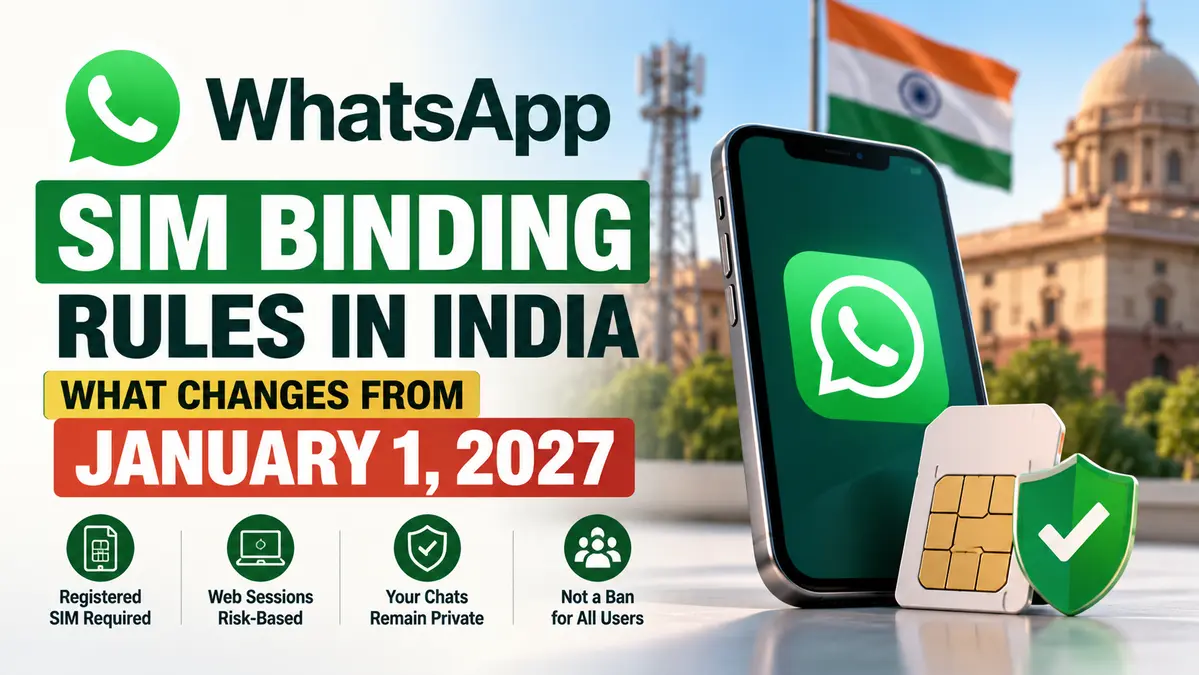
WhatsApp SIM binding rules could change how millions of people in India use the messaging app from January 1, 2027. Under directions issued by the Department of Telecommunications (DoT), covered communication platforms must keep accounts linked to the active SIM associated with the registered mobile number.
The requirement could affect users who register WhatsApp on one phone and later remove, replace or deactivate the SIM while continuing to use the account. People who use multiple phones, travel internationally or depend on linked devices may also need to review how their accounts are configured.
The government has set December 31, 2026, as the compliance deadline for messaging platforms. January 1, 2027, is being reported as the expected enforcement milestone, although the exact user experience will depend on how each platform implements the requirement.
Importantly, the government has also revised an earlier requirement that would have forced WhatsApp Web and similar desktop sessions to log out every six hours. The later clarification calls for risk-based session termination without a fixed logout interval.
This is not a nationwide WhatsApp ban, and it does not mean every Indian user will lose access on January 1. The central issue is whether an account can continue operating when its registered SIM is unavailable.
For practical mobile security measures beyond regulatory changes, see our Consumer and Small Business Cybersecurity Defense Guide.
Key Findings About India’s WhatsApp SIM Binding Rules
- Original directive: Issued by India’s DoT on November 28, 2025.
- Government framework: Telecommunications (Telecom Cyber Security) Rules, 2024, as amended.
- Compliance deadline: December 31, 2026.
- Expected user-facing milestone: January 1, 2027, subject to platform implementation.
- Main requirement: Messaging accounts must remain linked to their registered, active SIM in the relevant device.
- Covered services: The original DoT announcement names WhatsApp, Telegram, Signal, Snapchat, Arattai, ShareChat, Josh and JioChat.
- WhatsApp Web: Risk-based session logouts; the original fixed six-hour requirement is no longer the government’s later stated position.
WhatsApp SIM Binding Rules: What Changes From January 1, 2027?
The new requirements are intended to prevent communication accounts from continuing indefinitely without the SIM card originally associated with their registered phone number.
Under the DoT’s directions, covered messaging services must maintain a continuous connection between the account and the active SIM associated with that account.
Previously, a user could commonly verify WhatsApp with a phone number, complete registration and continue using the service even if the original SIM was later removed.
The government considers this separation between account access and SIM availability a security gap.
Under the planned framework, a messaging service may restrict access when it cannot establish the required relationship with the registered SIM.
However, the publicly available policy explanations do not provide a complete technical implementation specification for every supported smartphone, operating system or linked device.
Consequently, January 1 should be treated as the expected implementation milestone, not proof that all accounts without a registered SIM will disconnect simultaneously at midnight.
Why India Introduced SIM Binding for WhatsApp and Telegram
The Department of Telecommunications says certain messaging platforms allow accounts registered with Indian mobile numbers to remain active even after the underlying SIM is removed from the device.
According to the government, criminals have used this capability to operate communication accounts remotely, including from outside India.
Such accounts may be used for impersonation, investment fraud, phishing and so-called digital arrest scams.
A digital arrest scam involves criminals pretending to represent law enforcement or government authorities and pressuring victims into transferring money or disclosing sensitive information.
The government argues that maintaining a link to a live, verified mobile connection can improve accountability and make misuse of Indian numbers more difficult.
Its December 2025 explanation also cited cyber-fraud losses exceeding ₹22,800 crore during 2024.
That amount provides broader policy context; it is not a figure specifically attributed to WhatsApp accounts operating without their registered SIMs.
India’s messaging security debate also extends to phone-number privacy and digital identities. Our earlier report on WhatsApp usernames and India’s cybersecurity concerns explores the tension between user privacy, impersonation risks and regulatory oversight.
WhatsApp usernames and SIM binding are separate issues. A username feature does not itself establish an exemption from the government’s registered-SIM requirements.
SIM binding is intended to reduce some forms of number misuse, but it cannot independently prevent every phishing attempt, fraudulent message or account takeover.
Who Could Be Affected by the Registered SIM Requirement?
The practical impact depends on how users currently access their messaging accounts.
| User Situation | Possible Impact | Recommended Action |
|---|---|---|
| Registered SIM remains active in the primary phone | Lower likelihood of disruption from SIM absence | Keep the registered number active and monitor official notices |
| Registered SIM removed after account verification | Access may be restricted | Restore the correct SIM or review supported account options |
| SIM permanently deactivated | Account continuity may be affected | Contact the mobile operator and follow number-change procedures |
| Dual-SIM handset | Depends on registered SIM availability | Identify which number is linked to WhatsApp |
| Phone using an active eSIM | Expected to be compatible, subject to final implementation | Keep the registered eSIM profile active |
| Secondary or companion phone | Implementation details remain uncertain | Check official linked-device guidance |
| WhatsApp Web or desktop | Sessions may be terminated based on risk | Review linked sessions and retain access to the primary account |
This table describes possible operational effects rather than a confirmed device-by-device compatibility list from WhatsApp.
Will WhatsApp Stop Working if You Remove Your SIM?
Under the original DoT direction, covered apps must remain continuously associated with the specific active SIM linked to the registered mobile number.
That suggests users who remove the relevant SIM may face restrictions once the requirement is implemented.
But the precise response, such as a warning, verification prompt, temporary suspension or another restriction, has not been conclusively documented across all WhatsApp versions.
Users should not assume that removing a SIM today proves how WhatsApp will behave after the compliance deadline.
Likewise, they should not delete their accounts or uninstall WhatsApp merely because of reports about the upcoming rule.
If a SIM has been lost, damaged or deactivated, the safest route is to contact the mobile operator and follow WhatsApp’s supported account-recovery procedures.
What Happens to WhatsApp on Dual-SIM Phones?
Dual-SIM smartphones are common in India, and many people use one number for voice calls while keeping another number registered with WhatsApp.
The policy concerns the SIM associated with the messaging account’s registered number.
For example, if a user registers WhatsApp using SIM A but generally uses SIM B for mobile data, the relevant question is whether SIM A remains present and active.
The published direction does not explicitly require the registered SIM to be selected as the handset’s default mobile-data connection.
Users should therefore distinguish between the SIM used to access the internet and the SIM associated with their WhatsApp account.
Specific enforcement details should be checked against official WhatsApp documentation once final implementation guidance is available.
Will eSIM Users Be Affected?
An eSIM is a digital SIM profile built into a supported device rather than a removable physical card.
The policy focuses on an active subscriber identity associated with the registered mobile number.
Current reporting indicates that supported active eSIM profiles are expected to be included in the framework.
However, an eSIM user should not assume every device-transfer or temporary deactivation scenario will behave identically.
Moving an eSIM profile to another phone, deleting it or deactivating the number may require additional account verification after implementation.
The safest approach is to maintain control of the registered number and follow the operator’s official eSIM transfer process.
Will WhatsApp Web Log Out Every Six Hours?
The later government clarification does not require every WhatsApp Web session to end automatically after six hours.
The original November 2025 DoT direction called for messaging platforms to log out web sessions periodically, with a maximum interval of six hours.
That requirement generated concern among users and businesses relying on desktop messaging.
In April 2026, the government informed Parliament that the SIM-binding compliance deadline had been extended to December 31, 2026.
It also clarified that web instances should be logged out based on risk analysis, with no specific time period stipulated.
This is an important change from the original announcement.
Users may still experience reauthentication or session termination when suspicious activity or other relevant security conditions are detected.
However, claims that all WhatsApp Web sessions must automatically expire after exactly six hours repeat the earlier policy wording rather than the later clarification.
How Could Linked Devices and Companion Phones Be Affected?
WhatsApp supports linked-device functionality that allows people to access conversations from additional supported devices.
These features are distinct from directly registering a new messaging account using a mobile number.
The original SIM-binding directions focus on maintaining a relationship between the registered number, the associated SIM and the service.
However, public policy materials do not establish how every companion phone or tablet will be checked under the final implementation.
It would therefore be premature to claim that all tablets without SIM slots will stop supporting WhatsApp or that every companion device will require its own registered SIM.
Users who rely on multiple devices should monitor official WhatsApp release notes and support information as the deadline approaches.
Will International Roaming Users Lose WhatsApp Access?
The government’s original policy explanation specifically says that ordinary roaming is not affected where the registered SIM remains present in the handset.
That distinction matters for Indian users traveling abroad.
A person using an Indian SIM through an operator-supported roaming arrangement is not necessarily in the same situation as someone who has removed or deactivated the registered SIM entirely.
Nevertheless, international travelers should ensure they maintain control of the registered number and can receive necessary account-recovery communications.
Users who switch physical SIMs or move eSIM profiles between devices while traveling may need to confirm how final SIM-binding checks operate.
Does SIM Binding Prevent WhatsApp Scams and Account Takeovers?
SIM binding is designed to address one specific security concern: messaging accounts continuing to operate without an active connection to their registered subscriber identity.
It does not guarantee protection against every social engineering or account-hijacking attempt.
Criminals may still try to trick users into disclosing verification codes, authorizing linked devices or responding to fraudulent messages.
Likewise, possession of an active SIM alone does not prove that the person operating the phone is trustworthy.
SIM binding is only one part of account security. Our WhatsApp passkeys and account protection guide discusses additional authentication safeguards that users can review alongside the new SIM requirements.
Users should continue using available security features and remain cautious about unexpected login or verification requests.
SIM binding may increase friction for certain fraud operations, but its actual effectiveness will depend on implementation, enforcement and attackers’ changing techniques.
What Should WhatsApp Users Do Before December 31, 2026?
Users do not need to panic or immediately replace their phones.
However, several practical checks can reduce the risk of losing access when the new requirements are introduced.
1. Check Your Registered WhatsApp Number
Open WhatsApp settings and verify which mobile number is associated with your account.
Make sure you still control that number through a legitimate mobile connection.
2. Keep the Registered SIM Active
If you use a physical SIM or eSIM associated with WhatsApp, avoid unnecessary deactivation.
Contact the mobile operator if the number has expired or the SIM needs replacement.
3. Review Linked Devices
Open WhatsApp’s Linked Devices settings and check which browsers, computers or companion devices are connected.
Log out unfamiliar sessions and investigate unexpected activity.
4. Enable Available Account Protection
Use WhatsApp’s supported two-step verification and account-security settings.
Never share a verification code or account PIN in response to an unexpected call or message.
5. Keep WhatsApp Updated
Install updates through your phone’s official app store.
Do not download unofficial APK files or supposed SIM-binding bypass tools advertised through messaging groups.
6. Prepare for Phone or SIM Changes
If you plan to switch numbers or replace a phone, use WhatsApp’s official account-transfer and number-change features.
Review appropriate chat backup and recovery options before changing devices.
What About Businesses Using WhatsApp?
Businesses that use WhatsApp for customer communication should review how their numbers and devices are managed.
Employees may depend on desktop sessions, linked devices or a dedicated business number held in a separate handset.
SIM binding could require changes to those workflows depending on how the relevant WhatsApp product is implemented.
However, the original government direction does not provide a complete public technical specification for every business integration or API-based arrangement.
Organizations should avoid assuming that all WhatsApp Business Platform integrations will work exactly like ordinary consumer accounts.
Businesses should consult official Meta and WhatsApp Business documentation for product-specific guidance.
They should also maintain account ownership records, recovery contacts and documented procedures for employee device changes.
Confirmed vs Unknown: India’s WhatsApp SIM Binding Policy
Confirmed
- DoT issued SIM-binding directions on November 28, 2025.
- The government publicly explained the policy on December 1, 2025.
- The directions concern covered communication services using Indian mobile numbers.
- The implementation deadline was extended to December 31, 2026.
- The stated objective includes reducing telecom-number misuse and cyber fraud.
- The government later clarified that web sessions should be terminated based on risk, without a fixed six-hour logout period.
- The original explanation says ordinary roaming is unaffected when the registered SIM remains present.
Not Yet Established for Every Platform
- That every WhatsApp account without its registered SIM will disconnect at midnight on January 1.
- The exact warnings or restrictions WhatsApp will display.
- How every companion phone, tablet and linked device will be treated.
- The final implementation for all eSIM and device-transfer scenarios.
- Whether every business integration will follow identical verification steps.
- That SIM binding will eliminate all phishing, impersonation or account takeover attempts.
CyberUpdates365 Analysis
India’s SIM-binding requirements reflect a policy decision to connect messaging accounts more closely with verified telecom identities.
From the government’s perspective, the concern is that criminals can continue using Indian-number messaging accounts even when they no longer possess the original SIM.
Requiring continued association with the registered subscriber identity could make some remote misuse more difficult.
However, the policy also introduces operational questions for legitimate users.
Modern messaging habits often involve multiple devices, international travel, eSIM transfers and desktop communication.
A regulation designed around continuous SIM availability must account for these workflows without creating unnecessary account-recovery problems.
The government’s later clarification replacing a fixed six-hour desktop logout requirement with a risk-based approach indicates that usability and implementation considerations are relevant to the rollout.
Another important distinction concerns phone-number privacy.
Features such as usernames may reduce the need to share a phone number publicly, while SIM binding addresses verification of the number used to register the underlying account.
These goals can coexist, but they are not interchangeable.
Preventing an account from operating without its registered SIM may reduce some fraud opportunities, but it cannot independently stop users from authorizing malicious linked devices or responding to impersonation scams.
Consequently, SIM binding should be understood as one layer of telecom cybersecurity rather than a complete solution to account misuse.
For WhatsApp users, practical preparation remains straightforward: retain control of the registered number, review linked sessions, maintain recovery options and follow verified platform instructions.
For businesses, the priority is understanding how the requirement may affect legitimate multi-device workflows and customer-service operations.
The central lesson is that stronger phone-number verification must be supported by usable account recovery and continued protection against social engineering.
Research Evidence
- Responsible authority: Department of Telecommunications, Government of India.
- Original directions: November 28, 2025.
- Government explanation: December 1, 2025.
- Legal framework: Telecommunications (Telecom Cyber Security) Rules, 2024, as amended.
- Revised compliance deadline: December 31, 2026.
- Expected enforcement milestone: January 1, 2027, according to October news reporting.
- Account requirement: Continuous association with the registered active SIM.
- Original desktop rule: Automatic logout no later than six hours.
- Later government clarification: Risk-based logout with no stipulated fixed interval.
- Targeted risks: Digital arrest scams, phishing, impersonation and misuse of telecom identifiers.
- Unresolved details: Platform-specific implementation for companion devices, eSIM transfers and certain business workflows.
Frequently Asked Questions
Will WhatsApp stop working without a SIM from January 1, 2027?
Users without the active SIM linked to their registered number may face restrictions once SIM binding is implemented. The exact rollout and account behavior depend on WhatsApp’s implementation.
What is the deadline for WhatsApp SIM binding in India?
The government extended the compliance deadline for covered messaging platforms to December 31, 2026.
Will WhatsApp work on Wi-Fi without mobile data?
The policy concerns the registered SIM remaining active and associated with the device, not necessarily using mobile data. Final verification behavior should be checked through official guidance.
Will dual-SIM phones support WhatsApp?
Dual-SIM use is not itself identified as prohibited. Users should ensure the SIM associated with their WhatsApp number remains active and available as required.
Will an eSIM work under the new rule?
Current reporting indicates active eSIM profiles are expected to be supported, although some implementation and transfer details remain to be confirmed.
Will WhatsApp Web automatically log out every six hours?
No. The government’s later clarification replaced the original fixed six-hour requirement with risk-based logout without a specified interval.
Will WhatsApp stop working while traveling abroad?
DoT’s original explanation says ordinary roaming is unaffected when the registered SIM remains present. Device-switching scenarios may depend on implementation.
Does SIM binding prevent WhatsApp account hacking?
It is intended to reduce certain forms of account misuse, but users still need to protect verification codes, review linked devices and avoid phishing scams.
Final Takeaway
India’s WhatsApp SIM binding rules could change how registered-number messaging accounts operate from January 2027.
The Department of Telecommunications has given covered platforms until December 31, 2026, to implement the requirement that accounts remain associated with their active registered SIM.
Users who keep their registered SIM active in the primary device may experience fewer difficulties, while those using removed SIMs, multiple devices or unusual account configurations should review official updates.
The original six-hour web logout rule has also been revised in favor of risk-based session termination.
The practical priority is to retain control of your registered number and follow official WhatsApp guidance, rather than assuming the app will stop working for everyone on January 1.
Will SIM binding alone protect your WhatsApp account?
The new policy focuses on keeping accounts associated with active mobile numbers. Our separate WhatsApp security guide explains additional authentication safeguards and why users should continue reviewing device access and account protection settings.
Read: WhatsApp Security Update 2026 — Passkeys and Account Protection →