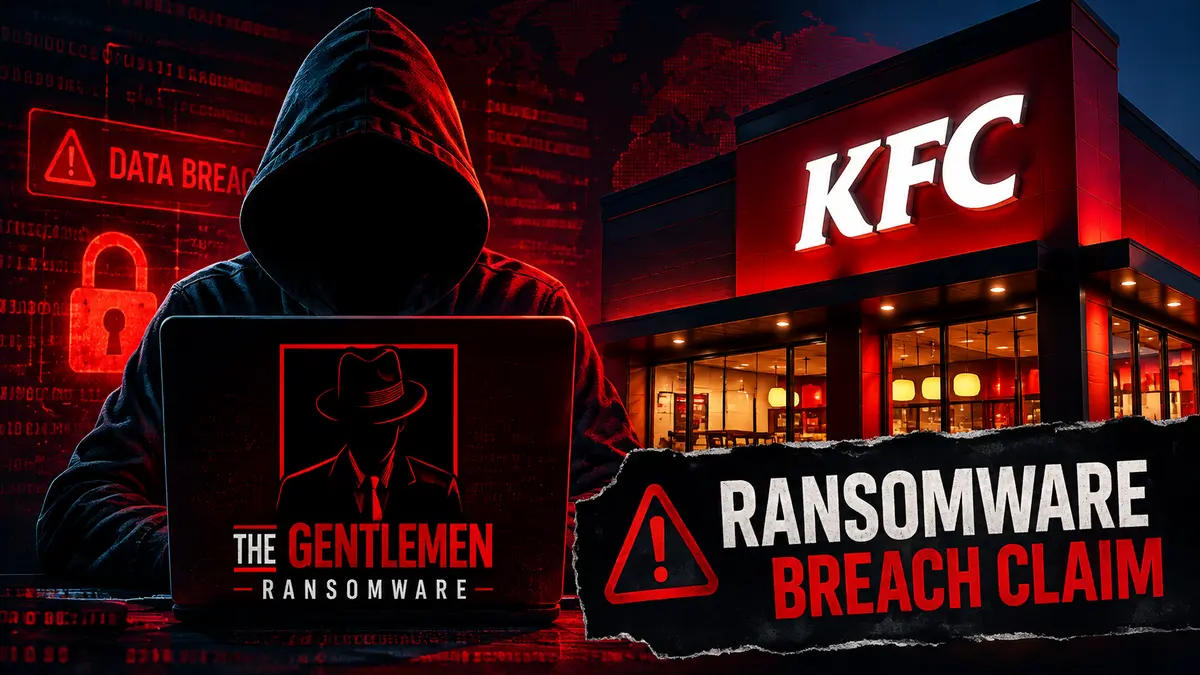
The Gentlemen ransomware operation has named KFC in a new breach claim, placing one of the world’s most recognizable restaurant brands on its victim list.
The listing was observed on October 10, 2026 and identifies the alleged target as KFC in the United States. However, the claim should be treated cautiously: there is currently no public confirmation from KFC or its parent company, Yum! Brands, that its U.S. systems were breached in this incident.
The available material also does not establish what systems may have been accessed, whether files were encrypted, how much data was allegedly stolen, or whether customer or employee information was involved.
For now, this is best described as a ransomware-group breach claim rather than a confirmed KFC data breach.
What Is Known About the KFC Ransomware Claim?
The Gentlemen ransomware group added a listing identifying KFC and referencing the company’s U.S. operations.
The listing establishes that the ransomware group is claiming KFC as a victim, but a leak-site post by itself does not prove that attackers successfully compromised the company’s corporate network.
No independently validated sample of stolen KFC data has been made public alongside the claim. There is also no confirmed attack timeline, initial-access method, ransomware demand or technical indicator currently tying the reported activity to specific KFC systems.
Another unanswered question is the scope of the alleged target.
KFC operates through a large franchise network, so a claim carrying the KFC name does not automatically establish whether the alleged access involved Yum! Brands infrastructure, KFC corporate systems, a franchise operator or another connected organization.
Until KFC, Yum! Brands or investigators provide additional evidence, those distinctions remain important.
No Current Confirmation From KFC or Yum! Brands
At the time of writing, no public statement located from KFC or Yum! Brands confirms that the October 2026 Gentlemen ransomware claim represents a successful compromise of KFC’s U.S. network.
That means reports describing customer information as stolen, systems as encrypted or restaurants as disrupted would go beyond the evidence currently available.
Ransomware leak sites are part of the extortion process used by criminal groups. Attackers often publish victim names to create pressure, but each claim still needs independent verification.
A credible confirmation would normally require additional evidence such as a company disclosure, validated stolen files, forensic findings, regulatory filings or other independently verified technical information.
Who Is The Gentlemen Ransomware Group?
The Gentlemen is a ransomware-as-a-service operation that emerged in 2025 and has expanded significantly through 2026.
Sophos threat researchers, who track the operation behind The Gentlemen as GOLD SHERWOOD, describe it as a double-extortion ransomware scheme.
In a double-extortion attack, affiliates attempt to steal information before encrypting systems. The victim can then face two forms of pressure: operational disruption from encrypted files and the threat that stolen information will be published.
Sophos said The Gentlemen’s victim leak site grew rapidly in 2026. By the end of July, 683 victim names had been posted, with 169 added during July alone.
Those figures describe the broader ransomware operation and should not be interpreted as evidence about the KFC claim itself.
The Gentlemen Can Move Quickly After Initial Access
Sophos examined 15 intrusions associated with The Gentlemen and identified a consistent post-compromise pattern involving privilege escalation, credential abuse, data exfiltration and aggressive attempts to weaken security controls.
In some investigated incidents, attackers moved from the first identified post-compromise activity to ransomware deployment in less than 24 hours.
The group and its affiliates have also made use of legitimate administrative and remote-access tools, helping malicious activity blend into normal enterprise operations.
This makes early detection particularly important. Once attackers obtain working credentials or privileged access, defenders may have only a limited window to contain the intrusion before encryption or data theft occurs.
Microsoft Found Self-Propagating Capabilities in The Gentlemen Ransomware
Microsoft Security researchers have separately analyzed The Gentlemen ransomware and documented a Go-based encryptor designed for Windows environments.
Microsoft found that the malware includes functionality intended to support lateral movement and propagation across networks after attackers have established sufficient access.
The operation uses double-extortion tactics and has affected organizations across multiple industries and geographic regions.
Microsoft also noted that The Gentlemen moved from a more closed ransomware operation into a ransomware-as-a-service model, broadening access to affiliates capable of conducting their own intrusions.
Why Remote Access and Stolen Credentials Matter
Research into previous Gentlemen ransomware incidents shows that exposed remote-access infrastructure and compromised credentials can play an important role in ransomware operations.
Sophos recommends strengthening remote access with multifactor authentication, monitoring administrative activity and detecting unusual use of tools commonly associated with staging or exfiltrating information.
That recommendation aligns with a broader change in ransomware operations: attackers increasingly focus on identities and legitimate access instead of relying exclusively on malware-based entry points.
For a deeper look at this trend, see our analysis of why identity has become a leading ransomware entry point.
KFC’s Parent Company Experienced a Separate Ransomware Attack in 2023
The current Gentlemen claim should not be confused with a separate and confirmed ransomware incident involving Yum! Brands in January 2023.
In an official filing with the U.S. Securities and Exchange Commission, Yum! Brands disclosed that ransomware had affected certain IT systems.
The incident temporarily disrupted systems and resulted in fewer than 300 restaurants in one market being closed for one day.
Yum! later reported that information had been taken from its network. After completing its forensic investigation, the company said the affected information was limited to certain personal data belonging to current and former employees and that it found no evidence that customer databases had been accessed.
That 2023 event is historically relevant because it shows that Yum! Brands has previously dealt with ransomware, but there is currently no evidence linking the old incident to The Gentlemen’s October 2026 claim.
What Data Did The Gentlemen Allegedly Steal From KFC?
At this stage, that is unknown.
No verified public information establishes the amount or type of data allegedly obtained.
There is currently no confirmed evidence showing that the attackers accessed:
- KFC customer information
- Payment card information
- Employee records
- Restaurant point-of-sale systems
- Franchise information
- Corporate email accounts
- Internal business documents
Unless evidence supporting those claims emerges, they should not be presented as part of the confirmed incident.
Was KFC’s Network Encrypted?
There is also no public evidence currently showing that KFC systems were encrypted by The Gentlemen.
The Gentlemen is capable of encrypting enterprise networks, but a threat actor’s capabilities in previous attacks do not prove those same actions occurred against every organization listed on its leak site.
No KFC-specific ransomware note, encryption evidence or operational outage has been publicly verified in connection with the October 2026 claim.
Why Ransomware Leak-Site Claims Require Caution
Ransomware groups use public leak sites as an extortion mechanism.
A listing can indicate that criminals believe they have obtained leverage over an organization, but researchers still need independent evidence to determine what actually happened.
There can also be uncertainty around company names, subsidiaries, third-party providers and franchise networks.
For a global brand such as KFC, accurately identifying the affected legal entity or network is particularly important because thousands of restaurant locations can involve multiple operators and technology environments.
This is why the current KFC case should remain labelled as an alleged breach unless stronger evidence becomes available.
What Organizations Can Learn From The Gentlemen’s Playbook
Regardless of whether the KFC claim is ultimately confirmed, The Gentlemen represents an active ransomware threat that security teams should understand.
Organizations can reduce exposure by prioritizing:
- Multifactor authentication for VPN and remote-access accounts
- Immediate patching of internet-facing infrastructure
- Strong protection for privileged administrator accounts
- Monitoring for unexpected privilege escalation
- Detection of unusual remote-management tools
- Protection of backups from administrative compromise
- Monitoring for abnormal data staging and exfiltration
- Rapid revocation of compromised credentials
Organizations should also maintain offline or otherwise isolated recovery copies so ransomware operators cannot easily destroy backups after gaining administrative access.
For broader guidance on ransomware resilience and recovery planning, see our Ransomware and Critical Infrastructure Defense Hub.
Frequently Asked Questions
Did The Gentlemen ransomware group breach KFC?
The Gentlemen has claimed KFC as a victim, but the alleged compromise has not been independently confirmed. No current public statement from KFC or Yum! Brands verifies that the October 2026 claim represents a successful breach.
Was KFC customer data stolen?
There is currently no verified evidence showing that KFC customer information was stolen in the alleged 2026 incident.
Did ransomware encrypt KFC systems?
No KFC-specific encryption evidence or operational disruption has been publicly confirmed in connection with the current Gentlemen ransomware claim.
Who operates The Gentlemen ransomware?
Sophos tracks the threat group operating The Gentlemen ransomware-as-a-service scheme as GOLD SHERWOOD. Affiliates use the operation’s ransomware and supporting infrastructure to conduct attacks.
Has KFC or Yum! Brands experienced ransomware before?
Yes. Yum! Brands confirmed a separate ransomware attack in January 2023 that disrupted certain IT systems and temporarily closed fewer than 300 restaurants in one market for one day. Yum! later said some employee information had been taken but found no evidence that customer databases were accessed.
Final Thoughts
The Gentlemen ransomware group’s decision to name KFC is significant because of the global visibility of the brand, but visibility should not be confused with verification.
At present, the evidence confirms a ransomware-group claim, not a confirmed compromise of KFC’s U.S. corporate systems.
There is no verified amount of stolen data, no confirmed ransomware demand, no publicly established entry point and no company confirmation of the alleged October 2026 breach.
That status could change if KFC, Yum! Brands, regulators or investigators release additional information. Until then, the most accurate description is that KFC has been named in an unverified Gentlemen ransomware breach claim.