
WeaveLotus espionage activity compromised five government, military and legislative organizations in Thailand and the Philippines during August and September 2026, according to newly published research from SOCRadar. The suspected Vietnam-linked operators also investigated more than 30 government organizations in Indonesia, but researchers found no confirmed intrusion there.
The campaign, named RedOps, focused on intelligence concerning South China Sea defense agreements, government planning and military cooperation. Instead of relying on a single sophisticated malware implant, the attackers combined vulnerable public-facing applications, weak credentials, network tunneling and access to poorly protected internal systems.
SOCRadar published its findings on November 26, 2026, after examining the operators’ tools, infrastructure and activity records. The company assesses a Vietnam connection with moderate confidence, but the evidence does not conclusively establish government sponsorship.
What Researchers Discovered About WeaveLotus and RedOps
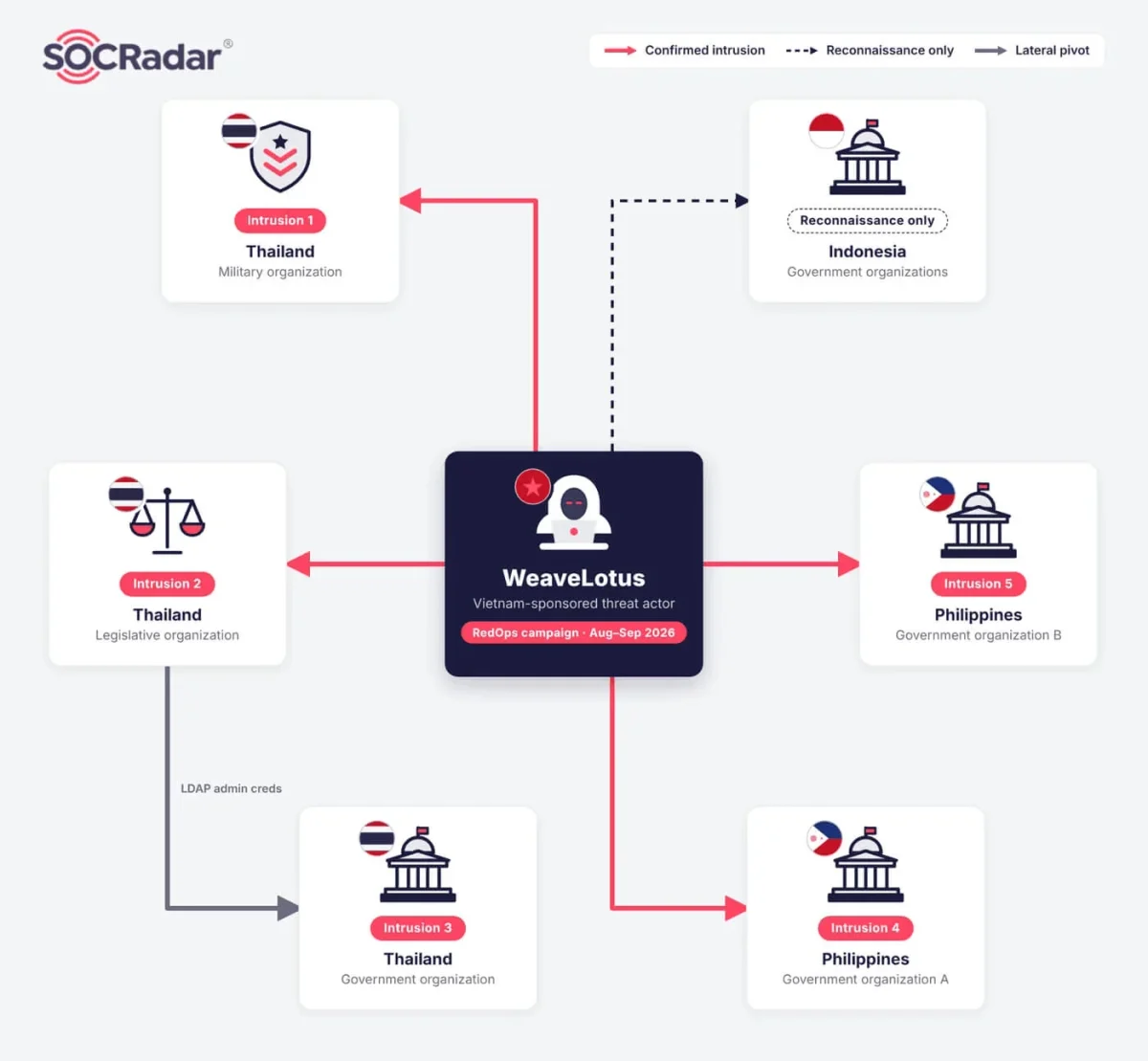
SOCRadar’s Threat Research Unit identified WeaveLotus as the activity cluster responsible for RedOps. Researchers reported five intrusions affecting government-related organizations in two countries, along with extensive reconnaissance against Indonesian agencies.
| Finding | Research assessment |
|---|---|
| Campaign | RedOps |
| Tracked threat actor | WeaveLotus |
| Observed period | August–September 2026 |
| Confirmed intrusions | Five organizations in Thailand and the Philippines |
| Indonesia | Reconnaissance against more than 30 organizations; no confirmed intrusion |
| Primary objective | South China Sea defense, diplomatic and government intelligence |
| Vietnam-related attribution | Moderate confidence, according to SOCRadar |
| State sponsorship | Not conclusively established |
The geographical focus is important. The research describes a targeted intelligence operation against government institutions rather than a widespread campaign against ordinary consumers or private businesses.
How the WeaveLotus Espionage Campaign Gained Access
The attackers repeatedly exploited an organizational weakness that defenders can recognize: internet-accessible applications with known security flaws, default administrative passwords or excessive permissions.
After gaining a foothold, the operators established reverse SSH tunnels and SOCKS5 proxies, allowing them to reach internal systems through compromised servers. In some environments, they used captured credentials to move beyond the initially affected application.
GeoServer Vulnerability Used Against a Thai Military Organization
In late August, the operators investigated a Thai military-affiliated organization’s exposed GeoServer deployment.
SOCRadar assessed that the attackers likely exploited CVE-2024-36401, a critical remote code execution vulnerability rated 9.8 under CVSS v3.1.
The resulting access enabled internal network reconnaissance and deployment of a proxy and reverse SSH tunnel. Researchers subsequently observed a scheduled persistence mechanism that checked the connection and restarted it when necessary.
The attackers also accessed a Directus content management system whose file API allowed unauthenticated access. According to SOCRadar, the operators enumerated approximately 95,000 file records and downloaded 31,418 files, totaling roughly 575 MB.
The collected material included documents associated with military operations, logistics, infrastructure and other government functions. The operators also used optical character recognition to extract searchable text from images.
Researchers observed attempts to access surveillance infrastructure, but the available findings do not establish that the attackers successfully obtained a live video feed.
Default JasperReports Credentials Opened a Second Path
A separate intrusion targeted a Thai legislative organization through a JasperReports server that still accepted its default administrative credentials.
The attackers uploaded a malicious report that triggered backend SQL execution and used the compromised environment to establish further network access. SOCRadar identified additional tooling that automated commands and supported persistence.
The compromised reporting server also provided a path toward a third-party document management system. The operators attempted password spraying using employee names and national identification numbers as candidate passwords.
After obtaining access, they collected user information, audit logs, configuration data and large volumes of documents.
SOCRadar verified approximately 19 GB of transferred material from this intrusion through exfiltration logs. Its findings include more than 5,000 ZIP archives collected during the operation.
Stolen Credentials Enabled Access to Another Thai Agency
The research also documented how one compromised environment led to a separate government organization.
Credentials captured through an identity trust relationship allowed the attackers to access a server running an older Keycloak deployment. They extracted credential records, tested recovered passwords and reached accounts with administrative privileges.
Using authenticated application access, the operators retrieved 349,782 records associated with national planning, public policy and fiscal information.
This progression illustrates why a compromised supplier or connected agency can create risk beyond its own network. The initial vulnerable server was not necessarily the system containing the most valuable information.
What Happened in the Philippines and Indonesia?
SOCRadar separately identified two Philippine government organizations affected by the campaign.
In one case, the operators exploited CVE-2021-42235, a critical SQL injection vulnerability affecting osTicket. The activity exposed database structures and employee account information, including password hashes.
The second Philippine incident involved a Laravel application with debug mode enabled. Verbose errors exposed internal paths and fragments of source code, revealing information about a government project-management and budgeting environment.
These cases did not follow identical exploitation paths, but they shared a central weakness: external services exposed more access or information than their legitimate users required.
In Indonesia, researchers observed scanning and reconnaissance against more than 30 government organizations. The activity included certificate transparency searches, port scanning and identification of VPN services.
SOCRadar did not report a successful Indonesian intrusion. Reconnaissance should not be described as a confirmed breach.
What Information Was Collected?
The reported theft went beyond usernames and passwords. Several affected systems contained records relevant to public administration, military planning and intergovernmental coordination.
| Affected environment | Reported collection or exposure |
|---|---|
| Thai military-affiliated organization | 31,418 downloaded files, approximately 575 MB |
| Thai legislative organization and connected document system | Approximately 19 GB of transferred material verified through logs |
| Additional Thai government application | 349,782 records involving policy, planning and fiscal information |
| Philippine government organization using osTicket | Staff usernames, email addresses and password hashes |
| Philippine Laravel application | Internal server paths and application information exposed through errors |
| Indonesian government organizations | Reconnaissance activity; no confirmed compromise |
These figures describe different systems and collection methods. They should not be combined into a single estimated number of stolen personal records.
The campaign’s apparent objective was intelligence gathering rather than ransomware deployment or immediate financial extortion.
Why Researchers Suspect a Vietnam Connection
Attribution is one of the most sensitive aspects of this investigation.
SOCRadar associated the activity with a suspected Vietnam-linked operator using several indicators:
- Vietnamese-language comments in custom scripts.
- Operational schedules consistent with UTC+07:00 working hours.
- Intelligence collection focused on Southeast Asian strategic and military issues.
- Custom tooling and consistent infrastructure behavior across the intrusions.
Taken together, these indicators support the company’s moderate-confidence assessment. Individually, however, none proves that a government directed the campaign.
SOCRadar also considered a possible connection with OceanLotus, also known as APT32, but assigned low confidence to that relationship. The observed techniques and tooling differed from several established OceanLotus patterns.
For broader context on attribution and long-running intelligence operations, see CyberUpdates365’s Nation-State Cyber Warfare and APT Threats Guide.
How Security Teams Can Detect Similar Intrusions
The RedOps investigation offers practical lessons for defenders because many of the entry points involved preventable exposure rather than previously unknown vulnerabilities.
1. Audit Exposed Applications and Patch Known Flaws
Identify internet-facing GeoServer, osTicket, JasperReports and other administrative applications. Review the affected versions and exposure of systems associated with CVE-2024-36401 and CVE-2021-42235, then apply vendor-supported fixes.
Prioritize systems that can execute server-side code or reach sensitive internal applications.
2. Remove Default Credentials and Disable Debug Output
Replace default administrative passwords, limit management access and remove unnecessary accounts.
Production Laravel applications should not display verbose debugging information to unauthenticated visitors. Review other frameworks for equivalent exposure.
3. Investigate Reverse SSH and Unexpected Proxy Connections
Monitor servers for unusual outbound SSH sessions, persistent connections over port 443, unauthorized SOCKS proxies and unexplained scheduled tasks.
Port 443 is commonly used for legitimate encrypted traffic, so detection should consider the originating process, protocol behavior, destination and business purpose rather than blocking every connection on that port.
4. Review API Permissions and Identity Trust Relationships
Check whether anonymous API roles can enumerate or download sensitive files. In Directus and comparable content systems, ensure public access grants only the minimum permissions required.
Review shared credentials, identity federation and trust relationships between suppliers and government or enterprise networks. A compromise in one connected system should not automatically expose another.
5. Hunt for Bulk Collection and Abnormal Authentication
Look for password spraying, repeated token requests, unusually large document downloads and unexpected data transfers to external storage infrastructure.
Organizations with relevant telemetry can compare suspicious events against the indicators published in SOCRadar’s original report. Historical infrastructure indicators should be used as investigation leads rather than conclusive evidence of an active infection.
Reported WeaveLotus Network Indicators
SOCRadar identified the following IP addresses in connection with RedOps. They are reproduced in defanged form to avoid creating direct clickable destinations.
| Indicator | Reported role |
|---|---|
172.235.255[.]195 | Earlier operator infrastructure |
172.235.245[.]49 | Later tunneling and staging infrastructure |
45.61.144[.]206 | Reported data exfiltration destination |
Security teams should correlate these indicators with timestamps, process execution, authentication logs and other independent evidence. IP addresses can be reassigned or used by unrelated tenants over time.
Additional file hashes and technical artifacts are available in SOCRadar’s original threat research.
CyberUpdates365 Analysis: The Larger Risk Is Trusted Access
The most significant feature of RedOps is not a single tool or exploited vulnerability. It is the way the operators turned limited access into wider intelligence collection.
A publicly exposed application created the initial opening. Network tunnels then allowed the attackers to investigate internal services. Weak permissions and captured credentials exposed additional document repositories and connected government environments.
For organizations in the United States, the relevant lesson is not that this campaign specifically targeted US networks; SOCRadar did not report such targeting. The lesson is that the same classes of weaknesses exist in government agencies, contractors and enterprises elsewhere.
Patch management matters, but patching alone cannot prevent every stage illustrated by this campaign. Administrators also need constrained service accounts, controlled egress, secure API permissions, monitored identity relationships and reliable visibility into large-scale document access.
The research also demonstrates why attribution must remain separate from technical findings. SOCRadar documented substantial intrusion evidence, but its assessment of Vietnam-related sponsorship remains an attribution judgment rather than independently established proof of state direction.
Sources and Research Notes
- SOCRadar Threat Research Unit — RedOps: WeaveLotus Targets Southeast Asian Governments for South China Sea Intelligence, November 26, 2026.
- The Hacker News — Suspected Vietnam-Linked Hackers Target Southeast Asia, November 27, 2026.
- NIST National Vulnerability Database — CVE-2024-36401.
- NIST National Vulnerability Database — CVE-2021-42235.
Editorial note: This article summarizes findings published by SOCRadar and additional reporting. CyberUpdates365 did not independently conduct forensic testing of the affected organizations. Attribution and intrusion findings are presented with the confidence levels and limitations reported by the researchers.