Editor’s note: This article reports on the Binance hot-wallet incident based on Binance’s security announcements and published reports. Figures and investigative details are as reported and remain under investigation; they have not been independently verified by CyberUpdates365.
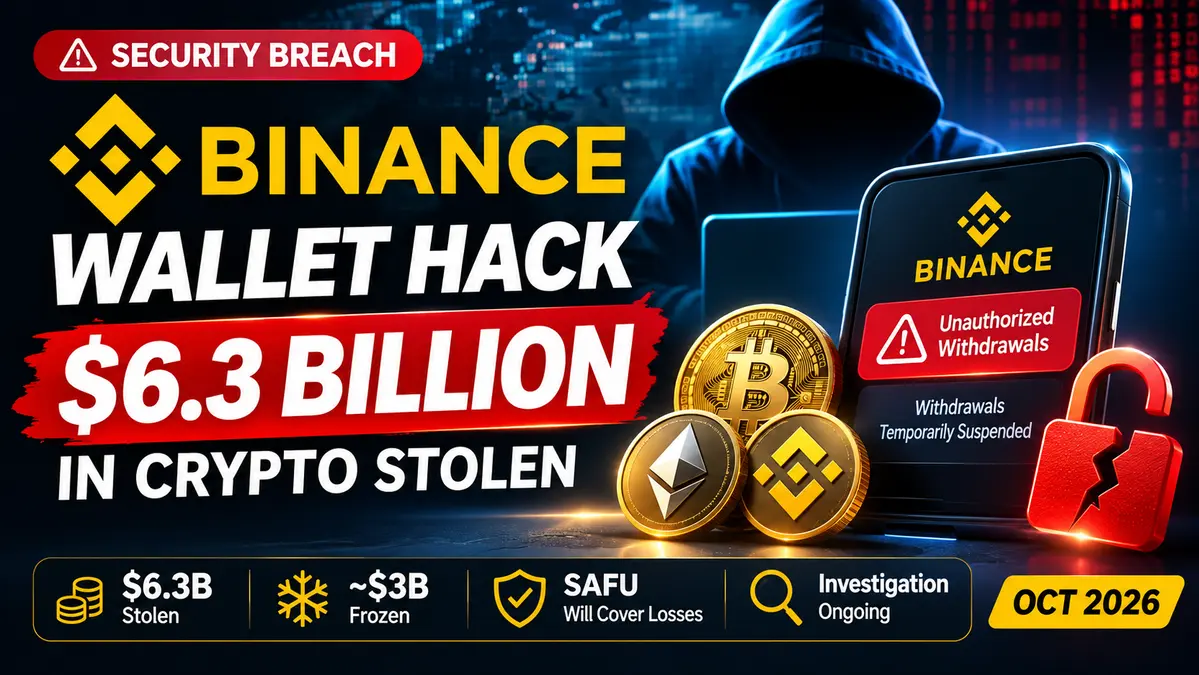
Binance has confirmed a major hot-wallet security breach involving approximately $6.3 billion in stolen cryptocurrency assets, making the Binance wallet hack one of the largest publicly reported crypto exchange thefts.
The unauthorized withdrawals occurred at approximately 20:05 UTC on October 29, 2026, according to Binance’s updated security announcement. The exchange temporarily suspended withdrawals, revoked affected authorizations, and worked with blockchain partners to trace and freeze stolen assets.
By its October 30 update, Binance reported that approximately $3 billion had been frozen on-chain. The company also committed to covering customer losses using its Secure Asset Fund for Users (SAFU) and corporate resources.
The investigation initially pointed toward a potentially compromised DevOps engineer’s laptop, but Binance subsequently identified additional intrusion points. The exchange says it has found no evidence that wallet private keys were leaked.
The critical distinction: A large amount of cryptocurrency was stolen from Binance-controlled hot-wallet infrastructure, but the complete method used to authorize the withdrawals remains under investigation.
For broader coverage of major security incidents and their operational impact, visit the CyberUpdates365 Data Breach and Security Incident Hub.
Key Findings From the Binance $6.3 Billion Hack
- Incident: Unauthorized withdrawals from Binance hot-wallet infrastructure.
- Attack time: October 29, 2026, at approximately 20:05 UTC.
- Estimated loss: Approximately $6.3 billion in token assets.
- Frozen assets: Binance reported around $3 billion frozen on-chain.
- Customer protection: Binance committed to absorbing the financial loss through SAFU and corporate funds.
- Replacement assets: More than $5 billion in corresponding token assets had reportedly been arranged, representing approximately 80% of the stolen amount.
- Initial attack theory: Possible compromise of a DevOps engineer’s laptop and access to a service container.
- Investigation status: Additional intrusion points discovered; complete attack chain not yet publicly established.
- Private keys: Binance says there is no evidence of a wallet private-key leak.
- Platform impact: Withdrawals were temporarily suspended while security checks continued.
What Happened During the Binance Hot Wallet Hack?
Binance operates a large cryptocurrency exchange that processes deposits, withdrawals, and other customer transactions across multiple blockchain networks.
Hot wallets are wallets connected to operational systems so exchanges can move assets when customers request withdrawals.
That connectivity makes hot wallets useful for everyday exchange operations, but it also creates security challenges. Systems involved in transaction processing must be protected against unauthorized access and instructions.
Binance says attackers successfully initiated unauthorized withdrawals from its hot-wallet infrastructure.
In the first hours following the incident, the exchange began investigating the source of the unauthorized transactions and coordinating with blockchain industry partners.
Its initial public statements described a possible compromise of a DevOps engineer’s laptop that may have allowed access to a service container.
However, Binance later clarified that its investigation had uncovered additional points of compromise, making the initial laptop theory insufficient to explain the entire incident.
That distinction matters because a preliminary indicator is not the same as a confirmed root cause.
Binance has promised a detailed technical incident report after the investigation establishes the relevant facts.
Binance Hack Timeline: October 29–31, 2026
| Date and Time | Reported Development |
|---|---|
| October 29, 20:05 UTC | Approximate time of the unauthorized hot-wallet withdrawals. |
| October 30 | Binance publicly acknowledged the security incident and described its initial investigation. |
| October 30 | The exchange reported approximately $3 billion in frozen assets and committed to covering customer losses. |
| October 30 | A follow-up security update confirmed the estimated $6.3 billion loss and additional intrusion findings. |
| October 31 | Investigators continued tracing assets and reviewing infrastructure while Binance prepared withdrawal restoration and updated reserve disclosures. |
| November 2, planned | Binance targeted publication of an updated Proof of Reserves report, subject to its announced schedule. |
The dates reflect the public information available by October 31, 2026. Restoration targets and planned reserve disclosures should not be mistaken for completed actions.
How Could a DevOps Laptop Lead to Unauthorized Crypto Withdrawals?
The most technically significant part of Binance’s initial disclosure was its reference to a potentially compromised DevOps engineer’s laptop.
A DevOps workstation may contain authenticated sessions, infrastructure-management tools, deployment configurations, cloud access, and other operational capabilities.
When an attacker compromises such an endpoint, the risk can extend beyond the computer itself if connected infrastructure does not enforce sufficient separation and authorization controls.
In a possible intrusion scenario, stolen operational access might allow an attacker to interact with services involved in sensitive financial workflows.
However, this is a general explanation of infrastructure risk, not a confirmed reconstruction of the Binance attack.
Binance’s first announcement suggested a compromised laptop may have enabled access to a service container and unauthorized withdrawal submissions.
Its subsequent announcement reported additional intrusion points, leaving the complete attack sequence unresolved.
Why a Service Container Is Important
Many modern applications use containers to isolate services and simplify deployment.
Containers can host application components that communicate with internal APIs, message queues, databases, and transaction-processing systems.
A compromised container may expose sensitive service-to-service privileges if identity policies and authorization controls are too broad.
For infrastructure teams, the general lessons include enforcing least-privilege service identities, protecting deployment credentials, isolating critical workloads, and monitoring unusual access to sensitive APIs.
But it would be premature to claim that a specific Kubernetes configuration, container vulnerability, secret leak, or CI/CD failure caused the Binance breach.
Binance has not established those details in its current public technical statements.
Were Binance Private Keys Stolen?
Binance has explicitly stated that investigators have found no evidence of wallet private keys being leaked.
This does not mean the unauthorized withdrawals were harmless or that the investigation is complete.
Cryptocurrency transfers may depend on multiple layers of transaction approval, service authorization, wallet policies, and operational infrastructure.
Unauthorized withdrawals demonstrate that the attackers were able to cause assets to move outside approved operations.
They do not, by themselves, establish that attackers obtained raw private-key material.
Determining exactly how transaction approval controls were bypassed or abused is one of the key questions for the pending technical post-mortem.
Until Binance or independent investigators release verified technical evidence, speculation about the precise signing mechanism should be clearly distinguished from confirmed facts.
How Much Crypto Was Stolen, Frozen, and Replaced?
Binance estimated that approximately $6.3 billion in token assets was stolen.
The exchange said it had worked with law enforcement, blockchain analytics providers, token issuers, and other industry partners to trace affected transactions.
By the October 30 update, approximately $3 billion had reportedly been frozen on-chain.
This is an important recovery development, but frozen assets are not necessarily assets already returned to Binance.
| Financial Metric | Binance’s Reported Position |
|---|---|
| Estimated stolen assets | Approximately $6.3 billion |
| Assets frozen on-chain | Approximately $3 billion |
| Company funds committed | More than $6.34 billion |
| Corresponding replacement token assets arranged | More than $5 billion |
| Remaining asset replacement | Purchases continuing at the time of the update |
The frozen-assets figure and the replacement-assets figure describe different activities. They should not be added together to calculate a supposed recovery total.
Binance identified USDC, USDT, BTC, ETH, and BNB among the token assets being used to replenish affected holdings.
The values remain subject to further updates as investigators trace funds and the exchange completes its replacement process.
Will Binance Users Lose Their Money?
Binance says it will bear the financial impact of the theft rather than pass the loss to customers.
The company stated that it would use its Secure Asset Fund for Users, or SAFU, alongside its own corporate funds to cover the stolen assets.
It also said more than $6.34 billion had been set aside for the response, with more than $5 billion in corresponding token holdings arranged at the time of its follow-up announcement.
That is a significant public commitment, but customers should distinguish the company’s funding assurances from independent verification of all final reserve positions.
Binance said it planned to publish an updated Proof of Reserves snapshot to provide greater transparency about assets backing customer balances.
The exchange targeted November 2, 2026, for publication of the relevant report.
What Is SAFU?
The Secure Asset Fund for Users is an emergency protection fund maintained by Binance to help address certain exceptional security-related losses.
In this incident, Binance says it will combine SAFU and corporate treasury resources to cover the loss.
The existence of SAFU does not remove the need to verify wallet security, financial backing, and incident remediation.
Users should follow official Binance support announcements for developments affecting their specific accounts and withdrawal availability.
Why Binance Temporarily Suspended Withdrawals
Binance temporarily suspended withdrawals after detecting the security incident.
According to the exchange, the pause was intended to give investigators time to review affected infrastructure, implement remediation measures, and verify the integrity of relevant systems.
The company said deposits and other unaffected platform services continued operating.
Binance expected withdrawal restoration to proceed in phases, with individual assets becoming available as security checks were completed.
Its stated target was approximately 34 hours, but the company made clear that timing depended on the results of security reviews.
As of this reporting snapshot, customers should not assume that every withdrawal service had already been restored.
The safest source for individual asset availability is Binance’s official status information and account interface.
What Are Investigators Doing to Recover the Stolen Funds?
Public blockchain networks create a transaction record that investigators can analyze when stolen assets move between addresses.
However, identifying an address is not the same as identifying the person controlling it.
Investigations may involve blockchain transaction tracing, cooperation with cryptocurrency exchanges, token issuers, and law enforcement agencies.
Binance said it had coordinated with these groups and implemented restrictions against affected infrastructure and authorizations.
Reuters also reported that U.S. federal law enforcement agencies, including the FBI and Secret Service, were involved in response efforts.
The ability to freeze particular assets depends on the token, issuing entity, blockchain mechanisms, and applicable legal or technical controls.
A frozen transaction balance should not be described as successfully recovered until the responsible parties confirm its disposition.
What Should Binance Customers Do Now?
The available evidence does not establish that individual customer passwords, recovery phrases, or wallet private keys were exposed in this incident.
Nevertheless, a widely publicized security breach can create opportunities for phishing and impersonation scams.
1. Verify Information Through Official Binance Channels
Use the Binance application, official website, and verified support announcements to check service status.
Be cautious of social media posts promising immediate compensation or offering special recovery links.
2. Do Not Share Recovery Phrases or Security Codes
Never disclose wallet seed phrases, passwords, one-time security codes, or authentication recovery details to anyone claiming to represent customer support.
A legitimate support process should not require you to hand over a private recovery phrase.
3. Review Account Security
Check recent sign-in activity, connected devices, security notifications, and withdrawal settings.
If your account shows unexplained changes, contact official customer support and follow the platform’s account-security instructions.
Crypto exchange users should also protect their mobile numbers against SIM-swapping attacks, which can expose SMS-based verification and account recovery processes. For practical prevention steps, read our complete SIM swapping prevention guide. This is a general account-security precaution, not a confirmed method used in the Binance breach.
4. Beware of Fake Compensation Websites
Attackers may use major incidents to advertise fraudulent reimbursement portals or malicious wallet-connection pages.
Avoid connecting a self-custody wallet to an unfamiliar site or approving transactions simply because a page claims to offer breach compensation.
Related research has shown how malicious Firefox extensions impersonate crypto wallets to steal recovery phrases. This is a separate campaign, but it illustrates why users must verify wallet-related software and recovery requests.
5. Monitor Official Withdrawal and Reserve Updates
Check whether the specific asset you want to withdraw is supported after Binance announces phased restoration.
Review the updated Proof of Reserves report when it becomes available, rather than relying on unverified screenshots circulating online.
Infrastructure Security Lessons From the Binance Incident
The evolving investigation offers several useful questions for cryptocurrency exchanges and other organizations running high-value transaction infrastructure.
Separate Developer Access From Financial Authorization
Development and operational access should not automatically grant the ability to initiate or approve sensitive transfers.
Critical financial workflows benefit from independent authorization checks and limits on the privileges available to individual services.
Use Short-Lived Credentials and Workload Identity
Infrastructure teams should reduce reliance on long-lived secrets stored on employee laptops or inside application containers.
Where feasible, use controlled identity federation, short-lived credentials, and tightly scoped service permissions.
Monitor Sensitive Service-to-Service Activity
High-value transaction systems should generate useful audit records for authorization changes, unexpected service identities, and abnormal withdrawal patterns.
These records can support rapid detection and post-incident investigation.
Strengthen Endpoint and Container Security
Organizations should protect privileged engineer workstations, enforce appropriate endpoint security controls, and monitor production infrastructure for unusual access.
Containers should run with the minimum necessary permissions and should not have unnecessary access to wallet or treasury operations.
These are general security recommendations based on the risk class. They are not claims that Binance failed to implement a particular control.
Test Emergency Transaction Controls
Exchange security teams should know how to revoke service authorizations, isolate affected infrastructure, pause sensitive operations, and coordinate with external financial partners.
Incident response plans should be tested before a major breach occurs.
Binance Wallet Hack: Confirmed vs Unknown
What Binance Has Confirmed
- Unauthorized hot-wallet withdrawals occurred on October 29, 2026.
- The estimated stolen asset value was approximately $6.3 billion.
- Approximately $3 billion in affected assets had been frozen on-chain.
- Withdrawals were temporarily suspended while security checks continued.
- Binance committed to covering the stolen funds using SAFU and corporate resources.
- The initial investigation raised the possibility of a compromised DevOps engineer’s laptop.
- Further investigation identified additional intrusion points.
- Binance reported no evidence of wallet private-key leakage.
What Remains Unconfirmed
- The complete technical sequence used to carry out unauthorized withdrawals.
- Whether the initial laptop compromise was the primary entry point.
- Which specific infrastructure permissions or approval controls were abused.
- Whether a particular container vulnerability, leaked secret, or software exploit was involved.
- The identities and affiliations of the attackers.
- The final amount of stolen assets that can be recovered.
- The final restoration time for every withdrawal service.
CyberUpdates365 Analysis: The Bigger Risk Is Transaction Authority
The Binance incident highlights a critical distinction between protecting cryptographic secrets and protecting the infrastructure authorized to move assets.
An exchange may maintain strong controls around private-key material, but that alone does not answer every question about whether an attacker can abuse surrounding operational systems.
Modern financial infrastructure includes service identities, approval workflows, internal APIs, authorization policies, and transaction-monitoring systems.
Each layer matters because a high-value transfer should not depend entirely on the security of a single workstation or application environment.
Binance’s reported absence of evidence for a private-key leak is therefore an important finding, but it is not an explanation of the full breach.
The revised disclosure about additional intrusion points further reinforces why early technical theories should remain provisional.
Another important element is the response to financial loss. The company’s pledge to replace stolen assets may protect customers, but independent reserve disclosures and verified restoration are necessary to assess the final outcome.
CyberUpdates365’s takeaway: Exchanges should protect both signing material and every system capable of requesting, authorizing, or executing high-value transactions. The immediate priority for customers is to follow verified updates and avoid recovery-related phishing scams.
Research Evidence
- Organization: Binance.
- Incident type: Hot-wallet compromise and unauthorized withdrawals.
- Incident date: October 29, 2026.
- Incident time: Approximately 20:05 UTC.
- Estimated stolen value: $6.3 billion.
- Reported frozen assets: Approximately $3 billion.
- Corporate funding commitment: More than $6.34 billion.
- Corresponding replacement assets: More than $5 billion at the time of the October 30 update.
- Initial investigation: Possible compromised DevOps laptop and service-container access.
- Updated investigation: Additional intrusion points identified.
- Private-key exposure: No evidence reported by Binance.
- Service impact: Temporary withdrawal suspension.
- Customer coverage: Binance committed SAFU and corporate funds.
- Next planned disclosure: Updated Proof of Reserves targeted for November 2, 2026.
Frequently Asked Questions
Was Binance hacked in October 2026?
Binance reported unauthorized withdrawals from its hot-wallet infrastructure around October 29, 2026, with an estimated impact of approximately $6.3 billion.
How much cryptocurrency was stolen?
Binance estimated that approximately $6.3 billion worth of token assets was stolen.
How much stolen crypto has been frozen?
Binance reported that approximately $3 billion in affected assets had been frozen on-chain by its October 30 security update.
Were Binance private keys leaked?
Binance says investigators found no evidence that wallet private keys were leaked. Its investigation into the full attack sequence remains ongoing.
Was a DevOps laptop responsible for the hack?
A compromised DevOps engineer’s laptop was part of Binance’s initial investigation, but the company subsequently identified additional intrusion points. The final root cause has not been confirmed.
Will Binance reimburse affected users?
Binance committed to covering the financial losses through SAFU and corporate funds. Customers should monitor official announcements for further reserve and account-related updates.
Why were Binance withdrawals suspended?
The exchange temporarily suspended withdrawals to investigate the incident, strengthen security controls, and validate affected systems before phased restoration.
Should Binance users change their passwords?
The incident has not established that customer passwords were stolen. Users should nevertheless review account security, use strong authentication, and immediately report suspicious account activity.
Final Takeaway
The Binance wallet hack resulted in an estimated $6.3 billion in stolen cryptocurrency assets, according to the exchange’s security disclosures.
Binance reported approximately $3 billion in frozen assets, committed to replenishing affected holdings, and began restoring services only after additional security reviews.
The exact technical cause remains under investigation, particularly after Binance identified additional intrusion points beyond its preliminary laptop-compromise theory.
For customers, the most important actions are monitoring verified Binance updates, protecting account credentials, and avoiding phishing messages claiming to offer compensation.
Related reading: Cryptocurrency theft is not limited to exchange infrastructure. Our investigation examines malicious browser extensions designed to capture wallet recovery phrases.
Read Next: Malicious Firefox Extensions Steal Crypto Wallet Recovery Phrases