
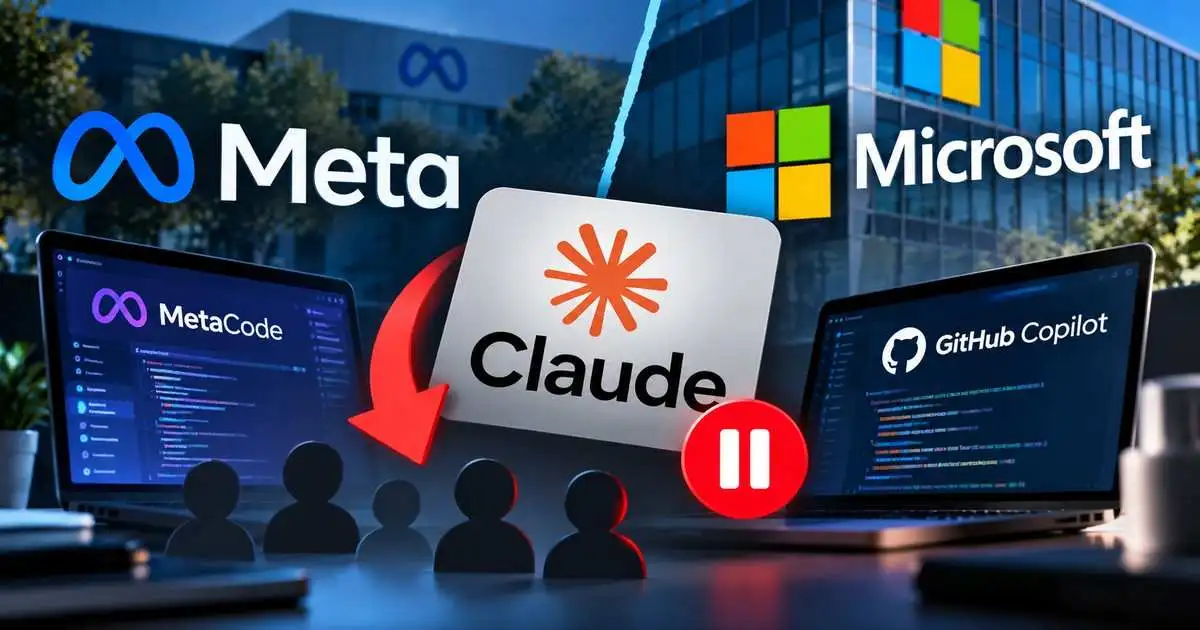
Meta Microsoft Claude AI usage is reportedly being reduced internally as both companies push employees toward their own AI coding tools and tighter spending controls.
The shift does not mean either company is cutting off Claude from customers. Microsoft continues to offer Anthropic models through Microsoft Foundry, while Meta is expanding its own AI ecosystem with tools such as Muse and Muse Code.
Recent reporting indicates that the changes are focused mainly on internal employee workflows, AI budgets, and developer-tool strategy rather than a complete break with Anthropic.
For broader coverage of enterprise AI risks, agentic systems, and changing AI-security practices, see our AI-era threats and agentic security guide.
Key takeaway: Meta and Microsoft are reportedly reducing internal reliance on Claude while pushing their own coding tools, but both companies still maintain significant commercial relationships with Anthropic.
Why Are Meta and Microsoft Reducing Claude Use?
The reported changes appear to be driven by a combination of cost control, competition, and the desire to increase adoption of internally developed AI tools.
AI coding assistants have become deeply embedded in software-development workflows, but large-scale use can also create substantial compute and licensing costs.
As companies build their own models and developer tools, they have a stronger incentive to route internal usage toward those systems instead of paying external providers for every interaction.
Microsoft Reportedly Cuts Internal Claude Spending
Recent reporting says Microsoft had previously expected internal spending on Anthropic technology to reach at least $1 billion annually.
That projection has reportedly been reduced by more than one-third after company leaders encouraged employees to use more Microsoft-controlled tools, including GitHub Copilot and OpenAI-powered models.
Within Microsoft’s cloud and AI organization, monthly AI-spending limits were also reportedly reduced from approximately $100,000 per employee to around $10,000 in many cases.
These figures should be interpreted carefully. They represent reported internal budget limits and projections, not necessarily the amount every individual employee actually spent.
Microsoft Still Offers Claude to Customers
The internal pullback does not mean Microsoft has removed Claude from its commercial products.
Microsoft officially supports Anthropic Claude models in Microsoft Foundry, where Azure customers can access Claude through Azure-native infrastructure, authentication, and billing.
Microsoft documentation confirms that Claude models remain available as partner models for developers and enterprise customers building applications and AI agents.
This creates an important distinction between:
- Microsoft reducing Claude use among its own employees
- Microsoft continuing to sell Claude access to customers
Those two strategies can exist at the same time.
Meta Reportedly Cuts Claude Code Users by Half
Meta has also reportedly reduced internal use of Claude Code.
Employee usage reportedly fell from around 60,000 users earlier in 2026 to roughly 30,000.
Part of the decline may be related to workforce reductions, but reporting indicates that Meta’s growing push toward its own coding tools is a larger strategic factor.
Meta has been developing multiple internal and commercial AI tools designed to reduce dependence on outside providers.
MetaCode and Muse Code Gain Ground
Meta reportedly has more than 30,000 internal users on MetaCode, its in-house coding assistant.
Muse Code, which is positioned as a broader coding tool using Meta’s own models, reportedly has more than 6,000 internal users.
Meta has also begun expanding Muse beyond internal experimentation.
Official Meta announcements confirm that Muse and Muse Code are part of the company’s broader enterprise AI strategy.
Meta’s recently launched enterprise platform is designed to bring tools such as Muse, Muse Code, and other AI services to businesses and developers.
Why Companies Want Their Own AI Coding Tools
There are several reasons large technology companies may prefer internally controlled AI tools.
- Lower long-term external model costs
- Greater control over developer workflows
- Better integration with internal systems
- More control over data handling
- Ability to tune tools around company-specific codebases
- Less dependence on competing AI providers
For companies operating at Meta and Microsoft scale, even relatively small changes in per-user AI costs can translate into very large annual spending differences.
Cost Is Only Part of the Story
The reported shift is not purely about reducing bills.
Both Meta and Microsoft compete directly with Anthropic across several parts of the AI market.
Microsoft has deep ties to OpenAI and operates its own Copilot ecosystem, while Meta is increasingly pushing its Muse and enterprise AI platforms.
At the same time, both companies continue to benefit from offering third-party AI models to customers.
This creates a complicated relationship where a company can simultaneously be a customer, platform partner, and competitor.
Claude Still Has a Large Enterprise Footprint
Anthropic remains one of the most prominent enterprise AI providers.
Claude is available across multiple major cloud platforms, including Microsoft Foundry, and continues to be used for coding, automation, research, and agentic workflows.
Anthropic has also continued to expand enterprise partnerships and AI-agent capabilities.
The reported internal reductions at Meta and Microsoft therefore do not indicate a collapse in Claude demand.
They are better understood as part of a broader effort by large technology companies to control AI spending and increase use of their own platforms.
Why AI Coding Assistants Create Security Concerns
Moving from one coding assistant to another does not eliminate the security risks associated with agentic development tools.
Modern AI coding systems can interact with:
- Source-code repositories
- Local files
- Command-line tools
- Development credentials
- CI/CD environments
- Cloud services
This means the security question is not simply which model an organization uses.
Permissions, sandboxing, repository trust, credential handling, monitoring, and human review remain important regardless of whether the tool is Claude Code, GitHub Copilot, MetaCode, or another coding agent.
For additional context, see our AI agent security and enforcement coverage.
AI Spending Controls Are Becoming an Enterprise Issue
As companies deploy AI tools more widely, internal AI spending is becoming a management problem of its own.
Usage-based pricing can make costs difficult to predict when thousands of employees rely on models for coding, research, document analysis, and automated workflows.
Organizations are increasingly likely to introduce:
- Per-user budgets
- Approved-model lists
- Usage monitoring
- Centralized procurement
- Internal AI gateways
- Model-routing controls
These controls can reduce costs while also giving security and compliance teams better visibility into how AI systems are being used.
Does This Mean Microsoft Is Dropping Claude?
No.
Microsoft continues to support Claude models through Microsoft Foundry.
Official Microsoft documentation confirms that Claude remains available to Azure customers as a partner model for enterprise applications and AI agents.
The reported changes relate primarily to Microsoft’s own employee usage and internal spending priorities.
Does This Mean Meta No Longer Uses Claude?
No.
Reporting indicates that Meta still has a substantial number of Claude Code users and remains a major Anthropic customer.
The change appears to be a reduction in reliance rather than a complete removal of Claude.
Meta is simultaneously increasing adoption of MetaCode, Muse Code, and other internally controlled systems.
Why the Numbers Should Be Treated as Reported Figures
The internal user counts, spending projections, and employee budget figures discussed in public reporting have not been independently published by Meta or Microsoft in official company statements.
They should therefore be described as reported internal figures rather than confirmed public financial guidance.
Official company materials do, however, confirm the broader strategic context: Microsoft continues to distribute Claude models through Foundry, while Meta is expanding Muse and Muse Code as part of its enterprise AI platform.
Frequently Asked Questions
Are Meta and Microsoft stopping use of Claude AI?
No. Both companies are reportedly reducing internal employee use, but Claude remains in use and Microsoft continues to offer Claude models to customers.
Why is Microsoft reducing internal Claude usage?
Reported reasons include AI spending control and a push toward Microsoft-controlled tools such as GitHub Copilot and OpenAI-powered systems.
How many Meta employees reportedly use Claude Code?
Recent reporting places the number at roughly 30,000, down from around 60,000 earlier in 2026.
What is MetaCode?
MetaCode is Meta’s internal AI coding assistant designed for employee software-development workflows.
What is Muse Code?
Muse Code is part of Meta’s broader Muse AI ecosystem and is positioned as a coding assistant built around Meta’s own AI models.
Can Microsoft customers still use Claude?
Yes. Claude models remain available through Microsoft Foundry for eligible Azure customers.
Is this mainly about security?
No. The reported changes appear to be driven primarily by cost, competition, and internal platform strategy, although security and governance remain important when deploying AI coding agents.
Final Takeaway
The reported decline in Meta Microsoft Claude AI usage highlights how quickly the enterprise AI market is changing.
Large technology companies are no longer simply choosing the best available model. They are also balancing cost, control, internal product strategy, security, and competitive positioning.
Meta and Microsoft may be reducing some internal Claude usage, but neither company appears to be abandoning Anthropic.
Instead, both are pushing their own tools more aggressively while continuing to support or purchase Claude where it still provides value.
Stay Updated on Enterprise AI Security
Enterprise AI tools are rapidly becoming part of everyday software development, business operations, and automated workflows.
Follow CyberUpdates365 for verified AI security news, enterprise AI developments, agentic threat research, vulnerability analysis, and practical guidance.
Using AI coding assistants in your organization? Review model access, permissions, spending controls, and monitoring policies instead of relying on a single tool by default.
Official Sources
Microsoft Foundry — Claude Models:
Official Microsoft documentation for Anthropic Claude models in Microsoft Foundry
Microsoft Foundry — Claude Capabilities:
Microsoft Foundry update on Claude capabilities
Meta Enterprise Platform:
Meta’s official enterprise AI platform announcement
Meta Muse:
Meta’s official Muse AI announcement