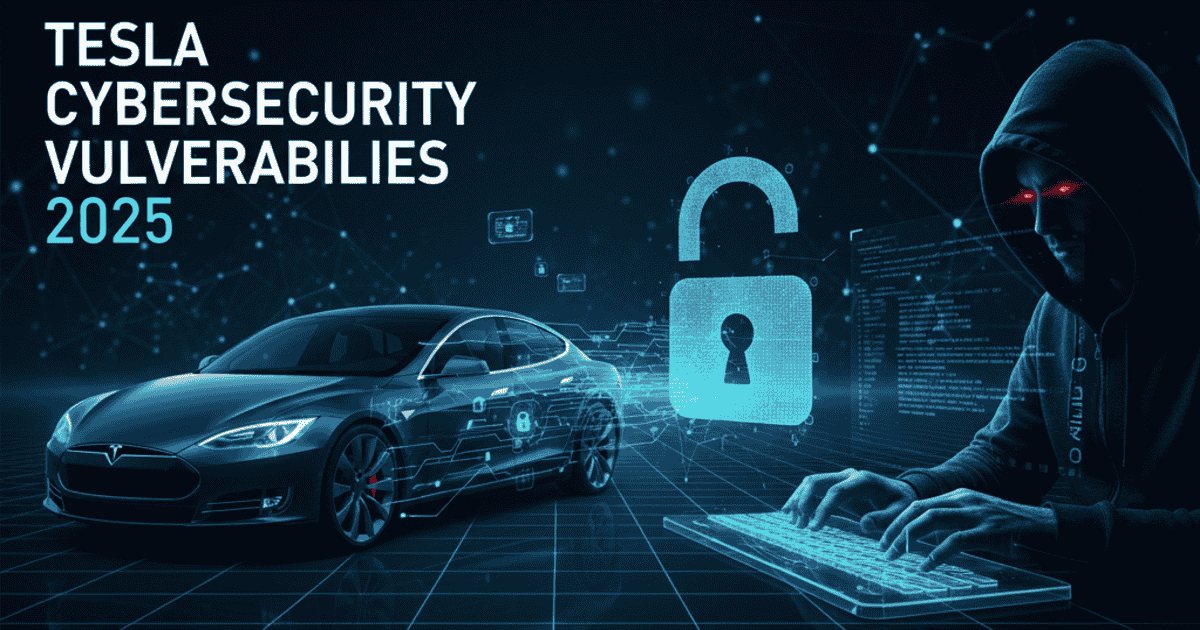
Critical automotive security intelligence reveals that tesla cybersecurity vulnerabilities 2025 represent an escalating operational risk as cybercriminal syndicates develop advanced methodologies to exploit connected electric vehicle (EV) architectures. While Tesla continues to lead the automotive industry in autonomous driving technology and over-the-air software engineering, cybersecurity researchers warn that high-bandwidth vehicular networks have become prime targets for automated digital exploitation.
I understand the profound vulnerability electric vehicle owners and enterprise fleet supervisors experience when cutting-edge infotainment touchscreens and remote smartphone control pipelines transition from convenient consumer features into unmonitored digital attack vectors. Here is my ironclad commitment: by implementing the technical defensive manual outlined below, you will secure your vehicle’s local wireless connectivity, protect your account authentication credentials against remote credential exploitation, and fortify critical connected vehicular endpoints before unauthorized threat actors manipulate your automotive investment.
In this technical automotive security briefing, we dissect confirmed architectural attack surfaces, analyze deep software vulnerabilities across autonomous steering neural networks, and deliver an actionable vehicular hardening blueprint. To evaluate how advanced cyber exploitation targets connected hardware ecosystems, review our investigation covering Tesla Cyber Attack Vulnerabilities & 5M Vehicle Risk Assessment, examine municipal telecommunications risks in our Massachusetts Boston 5G Network Security Breach Audit, analyze automotive engineering exposures in our Mercedes-Benz Source Code Data Breach Report, review national defense alignments in our Federal Cybersecurity Initiatives Guide, fortify enterprise cloud gateways via our CISA Supply Chain Emergency Directive Brief, and explore verified defensive frameworks from our central 2026 Small Business & Consumer Cyber Security Defense Vault.
To evaluate how hardware exploits bypass mobile firmware perimeters, read our Zero-Click Device Exploit and Firmware Security Guide.
Understanding Tesla’s Connected Architecture & Attack Surface
Modern electric vehicles function as interconnected digital computational clusters traveling across high-speed cellular networks, creating multiple logical interfaces that external security researchers and malicious threat operators continuously evaluate for software weaknesses.
Here is the architectural reality: according to regulatory guidance published by the Cybersecurity and Infrastructure Security Agency (CISA), advanced automotive networks are formally categorized as critical mobile infrastructure requiring defense-grade logical separation. Because modern EV operating systems fuse high-voltage power management with consumer web applications, exploitation of secondary wireless entry points threatens core vehicle stability. Current diagnostic analyses across connected automotive networks highlight six primary systems exposed to external interception:
- Infotainment Computer Units: Central cabin touchscreens running embedded operating systems, managing web browsing, streaming applications, and environmental controls.
- Autopilot & Full Self-Driving (FSD): Autonomous computational sensor arrays integrating optical camera feeds and neural network path prediction algorithms.
- Mobile Application Pipelines: Remote smartphone REST API portals enabling keyless environmental conditioning, door unlocking, and real-time GPS location tracking.
- Over-the-Air (OTA) Mechanisms: Wireless firmware distribution channels utilizing cellular 4G/5G connections for system upgrades and cryptographic patches.
- Supercharger Network Connectivity: High-voltage Direct Current (DC) charging infrastructure integrating automated billing protocols and diagnostic data exchange.
- Vehicle-to-Grid (V2G) Communication: Bi-directional energy transfer protocols linking vehicle battery storage directly to municipal electrical power grids.
To monitor emerging automotive fraud campaigns and report unauthorized digital intrusions targeting consumer vehicles, drivers should reference reporting portals managed by the FBI Internet Crime Complaint Center (IC3) alongside regulatory safety advisories from the National Highway Traffic Safety Administration (NHTSA).
Technical Deep Dive: Dissecting Attacker TTPs and Memory Corruption Bug Mechanics
Sophisticated vehicular exploitation relies upon bypassing memory isolation constraints within embedded vehicle controller boards, allowing malicious operators to execute privilege escalation routines and disrupt internal vehicular communications.
Let’s examine the attack mechanics: forensic penetration testing across commercial electric fleets confirms that unmitigated software flaws can allow unauthorized operators to execute arbitrary code across primary infotainment gateways. By analyzing advanced attacker tactics techniques and procedures (TTPs), security engineering teams established that persistent threat actors attempt to achieve unauthenticated remote code execution by targeting insecure Bluetooth and Wi-Fi transceivers. When exploitation succeeds against unpatched subsystems, attackers induce intentional buffer overflow errors, creating conditions that allow attackers to execute arbitrary commands directly within underlying Linux kernels. These software vulnerabilities threaten expansive automotive deployments, explicitly affecting consumer sedans such as tesla model 3 vehicles as well as commercial utility installations like Tesla Megapack 3 energy arrays.
Why does this matter for your vehicle investment? Because compromised wireless protocols allow **network adjacent attackers**—operating laptop scanning transceivers within close physical physical proximity—to intercept unencrypted handshake tokens. To elevate overall vehicle security, automotive cybersecurity engineers must mitigate deep OS kernel memory corruption vulnerabilities, ensuring that real-time sensor processing data remains strictly confined within its assigned **allocated buffer** space. Study the technical automotive threat architecture table below to understand vulnerability severities across electric vehicle tiers.
| Targeted Automotive Subsystem | Exploit Vector & Root Flaw | Observed Severity Tier | Engineering Remediation Protocol |
|---|---|---|---|
| Infotainment Web Browser | Heap Spray / Buffer Overflow | Critical (Remote Execution) | Enforce kernel memory sandboxing and disable unverified WebGL rendering scripts. |
| Mobile REST API Portals | Session Hijacking / Credential Reuse | High (Account Takeover) | Deploy mandatory FIDO2 hardware Multi-Factor Authentication (MFA) on user accounts. |
| Bluetooth Key-Fob Relays | Ultra-Wideband (UWB) Interception | High (Physical Theft) | Implement PIN-to-Drive verification and store primary key fobs inside RFID-blocking Faraday pouches. |
| Supercharger DC Portals | CAN Bus Packet Injection | Medium (Data Scraping) | Implement cryptographically signed Transport Layer Security (TLS) across vehicular billing handshakes. |
This technical mapping confirms that while Tesla maintains advanced over-the-air defensive patching capabilities, drivers must independently harden personal account credentials to prevent remote administrative exploitation.
Real-World EV Attack Scenarios & Defensive Mitigations
Analyzing documented penetration attempts reveals that threat actors consistently target three vulnerable intersection points between human operators, cloud database APIs, and electrical charging hardware.
Here is the tactical breakdown of observed automotive attack scenarios, illustrating the real-world progression from initial reconnaissance to full vehicle compromise:
Scenario 1: Mobile App Account Takeover via Social Engineering
- Intrusion Vector: Threat actors deploy highly polished phishing solicitations disguised as urgent Tesla account support emails, tricking vehicle owners into harvesting valid account login usernames and primary passwords.
- Compromise Impact: Upon achieving unauthorized authentication access, criminals gain full remote telematics control—allowing them to track real-time vehicle GPS coordination, unlock exterior cabin doors, and initiate battery draining operations.
- Defensive Mitigation: Never access user dashboards via unsolicited electronic correspondence, implement phishing-resistant authenticator applications, and regularly audit active session tokens within official Tesla account security settings.
Scenario 2: Charging Station Data & Billing Interception
- Intrusion Vector: Cybercriminal syndicates tamper with public charging infrastructure or third-party electrical adapters, inserting cryptographic packet sniffing modules across vehicle charging communication cables.
- Compromise Impact: Unauthorized hardware captures unencrypted payment billing records, driver identification metadata, and historical charging itineraries, facilitating localized identity fraud and movement pattern tracking.
- Defensive Mitigation: Prioritize authorized Tesla Supercharger terminal connections, physically inspect charging port receptacles for unauthorized external dongles, and monitor credit monitoring profiles for unexpected electrical utility charges.
Scenario 3: Over-the-Air (OTA) Firmware & Telematics Manipulation
- Intrusion Vector: Sophisticated intrusion teams attempt to intercept cellular telematics routing between vehicle modems and upstream vendor software distribution servers by establishing unauthorized rogue base station towers (IMSI catchers).
- Compromise Impact: If cryptographic firmware signature verification fails, malicious updates could execute persistent backdoors within central steering and braking control networks.
- Defensive Mitigation: Maintain reliance upon Tesla’s mandatory cryptographic package signing protocols, conduct system updates exclusively via secured domestic home Wi-Fi networks, and verify software build signatures directly through official support portals.
Industry Standards, Bug Bounty Research & Regulatory Frameworks
Maintaining resilience across global electric vehicle deployments requires transparent collaboration between independent cybersecurity researchers, automotive engineering leads, and international transport regulatory committees.
Let’s examine industry coordination frameworks: to establish validated security benchmarks across connected passenger cars, vehicle manufacturers adhere to institutional guidelines formalized within the NIST Cybersecurity Framework alongside rigorous international standards including UN Regulation 155 and ISO 21434 automotive engineering mandates. Additionally, industry operators actively collaborate within the Automotive Information Sharing and Analysis Center (Auto-ISAC), distributing real-time indicator of compromise (IoC) threat telemetry across competing automotive enterprises.
Simultaneously, Tesla operates one of the commercial technology sector’s most respected ethical hacker vulnerability programs via the official Tesla Bug Bounty Program and Tesla Security Support Desk. Offering financial bounties scaling up to $15,000 for critical zero-day software disclosures, this continuous engineering partnership enables rapid vulnerability identification, ensuring that verified patching routines deploy globally before exploitable bugs can be weaponized by extortion syndicates.
Actionable 3-Tier EV Hardening & Compromise Recovery Blueprint
Protecting automotive investments against remote software intrusion requires drivers to execute immediate practical hardening controls, elevate physical key security, and maintain rigorous software operational hygiene across all connected devices.
Why does this matter for everyday vehicle operations? Because securing automotive networks demands continuous maintenance of validated **firmware updates** and verifying that your central display operates on the latest authenticated firmware version. By executing the multi-layered defensive checklist below, vehicle owners can systematically neutralize every external wireless **attack vector**, insulating personal transportation from modern cyber extortion:
Mandatory 3-Tier Tesla Cybersecurity Hardening Checkboxes
- Control 1: Enforce Multi-Factor Account Security: Activate mandatory hardware-backed or application-based Two-Factor Authentication (2FA) across your Tesla account profile, eliminating reliance upon vulnerable SMS text messaging verification.
- Control 2: Activate PIN-to-Drive Verification: Enable Tesla’s built-in PIN-to-Drive console protection, requiring a secret multi-digit numerical passcode before the high-voltage drivetrain can engage, effectively neutralizing relay theft attacks.
- Control 3: Implement RFID Faraday Shielding: Store physical backup key fobs and smartphone authentication devices inside certified RFID-blocking Faraday pouches whenever parked at residences, blocking ultra-wideband signal amplification attempts.
- Control 4: Audit Connected Bluetooth & Wi-Fi Networks: Regularly review integrated vehicle network profiles, terminating automatic connection permissions for unfamiliar public wireless access points and deleting legacy paired Bluetooth hardware.
- Control 5: Maintain Sentry Mode & Firmware Vigilance: Keep Tesla Sentry Mode enabled during high-risk urban parking deployments, audit cloud monitoring permissions weekly, and verify that software security updates install immediately upon official vendor release.
Frequently Asked Questions (FAQ)
Definite, authoritative automotive security answers addressing core driver inquiries regarding Tesla connected vulnerabilities, remote mobile app safety, and autonomous system protection.
Q: Can hackers take remote control of a Tesla while it is driving?
Answer: While theoretical remote code execution vulnerabilities exist within connected automotive software, Tesla enforces strict architectural memory sandboxing separating external infotainment touchscreens from core drive motor controllers. Modern remote attacks primarily target mobile app authentication credentials to execute stationary unauthorized unlocking or GPS tracking rather than real-time motion control steering manipulation.
Q: How does the PIN-to-Drive feature protect against vehicle theft?
Answer: PIN-to-Drive serves as an internal cryptographic secondary lock requiring drivers to input a mandatory numerical sequence on the central touchscreen prior to engaging drive gears. Even if criminal syndicates intercept and clone your physical key fob signals via relay transmitters, the vehicle cannot operate without entry of this verified console passcode.
Q: What should I do immediately if my Tesla mobile account is compromised?
Answer: Instantly reset your Tesla account password utilizing a highly complex unique passphrase, enable application-based two-factor authentication, force log-out across all active device sessions, disconnect the vehicle from local Wi-Fi routing, and contact official Tesla security support teams to review administrative access logs.
Q: Are public electric vehicle charging networks completely secure from cyber attacks?
Answer: While official Tesla Superchargers deploy authenticated Transport Layer Security (TLS) encryption across billing communications, unverified third-party charging stations can harbor modified data collection hardware. Drivers should visually inspect charging plug terminals for foreign modifications and monitor financial profiles for unverified billing activity.
For broader enterprise methodologies on hardening mobile and IoT hardware ecosystems, explore our central device security audit and zero-click exploit defense guide.
Reported by CyberUpdates365 Threat Intelligence Desk: Delivering authoritative engineering dissections across connected automotive security, EV architecture protection, and zero-trust telematics defense. To strengthen personal and corporate infrastructure against associated threat methodologies, explore our diagnostic manuals covering Tesla 5M Vehicle Cyber Risk Assessments, audit municipal infrastructure in our Massachusetts Boston 5G Network Breach Report, analyze supply chain token exposures in our Mercedes-Benz Data Breach Audit, inspect federal regulatory alignments in our Federal Cybersecurity Initiatives Guide, review vendor hardening in our CISA Supply Chain Emergency Manual, and incorporate comprehensive institutional resilience protocols from our central 2026 Small Business & Consumer Cyber Security Defense Vault. All threat metrics, automotive guidelines, and hardening protocols are technically verified current as of August 2026.