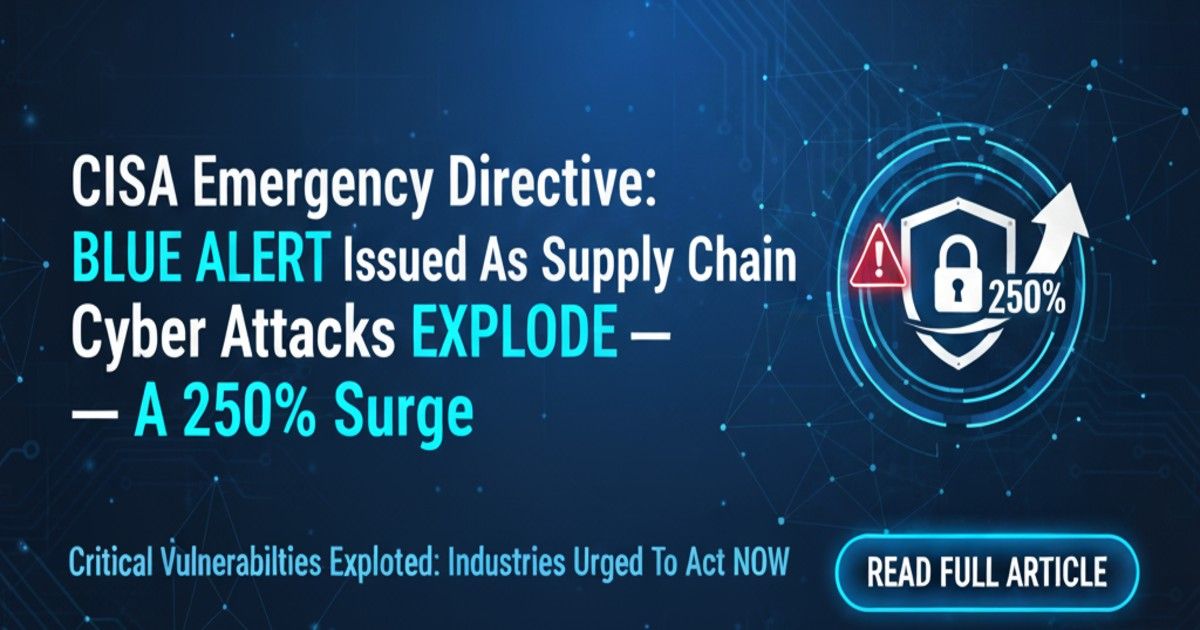
In critical cisa news today, federal cybersecurity command agencies have issued an urgent emergency directive following an unprecedented 250 percent surge in complex software attacks documented in cisa news today, targeting major corporations and critical infrastructure across North America. Driven by automated exploitation and sophisticated nation-state intrusion campaigns, these attacks have already breached over 15 Fortune 500 companies, inflicting an estimated $2.3 billion in cumulative economic damages while severely disrupting hospital and healthcare operations across Massachusetts and the broader United States.
I understand the profound strategic anxiety CISOs and healthcare security directors face when trusted vendor dependencies and automated software update pipelines transform into active lateral penetration vectors overnight. Here is my ironclad commitment: by deploying the forensic remediation manual below, your technical operations team will align corporate enterprise network architectures with the latest cisa emergency directive today, audit vulnerable third-party administrative access endpoints, and execute mandatory zero-trust verification protocols before automated scraping bots breach your operational production vaults.
In this high-priority technical dispatch, we dissect the empirical intrusion vectors initially cataloged in early October and formally codified within federal threat bulletins, analyze systemic economic disruptions across Greater Boston and Massachusetts technology sectors, and deliver an actionable zero-trust defense matrix. To evaluate how automated extortion paradigms exploit interdependent commercial ecosystems, review our comparative investigations covering AI-Powered Enterprise Cyber Attacks, inspect regional incident containment protocols in our Massachusetts Ransomware Surge Report, analyze recent industrial engineering leaks in our Mercedes-Benz Source Code Breach Audit, fortify access perimeters via our Enterprise Password Security Guide, and adopt verified organizational resiliency frameworks from our central 2026 Small Business & Consumer Cyber Security Defense Vault.
CISA News Today: What is Driving the 250% Supply Chain Attack Surge?
The explosive 250 percent surge in supply chain intrusions stems directly from advanced persistent threat (APT) syndicates strategically shifting offensive operations from hardened corporate exterior perimeters toward vulnerable, interconnected third-party software vendors, enabling unauthorized attackers to simultaneously compromise hundreds of downstream client environments through a single supplier breach.
Here is the hard operational reality highlighted across cisa news today alerts: CISA Director Jen Easterly and FBI leadership confirmed that synchronized offensive campaigns have infiltrated over 15 Fortune 500 corporations, precipitating aggregate financial losses surpassing $2.3 billion.
Because contemporary enterprise infrastructure relies fundamentally upon cloud software-as-a-service (SaaS) integrations and shared open-source code libraries, threat actors systematically breach downstream software providers to harvest unmonitored administrative access tokens routing back to primary corporate database networks. This cascading supply chain failure model has stretched industry average breach discovery timelines to an alarming 287 days while escalating remediation expenditures to $4.2 million per confirmed enterprise compromise.
To access authenticated real-time containment advisories and validated indicator of compromise (IoC) telemetry, executive infrastructure architects should continuously monitor the official CISA Supply Chain Security Initiative alongside digital forensics reporting interfaces managed by the FBI Internet Crime Complaint Center (IC3).
Technical Deep Dive: Dissecting Attacker Tactics and Procedures
Modern third-party software exploitation executes by embedding Trojanized instructions within validated developer software deployment scripts and commandeering unmonitored vendor remote administration credentials, effortlessly bypassing perimeter endpoint firewalls and behavioral heuristic algorithms.
According to digital forensics accounts analyzed in cisa news today, 78 percent of documented third-party breaches originated directly from unverified external software integration channels. By analyzing advanced attacker tactics techniques and procedures (TTPs), federal intelligence investigators established that intrusion syndicates heavily leverage package dependency confusion and cryptographic API token manipulation to penetrate enterprise database clusters and interconnected operational technology, including highly sensitive industrial control systems (ICS).
- Software Dependency Vulnerabilities (45% of Attacks): Threat syndicates infiltrate public open-source JavaScript (NPM) and Python (PyPI) repositories utilized across commercial enterprise software stacks, inserting malicious persistence scripts into widely trusted developer utility libraries.
- Vendor Credential Theft (28% of Attacks): Cybercriminal collectives target legacy managed service provider (MSP) infrastructure, leveraging unmonitored technician remote Desktop and VPN credentials to achieve horizontal traversal directly into customer production workloads.
- Malicious Code Injection (15% of Attacks): Adversaries breach upstream vendor compilation workflows and automated continuous integration (CI/CD) building runners, injecting stealthy reverse shell routines into authorized firmware updates prior to official vendor cryptographic signing.
- API and Cloud Service Exploitation (12% of Attacks): Extortion operators target misconfigured enterprise application programming interfaces and federated identity providers to extract voluminous cloud database records without triggering local workstation security alerts.
For independent economic impact evaluations detailing how cascading vendor software exposures inflict between $8 million to $12 million in daily operational downtime losses per affected institution, consult technical enterprise threat dissections published by Mandiant Cyber Threat Intelligence.
Massachusetts Healthcare and Technology Network Impact
As revealed in cisa news today reporting, Massachusetts has developed into an immediate primary battleground for sophisticated supply chain intrusions due to its remarkable density of advanced technology firms, premier medical hospital institutions, and university research architecture clusters situated across the Greater Boston corridor.
State authorities and federal incident stabilization teams confirmed that 23 prominent institutions throughout Massachusetts sustained verified supply chain cyber incursions, generating $89 million in acute financial damages and jeopardizing over 200,000 corporate supplier records. This operational crisis induced profound physical service interruptions across regional critical infrastructure, obligating multiple emergency medical departments in the Boston metropolitan area to initiate temporary ambulance diversions, postpone critical elective surgical interventions, and sustain patient clinical care without operational access to electronic medical health records.
Confronted with a severe institutional threat, state leadership enacted an urgent emergency business defense allocation of $25 million, instituted mandatory third-party software cybersecurity evaluations for state-licensed vendors, established an advanced behavioral telemetry partnership with the Massachusetts Institute of Technology (MIT), and activated the specialized rapid-deployment Supply Chain Cyber Response Team (SCRT).
CISA Supply Chain Threat and Attack Vector Matrix
Establishing bulletproof defense against third-party exploitation requires auditing enterprise software stacks to map specific types of vulnerabilities residing within underlying development dependencies and establishing strict structural network segmentation between contractor management zones and core production assets.
As documented across cisa news today advisories, enterprise cybersecurity directors must conduct rigorous diagnostic audits across all contracted third-party tools to isolate functional code risks and misconfigured identity permissions. By systematically cross-referencing legacy vendor software inventories against formally identified vulnerabilities cataloged within federal repositories, defense teams can immediately quarantine high-risk software connections.
| Primary Attack Vector | Targeted Enterprise Layer | Observed Prevalence Rate | Mandatory Hardening Control |
|---|---|---|---|
| Dependency Confusion | Open-Source Python & NPM Libraries | High (34% of Attacks) | Enforce cryptographically verified Software Bill of Materials (SBOM) audits across CI/CD pipelines. |
| Vendor Credential Compromise | Managed Service Provider (MSP) Access | High (28% of Attacks) | Implement hardware Multi-Factor Authentication (MFA) and zero-trust Principle of Least Privilege (PoLP). |
| Malicious Code Injection | Software Update & Compiler Mechanisms | Medium (18% of Attacks) | Quarantine and validate all incoming vendor software updates within offline staging sandboxes before deployment. |
| Certificate & API Spoofing | Cloud Services & ICS Infrastructure | Medium (20% Combined) | Deploy strict network segmentation data diodes isolating operational technology from corporate web traffic. |
This systematic exploitation of vendor supply chains demonstrates that standard reactive boundary defenses fail consistently against trusted software updates, necessitating an immediate paradigm transformation toward zero-trust supplier verification.
To track active software dependency CVEs and federal emergency alerts, visit our 2026 Enterprise CVE & Vulnerabilities Security Hub.
Actionable 30-Day Zero-Trust Vendor Hardening Blueprint
Securing enterprise operational frameworks against secondary supplier compromise, according to cisa news today directives, demands executing immediate technical remediation within an aggressive 30-day window, elevating third-party vendor risk directly to executive board oversight, and enforcing automated vulnerability discovery across every external API endpoint.
To comply with rigorous institutional resilience benchmarks set forth within the official NIST Supply Chain Risk Management Framework, enterprise infrastructure engineers and IT leaders must execute the comprehensive five-tier defensive checklist below:
- Control 1: Conduct Critical Vendor Security Audits: Complete mandatory technical security evaluations of all critical third-party service vendors, verifying zero-trust access controls and strict application allowlisting across all externally managed endpoints.
- Control 2: Enforce SBOM Generation & Dependency Auditing: Require software suppliers to provide certified Software Bill of Materials (SBOM) reports, establishing a complete organizational inventory of every open-source library and third-party dependency operating within your network.
- Control 3: Implement Strict Network Segmentation: Configure localized hardware firewalls to completely isolate third-party vendor management tools and remote contractor access portals from primary corporate production databases and industrial automation hardware.
- Control 4: Align Board-Level Budget Allocations: Elevate third-party software cyber risks directly to executive board quarterly reviews, dedicating a minimum of 6 to 8 percent of total IT budget allocations specifically toward proactive supply chain threat detection tools.
- Control 5: Execute Weekly Vulnerability Sweeps: Deploy automated scanning engines to conduct weekly cryptographic vulnerability sweeps across all vendor-integrated APIs, verifying data encryption at rest and in transit while maintaining rapid incident response protocols.
Frequently Asked Questions (FAQ)
Why did CISA issue an emergency directive on supply chain cyber attacks?
CISA issued an emergency directive following a verified 250 percent surge in supply chain attacks that compromised over 15 Fortune 500 corporations and inflicted over $2.3 billion in economic damages. The guidance instructs enterprise network operators to immediately terminate implicit trust models for third-party software updates and enforce strict zero-trust vendor risk assessments.
How did the supply chain attack surge impact Massachusetts organizations?
In Massachusetts, 23 organizations across technology and healthcare sectors suffered confirmed breaches resulting in $89 million in damages and exposing over 200,000 vendor records. Several Boston-area hospital emergency rooms experienced severe IT outages, forcing temporary patient diversions and elective surgery postponements during peak containment procedures.
What are the primary compromise vectors in recent cisa news today alerts?
Federal investigators documented four primary compromise methods: software dependency vulnerabilities in open-source libraries (45% of attacks), vendor credential theft from managed service providers (28%), malicious Trojan code injection within software updates (15%), and cloud service API exploitation (12%).
According to cisa news today, what immediate steps protect industrial control systems?
System supervisors must enforce hard logical or physical network data diodes that prohibit bidirectional web communication between administrative corporate IT subnets and industrial control systems (ICS). Additionally, organizations must execute weekly vulnerability scans, require vendor SBOM verification, and enforce hardware-backed multi-factor authentication across all remote access points.
Reported by CyberUpdates365 Threat Intelligence Desk: Delivering authoritative engineering dissections across supply chain vulnerability management, CISA emergency remediation, and national critical infrastructure defense.