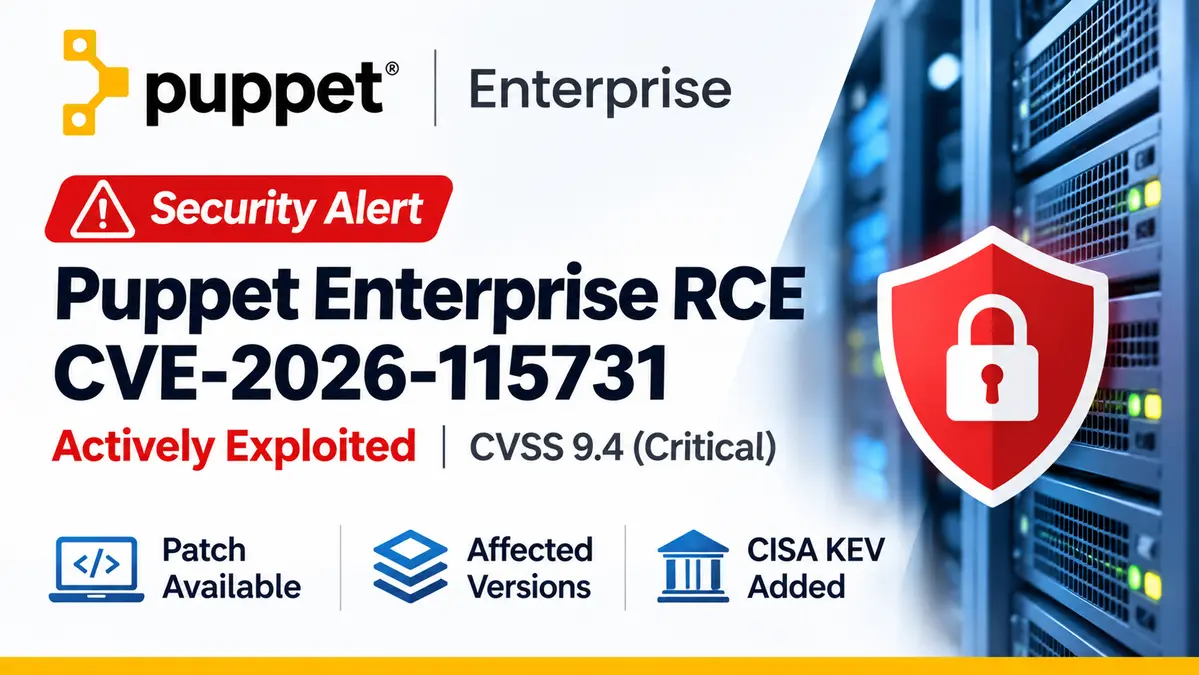
Hackers are actively exploiting a critical remote code execution vulnerability in Puppet Enterprise, putting the central infrastructure management servers used by businesses and IT teams at risk.
The vulnerability, tracked as CVE-2026-115731, allows an attacker holding a valid Puppet agent certificate to run arbitrary code on a vulnerable Puppet Server. In environments with weak automatic certificate-signing rules, an attacker may be able to obtain that certificate without prior authentication.
The U.S. Cybersecurity and Infrastructure Security Agency (CISA) added the flaw to its Known Exploited Vulnerabilities (KEV) catalog on November 17, 2026, following reports of real-world exploitation.
The flaw carries a Critical CVSS 4.0 score of 9.4. Perforce had already released security updates on November 3, meaning patched software was available before CISA issued its exploitation warning.
The concern extends beyond a single server. Puppet is designed to manage software, configuration and security policies across many machines. A compromised management server can therefore become a pathway toward other systems, depending on the deployment’s permissions and security controls.
For affected organizations, the priority is to patch Puppet Server, review certificate enrollment settings and investigate potential compromise—not merely check whether the management interface is exposed to the internet.
Key Facts: Puppet Enterprise CVE-2026-115731
- CVE: CVE-2026-115731.
- Severity: Critical, CVSS 4.0 score 9.4.
- CVSS 3.1 score: 9.9 in NVD and Red Hat assessments.
- Vulnerability type: Deserialization of untrusted data, CWE-502.
- Affected software: Vulnerable versions of Puppet Enterprise, Puppet Core and related OpenVox implementations.
- Attack surface: Puppet Server’s report-processing functionality.
- Required access: Normally a valid CA-signed Puppet agent certificate.
- Additional risk: Weak certificate autosigning may enable an unauthenticated attack chain.
- Code execution privileges: Puppet Server service account.
- Vendor patch date: November 3, 2026.
- CISA KEV addition: November 17, 2026.
- Federal remediation deadline: December 1, 2026, for applicable U.S. Federal Civilian Executive Branch agencies.
Why a Puppet Server Vulnerability Is Especially Dangerous
Imagine an enterprise with hundreds of Linux servers. Instead of configuring each machine manually, the IT team uses Puppet to define approved software packages, service settings and system configurations.
Managed devices, known as Puppet agents, communicate with a central Puppet Server to obtain and apply those configurations.
This automation saves enormous amounts of administrative work. But it also makes the Puppet management infrastructure highly sensitive.
Depending on its configuration, the central server may hold a certificate authority, distribute configuration catalogs and coordinate tasks affecting many managed endpoints.
If an attacker compromises that management server, the incident may no longer be limited to the first machine.
Researchers warn that access to Puppet’s certificate-signing material can allow an attacker to impersonate trusted infrastructure. Certain orchestration features or insufficiently protected configuration catalogs could create additional routes into managed systems.
These consequences depend on the environment. Compromising Puppet Server does not automatically mean an attacker has obtained root access to every managed host.
This management-plane risk resembles a broader security problem involving privileged enterprise tools. In a separate case, our BeyondTrust Remote Support zero-day investigation examined how compromise of a trusted remote-access platform created opportunities to reach downstream systems.
The two incidents involve different products, vulnerabilities and known attack circumstances. The common lesson is that infrastructure management tools require stronger protection than ordinary application servers.
How CVE-2026-115731 Works: Unsafe Report Deserialization
The vulnerability exists in the way Puppet Server processes reports submitted by managed agents.
After a Puppet agent applies its configuration, it can send a report describing what changed, which resources succeeded and whether any errors occurred.
These reports contain structured information that the server converts back into internal software objects.
That conversion process is called deserialization.
Security researchers at Neodyme discovered that specially crafted report data could cause Puppet’s deserialization logic to create and evaluate attacker-controlled Ruby code.
As a result, an attacker able to submit a malicious report through the vulnerable processing path could execute commands with the privileges of the Puppet Server service account.
The affected reporting interface is associated with the Puppet Server API, including the /puppet/v3/report endpoint.
The key security problem is not ordinary JSON reporting. It is the unsafe handling of certain serialized object types that can reach dynamic code-generation functionality.
Neodyme demonstrated this behavior in a controlled research environment and coordinated disclosure with affected software maintainers.
Does the Puppet RCE Require Authentication?
Normally, yes. This is one of the most important details for accurately understanding CVE-2026-115731.
The vulnerable reporting functionality generally requires a valid agent certificate signed by the Puppet certificate authority.
An attacker who already controls a trusted Puppet agent or possesses an appropriate certificate may therefore have a route to exploiting the server-side vulnerability.
However, some organizations use automatic certificate signing to simplify the enrollment of newly provisioned machines.
If autosigning accepts requests without strong verification, an unauthorized system might obtain a trusted certificate and then submit a malicious report.
Under those circumstances, the certificate-enrollment process may turn an otherwise authenticated vulnerability into a broader unauthenticated attack chain.
Consider a large company that automatically provisions temporary cloud servers. If certificate requests from unfamiliar systems are approved without sufficient checks, an attacker might attempt to enroll a machine that the Puppet infrastructure mistakenly treats as legitimate.
That is why security teams must review both the vulnerable software version and the certificate authority’s signing policy.
Restricting the reporting interface to trusted networks can reduce exposure, but network restrictions alone do not repair the underlying defect.
Which Puppet Enterprise Versions Are Vulnerable?
Perforce’s advisory identifies affected Puppet Enterprise release branches and the first corrected releases.
| Product branch | Affected releases | First fixed release |
|---|---|---|
| Puppet Enterprise 2023.8 | 2023.8.0 through versions before 2023.8.13 | 2023.8.13 |
| Puppet Enterprise 2025 | 2025.0.0 through versions before 2025.12.1 | 2025.12.1 |
| Puppet Enterprise 2026 | 2026.0.0 | 2026.0.1 |
Administrators running an affected Puppet Enterprise branch should upgrade to its applicable fixed release or a newer supported build incorporating the correction.
Do not assume a major-version number alone confirms security status. An installation identified only as Puppet Enterprise 2025 could be vulnerable or patched depending on its complete release number.
Puppet Core and OpenVox Fixed Versions
The underlying report-processing problem also affects other Puppet implementations and related components.
The fixed versions differ by product family.
| Product | First fixed versions |
|---|---|
| Puppet Core 8.x | 8.22.2 |
| Puppet Core 9.x | 9.1.3 |
| OpenVox Server 8.x | 8.18.0 |
| OpenVox Server 9.x | 9.2.0 |
| OpenVox Agent 8.x | 8.32.0 |
| OpenVox Agent 9.x | 9.3.0 |
OpenVox published coordinated security updates on November 3 and advised customers to update affected server and agent packages.
Organizations using Red Hat Satellite, distribution-maintained Puppet packages or vendor-bundled installations should follow the applicable vendor’s security bulletin and package updates.
Updating a Puppet agent on an ordinary managed node does not necessarily patch the vulnerable Puppet Server service. The server-side component must be remediated.
If an organization operates multiple primary servers, compilers or other server-side Puppet components, each relevant deployment should be included in the patch inventory.
CISA Confirms Active Exploitation of CVE-2026-115731
CISA added CVE-2026-115731 to its Known Exploited Vulnerabilities catalog on November 17, 2026.
The KEV listing is significant because it reflects evidence of exploitation in real-world environments, rather than simply a theoretical vulnerability or laboratory proof of concept.
However, the publicly available CISA alert does not identify the attackers responsible, the number of compromised organizations or a complete exploitation timeline.
It also does not confirm that the vulnerability has been used in a specific ransomware campaign.
Federal Civilian Executive Branch agencies covered by the applicable CISA requirements have a remediation deadline of December 1, 2026.
That federal deadline is not automatically a legally binding deadline for every private business. Nevertheless, private organizations should treat documented exploitation of a Critical infrastructure-management flaw as a strong reason to accelerate remediation.
For broader risk-based patch prioritization and KEV monitoring, see our CVE Vulnerabilities and Enterprise Security Hub.
What Could Attackers Do After Exploiting Puppet Server?
Neodyme’s research and Red Hat’s assessment identify several serious potential consequences.
Execute Commands as the Puppet Service User
The immediate vulnerability allows code execution with the permissions of the account running the affected Puppet Server functionality.
This is not necessarily the operating system’s root account.
However, the service may still have access to sensitive files, credentials and administrative functions needed for Puppet operations.
Access the Certificate Authority’s Signing Material
Researchers demonstrated that a compromised Puppet Server can expose certificate-signing material in affected configurations.
An attacker with access to the signing key could potentially create trusted identities and impersonate managed machines or other Puppet components.
This can undermine the trust relationship between the central server and the devices it manages.
Manipulate Managed Infrastructure
Some Puppet environments permit management operations that affect the configuration or execution state of downstream systems.
Depending on file permissions, orchestration configuration and other security controls, an attacker controlling the management server might attempt to modify configuration catalogs or abuse supported remote-execution capabilities.
Those scenarios can create opportunities for lateral movement, unauthorized software deployment or disruption of business services.
They are potential consequences supported by the research, not evidence that every organization affected by CVE-2026-115731 has experienced those outcomes.
A Second Puppet Vulnerability: CVE-2026-115732
The same coordinated November disclosure also addressed another Critical vulnerability, CVE-2026-115732.
This separate flaw involves certificate-name authorization checks in components used by Puppet and OpenVox.
Under affected configurations, an attacker could use a certificate name extending another approved name to bypass intended authorization checks and impersonate a managed identity.
The issue carries a reported CVSS score of 9.0 and was discovered by the same Neodyme researcher, Alain Rödel.
Security teams should review both advisories when updating their Puppet environment.
However, CISA’s November 17 exploitation notice discussed in this article concerns CVE-2026-115731. It should not be interpreted as confirmation that CVE-2026-115732 is also being exploited in the wild.
How to Check Whether Your Puppet Environment Is Exposed
Enterprise administrators should approach this investigation in two stages: determine whether the software is vulnerable, then determine whether there are indications of unauthorized access.
1. Inventory Puppet Servers and Versions
Identify Puppet Enterprise primary servers, compilers, Puppet Core installations and relevant OpenVox servers.
Check the exact installed product releases through the management console, supported package inventory tools or vendor documentation.
Where applicable, puppet --version can help identify the installed Puppet executable version, but it does not by itself prove that the server-side component or complete Puppet Enterprise release is patched.
2. Review Certificate Signing Policies
Examine how new agents receive certificates from the Puppet certificate authority.
Determine whether automatic signing is enabled and whether enrollment requests are restricted to verified systems.
Investigate any mechanism that approves certificate requests without reliable identity validation.
3. Review Network Access to Puppet Server
Identify which networks can communicate with the Puppet Server API.
Remove unnecessary internet exposure and restrict management traffic to the systems and network segments that require it.
Do not treat this restriction as a substitute for installing the available security fix.
4. Review Historical Certificate Activity
Look for newly issued agent certificates that do not correspond to approved servers or expected provisioning events.
Compare certificate enrollment activity with asset inventory and infrastructure automation logs.
Unexpected certificates may be especially concerning in deployments that previously used permissive autosigning rules.
Detection and Incident Response: What Security Teams Should Investigate
Because exploitation has been reported in the wild, vulnerable organizations should assess more than patch status.
Security operations teams can prioritize the following investigation areas:
- Unexpected agent enrollment: New or unfamiliar Puppet certificates issued without approved provisioning activity.
- Suspicious report activity: Unusual report submissions or reporting requests inconsistent with normal agent behavior.
- Unexpected service processes: Shell commands, scripting interpreters or other child processes launched by Puppet Server service accounts without a legitimate operational reason.
- Certificate authority access: Unusual reads, copies or transfers of private signing-key material.
- Configuration changes: Unauthorized updates to Puppet catalogs, environments, modules or sensitive server configuration.
- Downstream anomalies: Unexpected configuration changes or administrative actions on managed hosts following suspicious Puppet Server activity.
- Network evidence: Unusual connections to the management server from unrecognized hosts or network segments.
These are defensive hunting priorities, not a list of confirmed malicious IP addresses or file hashes associated with a publicly documented attack campaign.
Organizations should retain relevant server, certificate authority, proxy and endpoint logs for investigation.
If evidence suggests compromise, preserve forensic data and investigate possible credential exposure and persistence before returning the environment to normal operation.
Where certificate-signing material may have been stolen, security teams may need a controlled certificate authority recovery or rotation procedure. Such operations should follow vendor guidance because improperly replacing the CA can disrupt communications across the managed fleet.
How to Patch CVE-2026-115731 Safely
The most reliable remediation is to deploy the supported vendor update that fixes unsafe report deserialization.
Step 1: Confirm the Appropriate Fixed Release
Match the installed Puppet Enterprise, Puppet Core or OpenVox release to the corresponding vendor advisory.
For example, Puppet Enterprise 2025 installations affected by this issue should move to version 2025.12.1 or a newer supported corrected release.
Step 2: Prepare for the Upgrade
Review the vendor’s upgrade notes, backup requirements, environment compatibility and any implications for dependent Puppet infrastructure.
Use a tested maintenance and rollback plan appropriate for the importance of the management service.
Step 3: Upgrade the Server Components
Apply the supported update through the vendor-recommended installation or package-management process.
Ensure the corrected server code is loaded by following the documented service restart or redeployment requirements.
Step 4: Validate Fleet Operations
Verify the installed server release, certificate enrollment behavior, agent connectivity and expected configuration runs.
Review any custom authorization rules after updating, particularly in OpenVox environments where the security changes may alter how matching rules are handled.
Step 5: Investigate Possible Prior Exploitation
A successful patch prevents exploitation of the corrected vulnerability path, but it does not automatically remove malware, invalidate stolen credentials or reverse malicious changes made before remediation.
If the environment was exposed while vulnerable, investigate suspicious activity and determine whether additional recovery measures are required.
What If Puppet Cannot Be Patched Immediately?
Temporary measures can reduce risk while a supported upgrade is prepared.
- Restrict Puppet Server network access to verified management and agent networks.
- Disable permissive certificate autosigning or replace it with strongly verified enrollment controls.
- Review which clients can reach the report-processing service.
- Increase monitoring for unusual agent certificates and unexpected Puppet service behavior.
- Limit unnecessary privileges and access to sensitive certificate authority files.
- Document the affected systems, responsible owners and remediation timeline.
Red Hat and OpenVox both emphasize hardening certificate issuance and reducing unnecessary access to the vulnerable service.
These measures do not eliminate the underlying deserialization vulnerability. They should be treated as interim controls, not a permanent replacement for patching.
Was Artificial Intelligence Used to Discover the Puppet Flaws?
Neodyme says AI-assisted analysis contributed to discovering the Puppet vulnerabilities.
The researchers used AI tools while examining the codebase, but emphasized that careful human direction and explicit investigative steps were essential to identifying the issues.
That distinction matters. The discovery shows how AI can support vulnerability research, but it does not establish that an autonomous AI attacker discovered or exploited CVE-2026-115731 in the wild.
Attribution, exploitation campaigns and the identity of active attackers remain separate questions requiring independent evidence.
Confirmed Facts and What Remains Unknown
Confirmed
- CVE-2026-115731 is a Critical deserialization vulnerability affecting Puppet Server report processing.
- A client with a suitable CA-signed agent certificate can trigger code execution with Puppet service-account privileges.
- Weak certificate autosigning can expand exposure by allowing unauthorized certificate enrollment.
- Perforce and OpenVox coordinated security fixes released on November 3, 2026.
- CISA added CVE-2026-115731 to its KEV catalog on November 17, citing exploitation in the wild.
- Applicable U.S. federal civilian agencies face a December 1, 2026 remediation deadline.
- Compromise of Puppet Server can threaten certificate authority material and, depending on configuration, additional managed systems.
Not Established by Available Public Reporting
- The identity or affiliation of the attackers actively exploiting the flaw.
- The number of organizations compromised through CVE-2026-115731.
- A confirmed ransomware campaign specifically using this vulnerability.
- That every vulnerable Puppet Server is exploitable without a certificate.
- That successful exploitation automatically provides root access to every managed endpoint.
- That all reported Puppet or OpenVox vulnerabilities are included in CISA’s November 17 KEV addition.
CyberUpdates365 Analysis: Why the Management Plane Needs Priority
The most important aspect of CVE-2026-115731 is not simply its high severity score.
It is where the vulnerability exists.
Puppet Server occupies a privileged position in enterprise operations. It helps define how many other systems should be configured and maintained.
That makes compromise of the management plane potentially more damaging than compromise of a single ordinary endpoint.
The risk also depends on a security decision that may have been made years earlier: how easily a new Puppet agent can obtain a trusted certificate.
A company may believe its Puppet environment is protected because agents use certificate authentication. But if certificate enrollment automatically trusts unfamiliar requests, that protection can be substantially weakened.
For US enterprises, government agencies, managed infrastructure providers and DevOps teams, the correct response combines three actions: apply the fixed server release, audit certificate trust and investigate possible misuse while the environment was vulnerable.
The broader lesson extends to other automation tools. Infrastructure platforms should be treated as sensitive control systems with tightly managed identities, restricted network access and sufficient logging to support incident response.
Frequently Asked Questions
What is CVE-2026-115731?
CVE-2026-115731 is a Critical deserialization vulnerability in Puppet Server report processing. An attacker with an appropriate signed agent certificate can use it to execute code with Puppet service-account privileges.
Is Puppet Enterprise CVE-2026-115731 actively exploited?
Yes. CISA added the vulnerability to its Known Exploited Vulnerabilities catalog on November 17, 2026, following reports of exploitation in the wild.
What is the CVSS score?
Perforce reports a Critical CVSS 4.0 score of 9.4. Red Hat and NVD also report a CVSS 3.1 score of 9.9. The scores use different CVSS versions and should not be confused.
Which Puppet Enterprise versions fix the vulnerability?
The first fixed releases are Puppet Enterprise 2023.8.13, 2025.12.1 and 2026.0.1 for their respective supported branches.
Can an unauthenticated attacker exploit Puppet Server?
The normal attack path requires a valid CA-signed agent certificate. However, weak or permissive certificate autosigning may allow an unauthorized attacker to obtain a certificate and exploit the vulnerability.
What is the CISA remediation deadline?
December 1, 2026, is the applicable remediation deadline for covered U.S. Federal Civilian Executive Branch agencies. Private organizations should prioritize updates according to their exposure and the confirmed exploitation risk.
Does patching guarantee that a Puppet Server is clean?
No. Applying the update fixes the vulnerability but does not automatically reverse an earlier compromise. Organizations should investigate suspicious certificate activity, unexpected processes and possible changes to managed configurations.
Does this flaw affect OpenVox?
Yes. Related OpenVox implementations are affected. OpenVox released fixes for supported server and agent branches as part of the coordinated November 3 disclosure.
Final Takeaway
The active exploitation of CVE-2026-115731 makes vulnerable Puppet Server deployments a high-priority enterprise security concern.
Perforce and OpenVox released fixes on November 3, 2026, but CISA’s November 17 KEV addition confirms that attackers have exploited the vulnerability in real-world environments.
Organizations should verify their Puppet Enterprise or Puppet Core release, deploy the appropriate update and review certificate-signing policies that may increase exposure.
Because Puppet occupies a trusted position in enterprise infrastructure, security teams should also investigate whether unauthorized certificates, unexpected code execution or downstream configuration changes occurred before remediation.
Patch the vulnerable management server, verify its trust relationships and investigate potential compromise. Updating the version alone may not be enough after an intrusion.
Official Sources and Further Reading
- Perforce — CVE-2026-115731 Report Deserialization Code Execution Advisory
- CISA — Known Exploited Vulnerabilities Catalog
- Neodyme — Technical Research on Puppet Server RCE
- Red Hat — CVE-2026-115731 Security Assessment and Mitigations
- OpenVox — November 3 Critical Security Updates
- OpenVox — Report Deserialization Security Advisory