

Your organization’s webmail server is no longer just a communication tool; to advanced threat actors, it is the ultimate edge device. And right now, it is actively under attack.
A new, highly sophisticated China-aligned threat cluster tracked as UNK_MassTraction is actively exploiting critical vulnerabilities in Roundcube webmail software. The campaign specifically targets U.S. and Canadian universities, heavily focusing on administrators and professors in astrophysics, particle physics, and national security departments.
By chaining together known flaws like CVE-2024-42009 (CVSS 9.3) and CVE-2025-49113 (CVSS 9.9), attackers are dropping persistent web shells, stealing 2FA tokens, and deploying advanced remote administration tools like VShell. Here is how they are doing it, and exactly how you can stop them.
The Hidden Reality: The Zero-Click XSS to RCE Pipeline
Most organizations assume breaching an email server requires stolen credentials or a misconfigured firewall. This campaign proves otherwise. The initial vector relies on a Cross-Site Scripting (XSS) exploit (CVE-2024-42009). The terrifying part? It only requires the victim to open a maliciously crafted email in the Roundcube client.
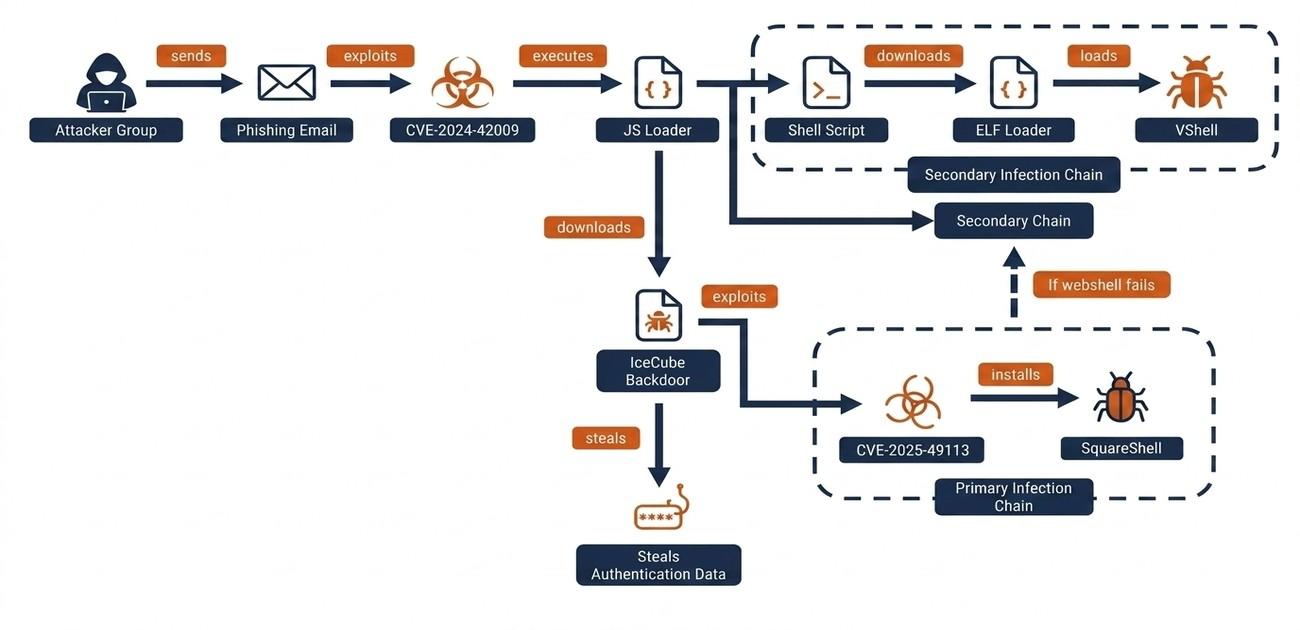
Once opened, the exploit deploys a JavaScript payload dubbed IceCube. IceCube immediately begins siphoning session cookies, 2FA tokens, and stored credentials. But it doesn’t stop there. It then leverages the stolen session CSRF token to weaponize a second vulnerability (CVE-2025-49113) to achieve Remote Code Execution (RCE) on the underlying mail server.
Similar to tactics we have tracked in other China-nexus APT campaigns, the ultimate goal is to drop a web shell named SquareShell or an ELF loader called SNOWLIGHT directly into server memory.
The Edge Case: “Deferred Triggers” Evading Forensics
The UNK_MassTraction group is demonstrating extreme operational security to avoid detection. They have built “deferred triggers” directly into the IceCube malware.
The malware actively monitors the victim’s browser window. If the user closes the page, changes tabs, moves their mouse out of the window, or clicks the logout button, the malware hooks those events. It instantly beacons back to its Command & Control (C2) server and subsequently destroys the user’s session on the server.
This forced logout acts as a self-destruct mechanism, erasing forensic evidence associated with the compromise from the Roundcube server logs before incident responders even know a breach occurred.
The Complete Fix Guide: How to Secure Roundcube
Patching a critical edge device like Roundcube is non-negotiable. Much like the recent BeyondTrust vulnerability, leaving these systems unpatched guarantees a breach. Follow these exact technical steps to secure your environment immediately:
Step 1: Verify Your Current Roundcube Version
Log into your mail server via SSH and check your current version. Vulnerable versions must be upgraded immediately.
cat /path/to/roundcube/index.php | grep 'RCMAIL_VERSION'Step 2: Apply the Security Patches (Upgrade)
You must upgrade Roundcube to a version that patches both the XSS and RCE flaws. Use the official Roundcube upgrade script (assuming a standard Linux environment):
wget https://github.com/roundcube/roundcubemail/releases/download/1.6.X/roundcubemail-1.6.X-complete.tar.gz
tar xvf roundcubemail-1.6.X-complete.tar.gz
cd roundcubemail-1.6.X
bin/installto.sh /var/www/html/roundcube
(Note: Replace ‘1.6.X’ with the latest secure release and adjust your installation path accordingly).
Step 3: Hunt for SquareShell Indicators of Compromise (IoCs)
Because patching does not remove existing backdoors, you must scan your web directories for the SquareShell web shell. Run this command to look for unauthorized modifications in the Roundcube plugins directory:
find /var/www/html/roundcube/plugins/newmail_notifier/ -name "mail_preview.php" -mtime -30If you find plugins/newmail_notifier/mail_preview.php, your server is actively compromised. Isolate the server and begin incident response.
Step 4: Enforce Strict DMARC Policies
The attackers relied on spoofing domains with lax DMARC policies to deliver the initial payload. Ensure your organization’s DMARC record is set to p=reject or p=quarantine to drop these spoofed emails at the gateway.
What Happens Next
The exploitation of Roundcube by a suspected Chinese APT marks a significant shift. Traditionally, Russian state-sponsored actors have dominated the exploitation of open-source webmail flaws. The entry of UNK_MassTraction signals that Chinese operators are now treating mail servers as highly valuable edge devices, equal in importance to VPN concentrators and firewalls.
Organizations must realize that email clients are no longer just software; they are execution environments. If a simple email preview can result in full server compromise, your defense-in-depth strategy must adapt.
Related guide: For broader context and related coverage, see our nation-state and APT threat guide.
Frequently Asked Questions
What is CVE-2024-42009?
It is a critical Cross-Site Scripting (XSS) vulnerability in Roundcube webmail (CVSS 9.3). It allows attackers to execute arbitrary JavaScript in the victim’s browser simply by the victim opening a malicious email.
How does the attack achieve Remote Code Execution?
After the XSS payload (IceCube) runs, it steals the user’s session tokens. It then uses those tokens to exploit a secondary post-authentication flaw, CVE-2025-49113, allowing the attacker to execute code on the server itself.
What is the purpose of the VShell tool?
Written in Go, VShell is a remote administration tool (RAT) with capabilities similar to Cobalt Strike. It provides the attackers with persistent, post-compromise control over the breached server.
For a complete tracker of all critical 2026 vulnerabilities, see our Enterprise CVE Security Hub.
🚨 ENTERPRISE APT DEFENSE DIRECTIVE:
To combat sophisticated nation-state actors and geopolitical cyber espionage across your enterprise infrastructure, continuous monitoring is critical. Explore verified defensive blueprints, real-time IOCs, and zero-trust mitigation architectures within our canonical intelligence repository: The 2026 Nation-State APT & Cyber Security Threat Monitoring Vault.
Reported by CyberUpdates365 Desk
Delivering the latest insights on enterprise security, federal AI directives, and the future of IT infrastructure. Follow us for daily updates on how technology is reshaping the corporate landscape.