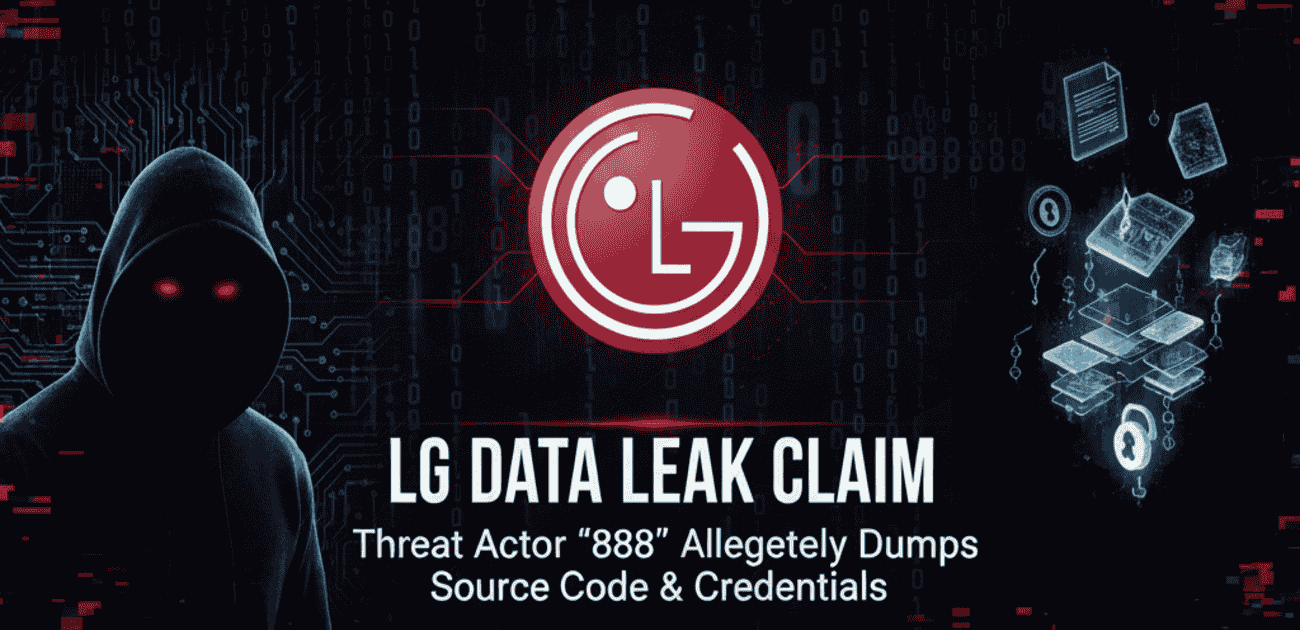
Verification notice — October 16, 2026: This article previously described a November 2025 allegation attributed to an actor using the name “888.” We have not independently verified the original incident report or alleged samples. It should not be treated as confirmation that LG Electronics suffered the described breach.
What remains unverified
The allegation concerned source code and credentials purportedly associated with LG Electronics. We have not established the authenticity, ownership, volume or age of the alleged data; whether any credentials remained active; or whether any LG product or customer was affected.
The earlier descriptions of a contractor entry point, specific device source code, gigabytes of material and risks affecting millions of users were not supported by evidence established in this review and have been removed. No causal connection to a separate LG Uplus incident has been established here.
Reporting source and company confirmation
ThreatMon is a monitoring and intelligence service. Its role must not be confused with a forum on which an attacker published data. This review did not establish the original posting location. A monitoring alert or threat actor assertion alone does not authenticate a dataset.
The LG Electronics website is a route to company information, not evidence supporting this allegation. We have not established a specific company statement that confirms the claims described here. That finding is not proof that no statement exists.
How to assess a leak allegation
Useful verification would identify the original dated report, its author, what evidence was examined and whether the organization acknowledged an incident. Distinguish an actor’s assertion from independent analysis and company confirmation. Do not infer the number of affected people from a company’s total customer base.
Source code exposure does not by itself establish exploitable device vulnerabilities. Credentials may be inactive, test-only or unrelated to production. Conversely, an active credential can require urgent action even when the rest of a dataset is unverified. Determining scope requires authorized investigation.
Proportionate steps for organizations
If your own systems show evidence of secret exposure, involve the responsible security team. Identify affected accounts and tokens, revoke or rotate them as appropriate, review use logs and investigate unauthorized access. Preserve relevant evidence. Do not download or test alleged stolen credentials against third-party services.
Maintain least-privilege vendor access and an inventory of secrets. Move hardcoded credentials into an appropriate secrets-management process. These are general defensive practices, not evidence that a particular contractor caused this allegation.
Advice for LG customers
Follow official product support and security notices, keep supported devices updated, use unique passwords and enable available multi-factor authentication. Be cautious of messages asking for credentials or payment in response to a supposed breach. This article has not established that all LG device users need emergency action.
Have I Been Pwned can help identify exposure in its indexed datasets. An absent result does not prove an account is safe, and the service is not a comprehensive audit of corporate API keys or source code.
Related coverage
These articles offer related context and are not independent confirmation of this allegation.
- supply chain cyber attacks surge 250 percent cisa emergency directive
- breaking att data breach affects 73 million customers fbi issues alert
- ai phishing attacks surge 300 percent us cisa emergency alert
- data breach 2026 major breaches timeline
For questions about this report, contact cyberupdates365connect@gmail.com.