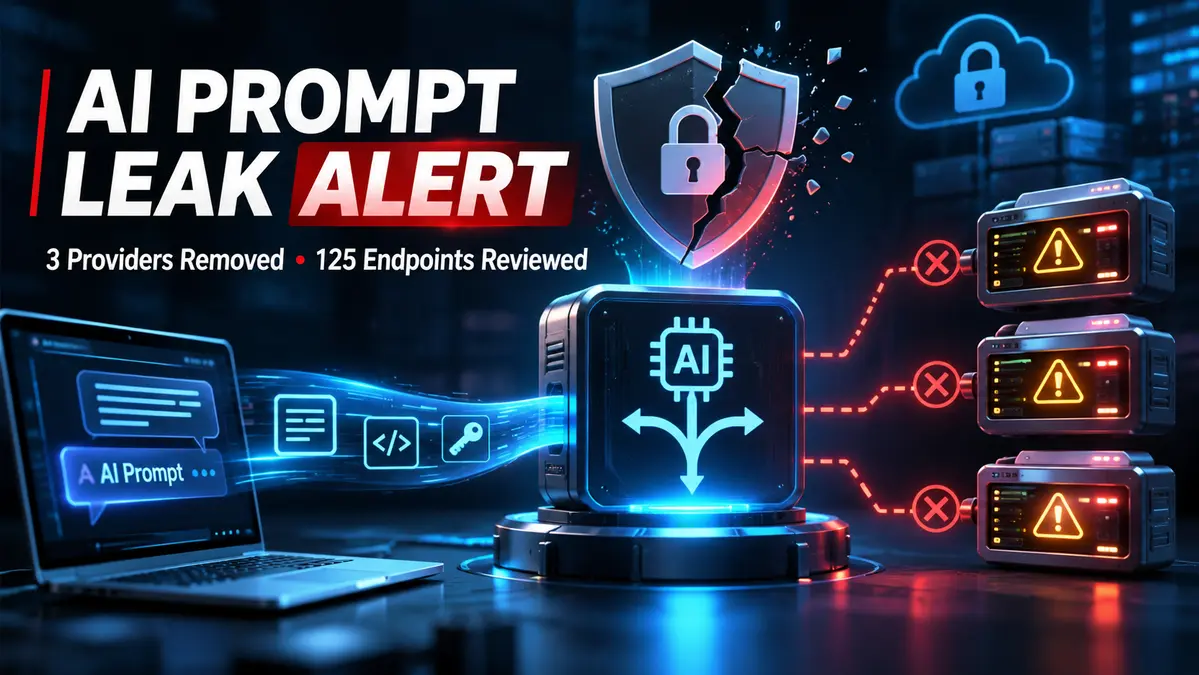
OpenRouter removed three AI inference providers and withdrew Zero Data Retention (ZDR) eligibility from 125 endpoints after security researchers uncovered stolen prompts, compromised provider systems and failures to follow advertised data-handling policies.
In a November 22, 2026, statement, the AI model routing platform said it had notified potentially affected customers and was reviewing whether requests had been forwarded to unexpected third parties. OpenRouter said the findings did not show a breach of its own infrastructure.
The action followed a five-month investigation by industrial cybersecurity company Dragos. Researchers sent approximately two million prompts containing unique tracking links and artificial credentials to AI services between July and November, then monitored whether those secrets appeared outside their intended destinations.
The results showed that some providers’ systems were compromised, while other services exposed prompts through logging or undisclosed routing arrangements.
Importantly, the 125 endpoints were not all confirmed breached. OpenRouter removed ZDR eligibility from additional endpoints as a precaution. The company has not publicly identified the three offboarded providers.
What OpenRouter Confirmed on November 22
OpenRouter provides a common API interface for accessing AI models hosted by different inference providers.
When a customer submits a request, the platform may select a provider based on available models, routing preferences and other configured requirements. This makes the underlying provider’s handling of prompt data important for security and privacy.
Following Dragos’s findings, OpenRouter announced three completed actions:
- Provider removal: It offboarded three inference providers following its investigations.
- ZDR eligibility changes: It removed 125 endpoints from eligibility for Zero Data Retention routing, including precautionary removals.
- Customer notifications: It notified customers potentially affected by the findings.
The company also announced ongoing work to validate the paths taken by customer requests, adapt the researchers’ monitoring techniques and require assurances before restoring any removed endpoint’s ZDR eligibility.
The full statement is available in OpenRouter’s official data-processing incident announcement.
The three providers removed from OpenRouter should not automatically be identified with the three compromised companies reported by Dragos. Neither organization publicly established that they were the same three providers.
How Dragos Detected Stolen AI Prompts With Canary Credentials
Dragos published its original investigation on November 19, 2026, describing how researchers tracked sensitive data through the AI inference supply chain.
The researchers created unique prompts containing artificial AWS credentials, web links and other test values. Because those values were generated specifically for the experiment, unexpected attempts to use them could indicate that someone had accessed the associated prompt.
The method helped Dragos distinguish several types of exposure.
1. Attackers Compromised Inference Providers
Dragos reported evidence that attackers stole request data from three AI hosting providers. The earliest identified compromise dated to mid-July 2026.
In the largest observed incident, a few hundred planted AWS keys were sent in individual requests during short testing windows in late October.
Every planted key in those particular test windows was subsequently accessed by the attacker. Some keys came from requests that the provider had rejected before the model executed.
Dragos interpreted that pattern as evidence that attackers were collecting data near the provider’s request-entry point, rather than only from completed model responses.
Attackers tested the artificial credentials, enumerated S3 buckets, searched AWS Secrets Manager and Systems Manager Parameter Store, and attempted to create additional cloud access.
The researchers observed tens of thousands of AWS API calls involving their canary credentials.
These measurements describe Dragos-controlled test credentials. They do not establish that the same number of genuine customer AWS accounts was accessed or that every request through the affected providers was stolen.
2. Some Marketplace Sellers Logged Prompts
Other findings did not involve a conventional intrusion.
According to Dragos, certain sellers on an AI inference marketplace could enable request logging and inspect prompts routed through their offerings.
Researchers observed individuals attempting to use usernames, passwords and AWS keys embedded in the planted requests.
One observation involved a seller-associated connection that tried to log in to a test server using a password contained in a prompt.
This matters because an AI request can expose sensitive data even when the router and hosting infrastructure are functioning as designed, if the selected provider is allowed to retain or inspect the content.
3. Requests Were Forwarded Beyond the Expected Provider
Dragos also observed cases where prompts sent through one provider appeared to reach additional organizations.
The researchers reported that systems associated with an unnamed Chinese AI laboratory accessed unique links embedded in prompts sent to its models, including requests passed through U.S.-based resellers.
Some requests had been marked for no data collection or Zero Data Retention.
In one case, a planted URL was later shared through a workplace chat system, weeks after the original request.
The investigation demonstrated that routing policies and advertised retention settings did not always reflect where prompt information ultimately traveled.
For the detailed experimental methods and evidence, see Dragos’s original AI supply-chain security investigation.
What Did the Affected Providers Disclose?
OpenRouter linked several public security and privacy notices from providers in its November 22 announcement.
These notices describe different events. They should not be combined into one intrusion timeline or treated as an official list of the three providers OpenRouter removed.
| Provider | What it disclosed | Relevant period or status |
|---|---|---|
| Phala | An attacker compromised inference infrastructure and could access request data during processing. | Precautionary exposure window: October 21 to November 8, 2026; incident contained November 8. |
| Together AI | An exposed repository credential allowed an unauthorized party to download stored samples of customer prompts. | Affected prompt samples were collected in June and July 2026; investigation and notifications were ongoing in November. |
| Novita | A routing configuration issue forwarded some MiniMax requests to MiniMax’s official API. | Potentially affected requests: May 28 to November 11, 2026. |
| Atlas Cloud | Prompts routed to MiniMax’s official API showed evidence of third-party access to embedded test links. | Related requests occurred during the third and early fourth quarters of 2026; Atlas stopped using the affected upstream route. |
These entries are based on the providers’ own published accounts. Their investigations, evidence and remediation statuses differ.
Phala: DeepSeek Requests May Have Been Exposed
Phala’s November 10 preliminary incident report describes unauthorized access involving its AI inference infrastructure and confidential virtual machine services.
The company said an attacker reached internal management interfaces and gained control of affected environments, exposing application credentials and some in-flight inference data.
For customers using DeepSeek V4 Flash 0731 through Phala via OpenRouter, Phala established a precautionary exposure window beginning October 21, 2026, at 00:00 UTC and ending November 8 at 05:35 UTC.
Phala said only its researchers’ canary credentials from requests on October 21 and 22 were later observed being misused. However, because the tests sampled only some requests, it retained the wider window for customer protection.
Phala explicitly advises users whose requests fall within that window to treat any embedded secrets as compromised and rotate them.
Phala reported that it contained the intrusion on November 8 and restored the affected model service with additional protections. The company also said full remediation verification and its final root-cause analysis remained in progress.
Read Phala’s original incident report for the precise UTC exposure window, confidential VM impact and recovery details.
Together AI: A Coding Agent Exposed a Repository Credential
Together AI disclosed a different incident on November 21.
According to the company’s statement, an AI coding agent working on its public GitHub repository committed a credential that provided access to a private Hugging Face repository.
That repository held prompt samples collected for authorized software testing from the MiniMax M3, GLM-5.2 and Kimi K2.6 models, primarily on selected dates in June and July 2026.
An unauthorized party obtained the credential and downloaded the stored samples.
The party then searched the data for other service credentials and tested whether some were valid. Together AI identified five tested credentials associated with Dragos’s canary experiment.
Those findings establish unauthorized access to stored prompt samples. They do not establish that every Together AI request was exposed.
Together AI reported strengthening development controls, introducing more restricted credentials and making Zero Data Retention the default for new accounts.
The company was still reviewing the affected data and determining which customers required direct notification when it published its report.
Read Together AI’s official security disclosure.
Novita and Atlas Cloud: The Risk of Unexpected Upstream Routing
Novita disclosed on November 22 that some requests to MiniMax models were sent to MiniMax’s official API instead of being processed entirely on Novita-hosted infrastructure.
It attributed the behavior to a routing configuration issue that caused an intended forwarding path to apply more broadly than expected.
Novita identified requests made between May 28 and November 11, 2026, as potentially affected. That scope included requests submitted directly to Novita and requests routed through OpenRouter.
Novita said its researchers observed access to test URLs, but did not observe use of the AWS test-key markers in that investigation. The provider recommended precautionary credential rotation for affected prompts containing live secrets.
Separately, Atlas Cloud reported on November 23 that links in test prompts sent to MiniMax’s official API had been accessed by a third party. Atlas attributed the observed access to the upstream API path, not a breach of Atlas Cloud infrastructure.
Atlas said it stopped sending requests to MiniMax’s official API and contacted accounts that had used the affected models.
The relevant original notices are available from Novita and Atlas Cloud.
What Does Zero Data Retention Mean After These Findings?
Zero Data Retention is intended to prevent an inference provider from storing prompts and responses after processing.
On OpenRouter, ZDR eligibility is used to select endpoints whose stated policies meet the requested retention requirements.
However, the Dragos investigation identified two important limitations:
- A compromised provider: An attacker inside the environment may capture requests during processing, regardless of the provider’s retention policy.
- Unexpected processing paths: Requests may be forwarded to another service whose access or retention behavior differs from what the customer expected.
OpenRouter’s removal of 125 endpoints from ZDR eligibility is therefore a policy-enforcement and risk-reduction action. It is not evidence that all 125 endpoints were breached or that all prior requests through them were accessed.
Likewise, a ZDR setting does not prove that a specific customer’s data was stolen.
For supported controls and their intended meaning, see OpenRouter’s Zero Data Retention guide.
What OpenRouter Users Should Do Now
The first task is to establish whether an organization’s requests passed through an affected provider or model route. Security actions should follow the provider-specific evidence, rather than assuming every OpenRouter customer experienced the same exposure.
1. Review Provider Notifications and Request History
Check messages from OpenRouter and the underlying inference provider, along with available request records, for the model, provider and time of each sensitive request.
For example, users who sent DeepSeek V4 Flash 0731 requests to Phala during its published exposure window should follow Phala’s explicit credential-rotation instructions.
Customers who used Together AI or affected MiniMax routes should check the corresponding provider notice and any individual notification before determining the scope of their response.
If records cannot identify the underlying provider, contact OpenRouter support rather than guessing which provider processed a request.
2. Rotate Credentials That May Have Appeared in Exposed Prompts
If a request was affected and included live credentials, revoke or rotate those values through the services that issued them.
Potential examples include:
- AWS access keys and other cloud service credentials.
- Database passwords and application API tokens.
- GitHub personal access tokens or other repository credentials.
- Service-account secrets, authentication tokens and private integration keys.
Changing an application configuration file does not necessarily invalidate the old credential. Revocation at the issuing service prevents continued use of the previous value.
Review relevant audit logs for unexpected authentication, unusual API calls, new users or permissions, and access to sensitive cloud resources.
3. Restrict Which AI Providers Can Receive Requests
OpenRouter supports provider routing preferences, including allowlists and Zero Data Retention requirements.
Organizations can use the provider.only setting to restrict routing to approved providers, provider.zdr to require ZDR-eligible endpoints and provider.allow_fallbacks to control automatic fallback behavior.
For sensitive workloads, verify the approved providers and decide whether the application should return an error rather than use an unapproved fallback route.
These controls are documented in OpenRouter’s provider routing guide.
Provider restrictions and ZDR policies reduce exposure, but they cannot independently guarantee that an approved provider is free from compromise.
4. Keep Live Secrets Out of AI Prompt Context
Avoid including production passwords, long-lived API keys or unnecessary customer information in prompts sent to third-party inference services.
For AI agents, review how logs, environment variables, tool outputs and repository files are added to model context. An agent may forward sensitive information even when the user did not intentionally type that information into a prompt.
Where suitable, use short-lived credentials, narrow permissions, secret references and input filtering to reduce the impact of accidental exposure.
These are follow-up protective measures, not a claim that they restore information already disclosed.
How This Relates to Earlier AI Cloud Security Incidents
CyberUpdates365 previously examined the October 2026 Railway security incident, which involved concerns about access to customer environment variables and a suspected broader interest in AI inference providers.
Railway discussed a possible connection to attacks targeting AI providers, but its earlier disclosure did not prove that it caused any particular downstream provider compromise.
The November Dragos and OpenRouter reports provide independently documented examples of provider-side exposure and data-handling failures. They do not, on the available public evidence, establish that every disclosed incident shares the same attacker or initial access route.
For broader coverage of AI security controls and agent access boundaries, see the CyberUpdates365 AI Cyber Threats and Agentic Security Guide.
For developers and security teams, the immediate priority is to identify actual inference routes, apply the relevant provider’s incident instructions, rotate potentially exposed secrets and verify that future requests go only to approved destinations.
Original Research and Official Incident Notices
- Dragos — AI Supply-Chain Security Canary Token Investigation, November 19, 2026
- OpenRouter — Data Processing Incidents on Inference Providers, November 22, 2026
- Phala — November Preliminary Incident Report
- Together AI — Prompt Leakage Security Event
- Novita — MiniMax Request Privacy Notice
- Atlas Cloud — MiniMax Upstream Security Notice