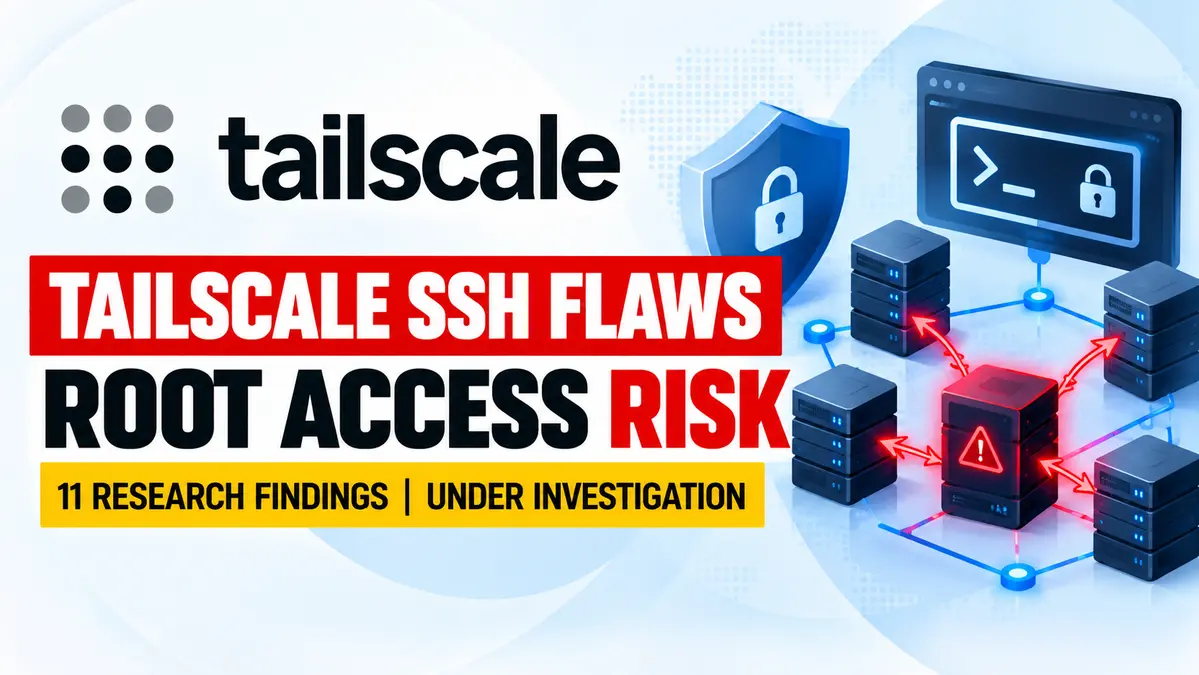
Tailscale SSH flaws described in a newly published security assessment could allow an attacker who already controls an authorized device to obtain root-level access on other reachable servers. The findings raise concerns about privilege separation, Unix socket forwarding and lateral movement within private networks.
The research, named Tailworm, was published by Erica Windisch of Cyberdione Labs on October 25, 2026. It describes 11 findings affecting Tailscale SSH and related components, including Tailscale Serve, app connectors, DERP relay behavior and the independently developed headscale control server.
The researcher tested Tailscale version 1.104.2 and headscale version 0.29.5 in controlled laboratory environments between October 22 and October 24.
Tailscale has acknowledged receiving the report and said its own investigations have identified issues that require fixes. However, the company has not confirmed every individual claim, published a dedicated Tailworm security bulletin or announced a patched release for these newly reported findings.
Importantly, the primary Tailscale SSH attack scenarios require an existing authorized connection or other specific configuration conditions. This is not evidence that an unauthenticated internet attacker can remotely obtain root access on every Tailscale-connected machine.
Organizations using Tailscale for developer access, cloud administration and private infrastructure should review SSH permissions and forwarding configurations while the vendor completes its investigation.
The incident also demonstrates the importance of enforcing least-privilege access between trusted devices. Our Zero Trust Architecture and Security Guide explains why internal network membership should never be treated as unlimited authorization.
Key Findings About the Tailscale SSH Flaws
- Research report: Tailworm, published by Erica Windisch of Cyberdione Labs on October 25, 2026.
- Number of findings: 11 reported issues across several Tailscale and headscale components, including configuration and threat-model concerns.
- Tested releases: Tailscale 1.104.2 and headscale 0.29.5.
- Potential impact: An authorized SSH connection could reach privileged Unix sockets and, in the researcher’s laboratory tests, lead to root-level access.
- Attack prerequisite: The central lateral-movement scenario requires prior compromise of an authorized device and an SSH access policy permitting the relevant connection.
- Vendor response: Tailscale acknowledges privilege-boundary issues under investigation but does not recommend disabling Tailscale SSH universally.
- Immediate protection: Restrict SSH access, disable unnecessary forwarding, review Serve and app connector configurations, and monitor vendor updates.
How Tailscale SSH Flaws Could Lead to Root Access
Tailscale creates encrypted connections between devices using a private network called a tailnet.
Its SSH integration allows administrators to control access through centrally managed policies rather than relying exclusively on traditional SSH key distribution.
On Linux systems, the Tailscale daemon commonly runs with root privileges because it performs system-level networking operations.
According to the Tailworm research, the security concern emerges when operations requested by a lower-privileged SSH session are performed by this highly privileged daemon without sufficient separation.
One particularly sensitive feature is Unix socket forwarding.
Unix sockets allow local processes to communicate. Some are intentionally restricted because the services behind them provide administrative capabilities.
For example, access to certain Docker or container-runtime sockets may allow extensive control over workloads and, depending on configuration, the underlying host.
The researcher reported that permitted SSH forwarding could cause the root-running Tailscale service to access sockets that the connected user should not be able to access directly.
In laboratory demonstrations, this behavior enabled unauthorized access to privileged resources.
The issue is therefore a potential privilege-boundary failure, rather than a claim that Tailscale’s underlying WireGuard encryption has been broken.
Tailworm Research Describes 11 Security Findings
The original Tailworm assessment organizes its findings across Tailscale SSH, connector functionality, relay behavior and other components.
Not every reported item is the same type of vulnerability. Some describe privilege-escalation paths, others involve denial of service, and some concern configuration behavior or disputed security boundaries.
| Finding | Component | Researcher’s Reported Concern |
|---|---|---|
| F1 | Tailscale SSH | Local Unix socket forwarding may access root-restricted services. |
| F2 | Tailscale SSH | Remote socket forwarding may replace privileged sockets. |
| F3 | Tailscale SSH | A timing race may bypass socket-path authorization checks. |
| F4 | App connectors | Connector entitlements may permit broader outbound destinations than intended. |
| F5 | Tailscale SSH | Session-handling behavior may cause daemon memory exhaustion. |
| F6 | headscale and DERP client | Registration disruption and memory-exhaustion scenarios. |
| F7 | Tailscale Serve | Forwarding to a privileged local API socket may expose administrative operations. |
| F8 | Tailscale Serve | A symlink race may undermine socket protection. |
| F9 | Tailscale Funnel | Researcher-reported authorization and threat-model concern. |
| F10 | Tailscale Serve | A configuration setting can expose Serve beyond the intended tunnel interface. |
| F11 | Tailscale Serve | Shared context behavior may allow authorization state to cross mount boundaries. |
These are descriptions of the researcher’s findings, not a list of 11 individually vendor-confirmed CVEs.
As of October 26, Tailscale had not assigned a public Tailworm-specific advisory or published a definitive list of affected configurations.
Finding F1: Local SSH Socket Forwarding May Cross Privilege Boundaries
The first major finding concerns local Unix socket forwarding through Tailscale SSH.
The researcher reported that when an authorized user requests forwarding to a Unix socket, the connection may be performed using the privileges of the Tailscale daemon.
Because the daemon runs as root on many Linux hosts, that operation may reach a socket unavailable to the connecting user.
In the controlled test, the researcher used this behavior to gain privileged access and read a root-protected system file.
The underlying concern is that an SSH policy may authorize a user to connect without intending to give that user unrestricted access to privileged local services.
For a production administrator, the most relevant question is whether forwarding is enabled for users who should have only limited shell or application access.
Finding F2: Remote Forwarding May Replace Privileged Sockets
The second major finding concerns remote Unix socket forwarding.
According to the researcher, certain forwarded socket operations can interact with existing files or sockets using elevated privileges.
The laboratory demonstration reportedly allowed a privileged socket to be replaced, creating a route to execute commands through another local service.
This differs from ordinary TCP port forwarding because local filesystem permissions and socket ownership play an important role.
A configuration that allows SSH access but assumes normal Unix user restrictions always apply to forwarding operations may therefore be unsafe under the reported conditions.
Tailscale has acknowledged that some sessions may be capable of performing more privileged operations than their configured local user should permit.
The company is still evaluating the precise configurations affected.
Finding F3: Socket-Path Race Conditions and Rogue Node Enrollment
The third major finding involves a time-of-check-to-time-of-use, or TOCTOU, race condition.
Such a vulnerability occurs when software validates a resource and later uses it after the relevant filesystem state has changed.
In the Tailworm laboratory tests, the researcher reported defeating socket-path checks by changing the target between validation and use.
One demonstrated attack chain reportedly reached a sensitive enrollment mechanism, obtained a key and used it to register another device within the test tailnet.
This is an especially serious scenario because unauthorized device enrollment could extend an intrusion beyond a single SSH session.
However, the demonstration should not be interpreted as evidence that every Tailscale deployment exposes reusable enrollment keys or permits arbitrary device registration.
The outcome depends on the permissions, available services, access rules and configuration of the affected environment.
How a Compromised Device Could Enable Lateral Movement
The central Tailworm scenario begins with an attacker controlling a device that already has legitimate access within a tailnet.
The initial compromise could involve stolen credentials, malware or a vulnerable application, although the report does not establish a particular real-world intrusion campaign.
If the compromised device is permitted to establish a Tailscale SSH session to another server, the attacker may be able to use that authorized path.
Where the relevant forwarding behavior is exposed, the researcher claims this can cross the intended Unix privilege boundary and lead to root-level access.
From that position, additional permitted connections could provide further opportunities for lateral movement.
The attack is constrained by the network’s actual access policies.
Strongly limited source-to-destination rules reduce the opportunities available to a compromised device.
Conversely, unnecessarily broad SSH permissions can increase the number of reachable targets.
The important distinction is that tailnet access does not automatically imply access to every device. Tailscale’s hosted control plane applies access policies, and the researcher’s broad peer-visibility claims should not be generalized to every configuration.
What Tailscale Officially Said About Tailworm
On October 25, Mike Shaver, Tailscale’s vice president of engineering, issued a public statement addressing the newly reported vulnerabilities.
He confirmed that Tailscale had received the research and that internal engineers, working with external security specialists, were already investigating related issues.
The company acknowledged concerns involving Unix privileges, SSH forwarding and the behavior of sessions after authorization.
However, Tailscale emphasized that these problems should not be confused with unauthenticated attackers obtaining access to arbitrary machines.
The company also stated that it was not recommending a universal shutdown of Tailscale SSH based on the information available at that time.
Instead, it advised customers to review access policies, disable unneeded SSH forwarding, consider SSH check mode and enable automatic updates where supported.
Tailscale said it would publish a security advisory covering confirmed findings, affected configurations and fixes after validation.
The company’s statement is particularly important because it distinguishes acknowledged security concerns from the researcher’s wider set of claims.
Are These Tailscale SSH Vulnerabilities Patched?
As of the October 26 review, no dedicated Tailworm security bulletin, CVE identifiers or fixed versions had been publicly announced for these newly reported issues.
That does not mean every existing Tailscale security bulletin is related to Tailworm.
Earlier in 2026, Tailscale separately fixed SSH and Unix socket handling vulnerabilities affecting older releases.
Those earlier fixes should still be installed, but they must not be presented as confirmed remediation for the new Tailworm findings.
| Security Issue | Status |
|---|---|
| New Tailworm research | Under vendor investigation; no dedicated fixed release announced as of October 26 |
| Earlier Tailscale SSH root-user policy bypasses | Previously addressed in Tailscale 1.98.9 or newer |
| Earlier Unix socket forwarding symlink issue | Previously addressed in Tailscale 1.98.9 or newer |
| Earlier SSH environment-variable disclosure | Previously addressed in Tailscale 1.102.1 or newer |
| October 21 TLS certificate bulletin | Separate issue addressed in Tailscale 1.104.2 or newer |
Administrators should monitor Tailscale’s official security bulletins for a future advisory that specifically identifies the Tailworm-related fixes.
How to Check Tailscale SSH Exposure on Linux Servers
Administrators can begin with non-destructive inventory and configuration checks.
1. Identify the Installed Tailscale Version
Run:
tailscale versionRecord the installed release, including any vendor-specific package information.
Remember that running Tailscale 1.104.2 does not mean the newly reported issues have been fixed. That version was included in the researcher’s testing.
2. Check Tailscale Service Status
On a systemd-based Linux server:
systemctl status tailscaled --no-pagerReview whether the service is active and identify the relevant configuration files and startup environment.
3. Review Tailnet SSH Policies
Inspect the SSH rules in the Tailscale admin console or the self-hosted control plane used by your organization.
Determine which users and devices may establish sessions to production servers.
Pay particular attention to wildcard rules, broad identity groups, tag-based privileges and SSH permissions extending across multiple systems.
4. Review Forwarding Requirements
Determine whether SSH forwarding is actually required for your environment.
Development workflows sometimes rely on forwarding, but many administrative sessions do not.
Where forwarding is unnecessary, disabling it provides an immediate reduction in exposure.
5. Identify Sensitive Local Services
Review privileged local Unix sockets associated with administrative services, container runtimes and local control interfaces.
Do not change filesystem ownership or permissions blindly on production sockets because legitimate workloads may depend on them.
Evaluate exposure together with Tailscale access policies and the relevant vendor guidance.
How to Mitigate Tailworm Risks Before an Official Patch
The safest interim approach is to reduce the permissions and functionality available to already-authorized SSH connections.
1. Disable SSH Forwarding Where It Is Not Needed
Tailscale’s engineering team recommends disabling SSH forwarding when it is not required.
On supported Linux deployments, the service environment can be configured with:
TS_SSH_DISABLE_FORWARDING=1This is an environment variable for the tailscaled service, not a command to paste into an interactive SSH session.
Administrators must configure it using their operating system’s supported service-management method and restart the service during an approved maintenance window.
Disabling forwarding may interrupt workflows that depend on TCP or Unix socket forwarding.
Tailscale says this setting mitigates several of the more serious findings without disabling all Tailscale SSH functionality.
2. Apply Least-Privilege SSH Access Rules
Limit SSH access to users and devices that require it for specific tasks.
Use narrowly scoped source-to-destination rules wherever possible.
Broad permissions should be reviewed particularly carefully for production servers, administrative systems and infrastructure containing sensitive credentials.
3. Consider SSH Check Mode
Tailscale recommends SSH check mode as an additional authentication step before a session begins.
This can add friction to unauthorized use of an existing connection.
However, check mode does not repair a privilege-escalation vulnerability after a session has been authorized.
4. Review Tailscale Serve and App Connectors
Audit Serve configurations that forward connections to local Unix sockets, especially sockets exposing administrative functionality.
Remove unnecessary connectors and entitlements.
Pay particular attention to experimental connector functionality and services with access to cloud metadata or Kubernetes control interfaces.
5. Monitor Device Enrollment and Tailnet Changes
Review newly registered devices, changes to tags, issued authorization keys and unusual administrative events.
If a device is suspected to be compromised, revoke its tailnet access through the appropriate control plane.
Reinstalling a compromised endpoint does not automatically invalidate credentials or device keys that an attacker may already have copied.
6. Enable Supported Automatic Updates
Keep Tailscale components current so confirmed fixes can be deployed when available.
However, do not describe an existing release as a Tailworm fix until the vendor specifically identifies it as such.
7. Evaluate High-Risk Environments Separately
For sensitive production environments where access rules cannot be sufficiently restricted, consider temporarily disabling the affected SSH integration until the vendor provides more complete guidance.
This is a risk-based operational decision, not a blanket instruction issued by Tailscale to all customers.
What About headscale Deployments?
Tailworm also examines headscale, an independently maintained open-source control server compatible with Tailscale clients.
The research included headscale version 0.29.5.
Several findings concern control-plane registration behavior, memory consumption and differences between hosted Tailscale and headscale deployments.
One important limitation in the research concerns SSH forwarding controls.
The researcher reports that the tested headscale configuration did not provide an equivalent way to disable forwarding through SSH policy rules.
Administrators should therefore avoid assuming that configuration instructions for the commercial hosted Tailscale control plane apply identically to headscale.
Headscale operators should review their installed version, upstream project guidance, SSH permissions and node enrollment procedures.
They should also monitor for security updates issued by the headscale maintainers separately from Tailscale’s own bulletins.
Does Tailworm Affect Ordinary OpenSSH Over Tailscale?
Tailscale SSH and ordinary OpenSSH connections carried through a Tailscale tunnel are not identical implementations.
The reported root-privilege concerns primarily involve Tailscale’s integrated SSH feature and related daemon behavior.
An organization using Tailscale only to provide private network connectivity to a separately managed OpenSSH server should not automatically assume it has the same exposure.
However, administrators still need to review the security of their traditional SSH service, access controls and any related forwarding configurations.
Neither the research nor Tailscale’s response establishes that WireGuard’s underlying encryption has been broken.
The issue concerns authorization and privilege handling around specific higher-level features.
Why This Matters for Zero Trust Infrastructure
Zero Trust security assumes that a device or user should not receive unlimited privileges merely because it has joined a private network.
Organizations often deploy Tailscale to simplify secure connectivity between developers, servers, containers and cloud environments.
That can reduce exposure from publicly reachable SSH ports.
However, private connectivity alone does not eliminate the risks associated with excessive permissions or privileged service behavior.
The Tailworm research highlights the importance of maintaining clear boundaries between network authorization and operating-system privileges.
An authorized user may legitimately connect to a server without being entitled to operate root-owned sockets or register additional devices.
Security controls must preserve that distinction after authentication.
The same principle applies to broader enterprise access platforms. Our related report on the BeyondTrust zero-day exploited by China-linked attackers discusses a separate remote-access security incident and the risks created when privileged infrastructure services are compromised.
The two incidents are distinct and are not evidence of a shared vulnerability or threat actor.
Confirmed vs Unknown: Tailscale Tailworm Research
Confirmed or Publicly Acknowledged
- Erica Windisch published a Tailworm assessment describing 11 findings.
- The research tested Tailscale 1.104.2 and headscale 0.29.5.
- Laboratory demonstrations included privilege-boundary and socket-forwarding scenarios.
- Tailscale received the report and acknowledged that it was investigating related issues.
- The vendor said some authorized sessions may be capable of operations beyond the intended Unix user privileges.
- Tailscale recommends reviewing policies and disabling unneeded SSH forwarding.
- The vendor is not recommending that every customer disable Tailscale SSH.
- The company said a detailed security advisory and fixes would follow its investigation.
Not Yet Established
- That all 11 reported findings are independently confirmed by Tailscale.
- That arbitrary unauthenticated internet users can compromise any Tailscale-connected machine.
- That all networks using Tailscale SSH permit root-level lateral movement.
- A publicly assigned CVE for each newly reported finding.
- A dedicated Tailworm fixed release as of October 26.
- Confirmed exploitation of these new findings in a real-world attack.
- The final list of vulnerable deployment configurations.
- That all Tailscale and headscale installations behave identically.
CyberUpdates365 Analysis
The Tailworm disclosure highlights a security problem that extends beyond a single SSH implementation.
Privileged background services sometimes perform operations on behalf of users with fewer permissions.
If the boundary between the requester’s authority and the service’s authority is not enforced consistently, an authenticated session may become a route to privilege escalation.
In the reported Tailscale scenarios, Unix socket forwarding is central to that concern.
An approved SSH connection is not supposed to grant every capability available to a root-running daemon.
That distinction is particularly relevant to DevOps environments, where the same private network may connect development workstations, cloud virtual machines, containers and administrative services.
A compromised workstation should not automatically provide broad access to production infrastructure.
Strongly scoped access rules and limited forwarding permissions reduce the potential impact of a single-device compromise.
Another important lesson concerns the difference between research disclosure and vendor confirmation.
The researcher documented laboratory behaviors and published reproduction evidence.
Tailscale acknowledged the broader security concerns but is still validating the complete set of reported findings.
This means organizations should take practical precautions without assuming that every headline claim applies to their environment.
The absence of a dedicated fixed release also shifts immediate attention toward configuration.
Administrators can review SSH grants, disable unnecessary forwarding, audit local socket exposure and strengthen device enrollment controls before patches are available.
Finally, the vendor’s response shows why specific mitigation guidance matters.
Disabling Tailscale SSH entirely may be appropriate for a small number of high-risk deployments, but Tailscale itself recommends a narrower, risk-based response for most customers.
The central lesson is that private network membership should never become an implicit grant of root privileges. Authorization, Unix permissions and administrative access must remain independently enforced.
Research Evidence
- Research name: Tailworm.
- Researcher: Erica Windisch, Cyberdione Labs.
- Publication: October 25, 2026.
- Testing period: October 22–24, 2026.
- Tested Tailscale release: 1.104.2.
- Tested headscale release: 0.29.5.
- Reported findings: 11.
- Key technical area: Unix socket forwarding and privilege separation.
- Additional components: Serve, app connectors, DERP and headscale.
- Reported potential impact: Root-level access, lateral movement, unauthorized administrative actions and denial of service under specific conditions.
- Vendor statement: Tailscale acknowledged receipt and an ongoing investigation on October 25.
- Dedicated Tailworm CVEs: Not publicly assigned in the reviewed sources.
- Dedicated patched release: Not publicly announced as of October 26.
- Confirmed in-the-wild exploitation: Not established.
- Immediate defensive action: Review access policies and disable SSH forwarding where unnecessary.
Frequently Asked Questions
What are the Tailscale SSH flaws reported in Tailworm?
Tailworm is a research report describing 11 findings involving Tailscale SSH and related components, including potential root access through privileged Unix socket forwarding in specific authorized configurations.
Can an attacker gain root access across Tailscale servers?
The researcher demonstrated that a compromised device with authorized SSH access could potentially reach root-level resources on another system. This depends on the relevant access rules and forwarding configuration.
Does Tailworm allow unauthenticated remote access?
The central Tailscale SSH escalation scenario requires prior authorized access. Tailscale has explicitly cautioned against treating the findings as universal unauthenticated access to arbitrary devices.
Which Tailscale versions were tested?
The research tested Tailscale version 1.104.2 and headscale version 0.29.5. The final affected-version range has not been established by a dedicated vendor advisory.
Are the new Tailworm vulnerabilities patched?
As of October 26, 2026, Tailscale had not announced a dedicated Tailworm fixed release. Earlier SSH security updates address separate vulnerabilities and should not be confused with these findings.
Should everyone disable Tailscale SSH?
No. Tailscale says it is not recommending universal shutdown. It advises reviewing access policies and disabling unnecessary SSH forwarding while the investigation continues.
How can administrators disable Tailscale SSH forwarding?
On supported deployments, configure the tailscaled service environment with TS_SSH_DISABLE_FORWARDING=1 and restart the service through the approved service-management process. Review operational dependencies before making changes.
Does Tailworm affect normal OpenSSH over a Tailscale tunnel?
The primary reported privilege-boundary issues concern Tailscale’s integrated SSH implementation, not every conventional OpenSSH server reachable through a Tailscale network.
Final Takeaway
The Tailworm report describes 11 security concerns affecting Tailscale SSH and related networking components, including laboratory scenarios where an authorized connection crossed the intended Unix privilege boundary.
Tailscale has acknowledged related issues under investigation but has not confirmed every finding or announced a dedicated fixed release as of October 26, 2026.
Organizations should avoid treating the report as evidence that every Tailscale network is compromised or that arbitrary unauthenticated attackers can access all connected servers.
Instead, administrators should review SSH grants, disable unnecessary forwarding, limit privileged socket exposure and monitor forthcoming vendor advisories.
The most important action is to reduce the privileges available to an already-compromised device before that access can be used against other servers.
Securing privileged remote access across enterprise infrastructure?
Our separate investigation examines how attackers exploited a BeyondTrust vulnerability in environments where trusted remote-access systems were exposed.
Read: China-Linked Hackers Exploit BeyondTrust Zero-Day →