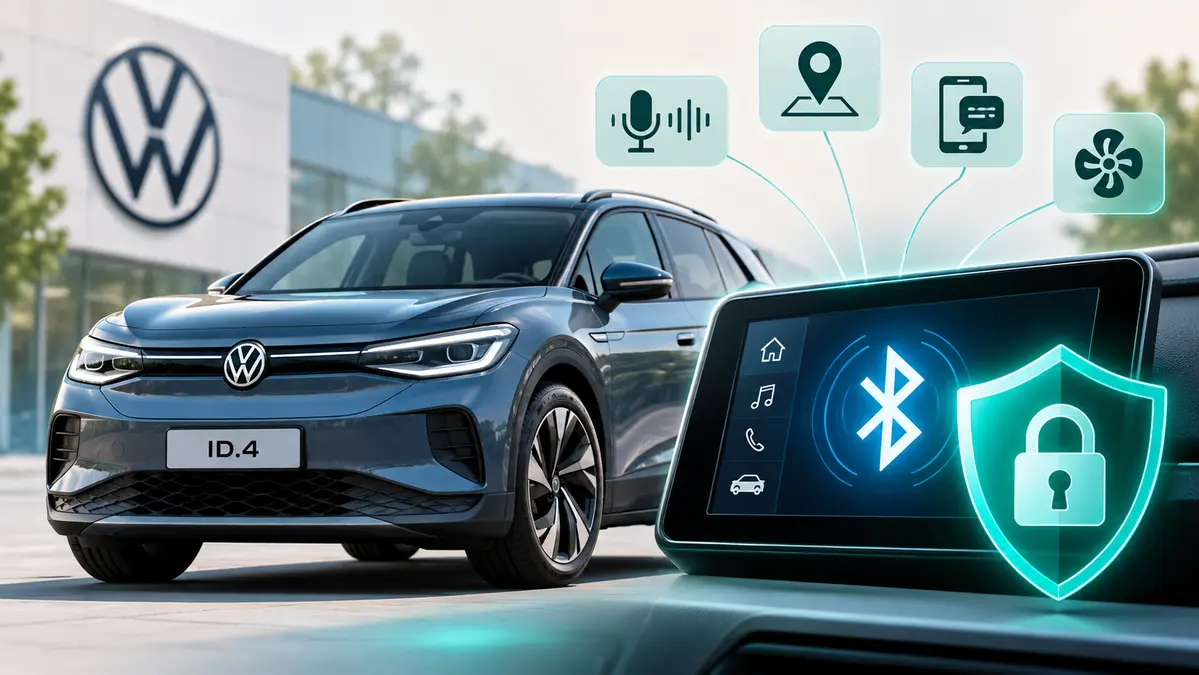
Security researchers demonstrated how Bluetooth vulnerabilities could allow a nearby attacker to compromise a Volkswagen ID.4 infotainment system after an unauthorized pairing request was accepted. During a controlled demonstration in Budapest, the researchers accessed cabin audio, vehicle location information and several connected functions.
The research team at PCA Cyber Security used weaknesses known as PerfektBlue, affecting OpenSynergy’s BlueSDK Bluetooth software. The underlying flaws were publicly disclosed in July 2025, while renewed coverage in November 2026 highlighted their practical impact and Volkswagen’s rollout of software fixes for older vehicles.
Researchers demonstrated access to information from a paired phone and control over selected functions, including cabin heating, windshield wipers and the sunroof. Volkswagen says the vulnerabilities did not give attackers access to steering, braking or acceleration.
The demonstrated Bluetooth attack required the attacker to be nearby and the vehicle user to accept a pairing request. It does not establish that every Volkswagen can be compromised silently or that criminals have successfully attacked hundreds of thousands of cars.
What Researchers Demonstrated on a Volkswagen ID.4
PCA Cyber Security investigated the Volkswagen ID.4’s infotainment system and demonstrated the results to journalists at its Budapest laboratory, according to reporting published by The Times in November 2026.
After establishing access through the vulnerable Bluetooth implementation, the researchers demonstrated several capabilities involving the connected cabin systems.
- Cabin audio: Researchers recorded a conversation between a driver and passenger using the vehicle’s emergency-call microphone.
- Vehicle location: The researchers accessed location information and demonstrated the ability to track the vehicle.
- Paired phone data: The demonstration exposed messages and contacts associated with a phone connected to the infotainment system.
- Cabin functions: Researchers operated heating, windshield wipers and the sunroof, and displayed content on the vehicle’s infotainment screen.
These observations describe a controlled security demonstration on a tested vehicle. They do not establish that all Volkswagen models support the same attack path or that the researchers gained control of safety-critical driving systems.
Volkswagen’s public response distinguished connected infotainment functions from steering, brakes and acceleration, which it said were not accessible through this vulnerability.
The November findings were also covered by WardsAuto’s November 19 report, which described the demonstration and the risks to in-car privacy.
How the PerfektBlue Bluetooth Vulnerabilities Work
PerfektBlue is a collection of four vulnerabilities identified by PCA Cyber Security in OpenSynergy’s BlueSDK Bluetooth software.
BlueSDK is used in embedded systems, including infotainment hardware supplied to automobile manufacturers.
Bluetooth connectivity allows drivers to make hands-free calls, connect phones and use media features. A vulnerability in the software processing Bluetooth connections can create an entry point into the infotainment system.
PCA demonstrated that multiple weaknesses could be combined to achieve remote code execution, meaning an attacker could cause code to run on the affected infotainment device.
The four vulnerabilities are:
- CVE-2024-45434: A use-after-free memory vulnerability in the AVRCP Bluetooth service.
- CVE-2024-45431: Improper validation of a remote channel identifier in L2CAP.
- CVE-2024-45432: An incorrect function parameter in the RFCOMM implementation.
- CVE-2024-45433: Incorrect function termination in RFCOMM, which could interfere with intended validation.
According to PCA Cyber Security’s original PerfektBlue advisory, the most severe flaw in the chain received a CVSS v3.1 score of 8.0.
Exploitation conditions vary depending on how a manufacturer implements BlueSDK and configures Bluetooth security. The original researcher report specifically notes that its tested devices required pairing, while other implementations could expose different connection requirements.
Which Volkswagen Hardware Was Actually Tested?
PCA verified PerfektBlue exploitation against the MEB ICAS3 infotainment system used in the Volkswagen ID vehicle family.
The original technical disclosure identifies two tested ICAS3 firmware builds:
- Firmware 0792: Associated with ID. software version 2.1.
- Firmware 0561: Associated with ID. software version 3.2.12.
Researchers also demonstrated successful code execution on firmware 0561 in the context of the infotainment system’s Bluetooth application account.
These are documented test configurations, not a complete inventory of every affected model, model year or installed software version.
Although PCA reported that additional versions were likely affected, individual vehicle exposure depends on the installed infotainment hardware, software branch and applicable fixes.
Did the Volkswagen Bluetooth Hack Require Driver Interaction?
Yes, in the reported Volkswagen demonstration.
The attacker needed to be within Bluetooth communication range and establish a connection with the vehicle. The user had to accept the relevant pairing request.
This is a meaningful limitation. An unexpected pairing request is not the same as an invisible compromise requiring no driver interaction.
However, accepting a connection from an unknown device can create an opportunity for exploitation if the vehicle’s Bluetooth software is vulnerable.
PCA’s November 2026 conference research also described additional vulnerabilities involving Apple CarPlay and the infotainment system’s virtualization boundaries.
Those findings involve different access conditions. In particular, the wired CarPlay route requires physical access to the vehicle’s interior, whereas the reported Bluetooth route depends on establishing the wireless connection.
The different routes should not be presented as a single universal attack that works on every Volkswagen vehicle without any action by the driver.
Volkswagen Software Fix: Which Versions Need Attention?
Volkswagen has begun distributing software updates addressing the Bluetooth issue in older infotainment systems, according to statements reported by Heise in November 2026.
The update route depends on the installed ID. software generation. Volkswagen’s official German software documentation also lists version 3.9.1 and identifies security improvements among its changes.
| Installed ID. software | Reported status or update route |
|---|---|
| Older 3.x versions, below 4.0 | Volkswagen identified software 3.9.1 as the relevant fix for eligible affected vehicles. An over-the-air rollout has begun in supported markets. |
| 4.x and 5.x versions below 5.6 | Affected vehicles may need a workshop-installed update. Owners should confirm the exact applicable fix with Volkswagen. |
| 5.6 or later | Volkswagen said these versions are not affected by the reported PerfektBlue issue. |
Important: The reported version guidance must be applied to the correct vehicle and market. A software version offered in Germany or another European market is not proof that the identical update is available for every U.S.-market ID.4.
Volkswagen’s official German ID. software update page lists the available software generations, including 3.9.1.
For U.S. owners, Volkswagen’s official vehicle software update guide explains how eligible updates are offered through the vehicle, myVW notifications and authorized dealers.
A version number alone does not confirm that a specific vehicle has received every applicable security repair. Owners should check the vehicle’s software information and confirm eligibility using their vehicle identification number (VIN) where necessary.
How to Check for a Volkswagen ID.4 Software Update
Owners concerned about the reported vulnerabilities can take the following steps without attempting to reproduce the exploit.
1. Check the Installed Software Version
Open the vehicle’s infotainment settings and locate its system information or ID. software information screen.
Volkswagen’s documentation identifies Setup → System information as one route on supported ID. software versions. The precise menu may differ by model and generation.
Record the installed version before contacting Volkswagen or reviewing an update notification.
2. Confirm the Update for Your Vehicle
Check official in-vehicle notifications, the myVW application or Volkswagen’s regional owner portal.
If an update is not offered, contact an authorized Volkswagen dealer and ask whether the vehicle’s infotainment system needs the PerfektBlue security fix.
Provide the model, software version and VIN so the dealer can determine the applicable update route.
Do not download unofficial vehicle firmware from third-party websites or attempt to install a software branch intended for another vehicle.
3. Follow Volkswagen’s Installation Requirements
Volkswagen states that over-the-air software updates must be installed while the vehicle is parked and unavailable for driving.
Its U.S. guidance advises electric vehicle owners to maintain at least 50% battery charge before installation, avoid charging during the installation process and leave the vehicle unplugged while the update is applied.
Installation can take up to three hours, depending on the applicable update.
Volkswagen’s German documentation for version 3.9.1 also cautions that vehicles with certain aftermarket technical modifications, such as equipment changing electronic control signals, should be referred to a Volkswagen service partner instead of proceeding directly with an over-the-air update.
Follow the instructions for the specific vehicle and region rather than assuming all installations have identical requirements.
Why Did the Bluetooth Fix Take So Long to Reach Some Cars?
The vulnerability-disclosure timeline illustrates how a software supplier’s patch can take considerably longer to reach deployed vehicles.
According to PCA Cyber Security’s original records:
- May 17, 2024: Researchers first contacted OpenSynergy about the Bluetooth issues.
- June 19, 2024: PCA verified the flaws on a Volkswagen ID.4 infotainment system and informed Volkswagen’s incident response team.
- September 2024: OpenSynergy reportedly distributed fixes to its customers.
- July 7, 2025: PCA publicly released the PerfektBlue advisory.
- November 2026: Volkswagen’s rollout for older affected software generations received renewed attention alongside the researchers’ practical demonstrations.
Volkswagen told Heise that older vehicle software required additional integration work and security validation before the fix could be distributed.
That distinction matters when evaluating the timeline. OpenSynergy’s delivery of a supplier patch did not mean every affected vehicle immediately received a completed, approved Volkswagen software update.
It also explains why headlines referring to approximately 16 months of delay commonly measure the period since public disclosure in July 2025, rather than the earlier private notification in June 2024.
Were Hundreds of Thousands of Volkswagen Cars Hacked?
No such conclusion is established by the public findings.
PCA researchers have warned that their broader attack chain could affect hundreds of thousands of vulnerable Volkswagen electric vehicles, including ID.4 models.
That is an estimate of potential exposure, not a confirmed count of compromised cars.
The publicly documented demonstration shows that the researchers successfully reached sensitive infotainment functions under controlled conditions. It does not establish the number of vehicles attacked by criminals.
The sources reviewed for this report did not document a widespread criminal campaign using this specific demonstration technique. That reporting limitation should not be confused with proof that no exploitation has ever occurred.
What Volkswagen Owners Should Do Now
The most useful immediate action is to check the vehicle’s software version and ask Volkswagen which security update applies.
Owners should also reject unexpected Bluetooth pairing requests. Volkswagen specifically warned against accepting connections from unknown devices or connecting unfamiliar USB hardware to the vehicle.
If the vehicle is used by multiple family members, drivers or fleet employees, make sure everyone understands that an unsolicited pairing prompt should not be approved.
Avoid treating Bluetooth as a reason to panic: the reported exploit requires specific vulnerable software and access conditions. But a vehicle that has not received an applicable security update should not be assumed protected merely because it appears to operate normally.
For additional context on connected-car attack surfaces, see CyberUpdates365’s connected-vehicle cybersecurity guide and our Device Security Audit 2026, which covers wireless proximity risks and device hardening.
Original Research and Official Sources
- PCA Cyber Security — Original PerfektBlue Security Advisory
- PCA Cyber Security — PerfektBlue Demonstrations and Tested Hardware
- PCA Cyber Security — November 2026 Volkswagen ID.4 Research Presentation
- Golem — November 20 Reporting on Volkswagen’s Patch Rollout
- Volkswagen Germany — Official ID. Software Versions and Updates
- Volkswagen USA — Official Vehicle Software Update Instructions