
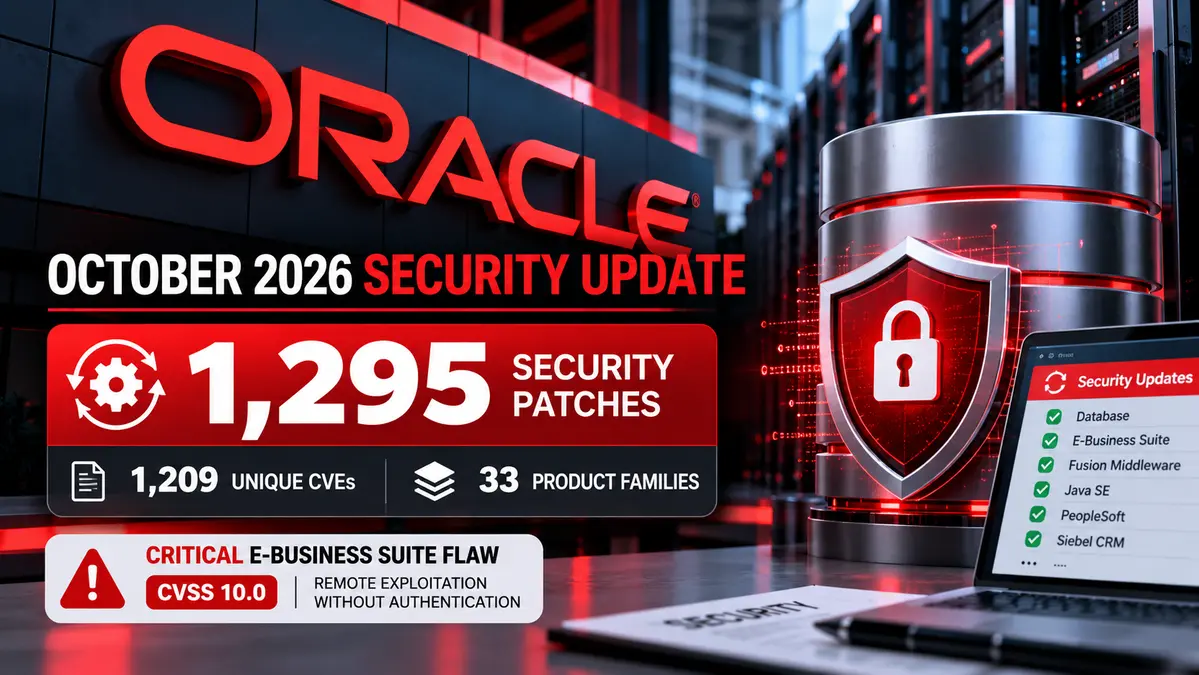
The Oracle October 2026 patch update delivers 1,295 security patches addressing 1,209 unique CVEs, including a maximum-severity vulnerability in Oracle E-Business Suite that could allow an unauthenticated remote attacker to take over a critical workflow component.
Released on October 20, the Critical Patch Update covers 33 Oracle product families, including Database Server, E-Business Suite, Fusion Middleware, Java SE, MySQL, PeopleSoft and Siebel CRM.
One of the most urgent vulnerabilities is CVE-2026-101809, affecting the Workflow Notification Mailer component of Oracle E-Business Suite. Oracle assigns it a CVSS 3.1 score of 10.0 and describes exploitation as possible over HTTP without authentication.
For enterprises relying on Oracle applications to process financial, operational and customer information, the release requires more than simply downloading a patch bundle. Administrators need to identify affected components, apply relevant updates and verify that connected systems remain secure.
There is an important distinction in the headline figures: the 1,295 count refers to security patch entries, not 1,295 different vulnerabilities. Tenable’s independent analysis identifies 1,209 unique CVEs.
The release also does not establish that the newly disclosed Workflow vulnerability is being actively exploited. Oracle’s broader warnings about attacks against unpatched customers should not be confused with incident-specific evidence.
For a broader view of enterprise vulnerability management, see our CVE Vulnerabilities and Enterprise Security Hub.
Key Findings From Oracle’s October 2026 Security Update
- Release date: October 20, 2026.
- Total security patches: 1,295, according to Tenable’s analysis.
- Unique vulnerabilities: 1,209 CVEs.
- Critical severity: 112 critical patch entries addressing 95 unique CVEs.
- Affected portfolio: 33 Oracle product families.
- Highest severity: CVSS 3.1 score of 10.0.
- Critical E-Business Suite issue: CVE-2026-101809, affecting Workflow Notification Mailer.
- Affected E-Business Suite versions: 12.2.3 through 12.2.15 for the highlighted vulnerabilities.
- Other serious findings: CVE-2026-101767, CVE-2026-75803 and CVE-2026-101521.
- Required response: Review Oracle’s risk matrices, identify affected deployments, install applicable fixes and confirm remediation.
Oracle October 2026 Patch Update: Why 1,295 Fixes Matter
Oracle’s Critical Patch Updates address security weaknesses across its supported enterprise software portfolio.
The October release is particularly large, covering database infrastructure, middleware, business applications, Java components and industry-specific platforms.
Tenable reports 1,295 patch entries associated with 1,209 unique CVEs.
The difference exists because a single vulnerability can affect multiple Oracle products or appear in more than one product-specific risk matrix.
Organizations should therefore avoid treating the total patch count as the number of distinct vulnerabilities present in their environment.
The update includes 112 critical patch entries, 475 high-severity entries, 613 medium-severity entries and 95 low-severity entries in Tenable’s classification.
However, an individual organization’s exposure depends on which Oracle components are installed, their versions, configuration and accessibility.
A company running Oracle Database without E-Business Suite does not automatically inherit every E-Business Suite vulnerability described in the advisory.
Conversely, organizations operating multiple connected Oracle products may need several separate patch procedures to address the full range of applicable weaknesses.
CVE-2026-101809: Critical Oracle E-Business Suite Vulnerability
The most severe issue highlighted in the release is CVE-2026-101809.
The vulnerability affects Oracle Workflow Notification Mailer within E-Business Suite versions 12.2.3 through 12.2.15.
Oracle rates the issue CVSS 10.0, the maximum score under CVSS 3.1.
According to the advisory, an attacker with network access through HTTP can exploit the vulnerability without valid authentication credentials.
Successful exploitation can allow takeover of the affected Workflow component.
The advisory also warns that a successful attack could affect additional Oracle products, depending on the affected system’s relationships and permissions.
This makes the vulnerability particularly concerning where Oracle Workflow participates in important business processes.
Workflow Notification Mailer supports email-based notifications associated with Oracle E-Business Suite workflows.
A compromise involving that component can create operational and data-security concerns, although the precise consequences depend on the affected deployment.
Oracle’s public vulnerability description does not establish that attackers have already compromised customer systems through this particular CVE.
Administrators should treat the maximum CVSS score as a prioritization signal while investigating the actual network exposure and patch status of their installations.
Another Critical E-Business Suite Flaw: CVE-2026-101767
Oracle also addressed CVE-2026-101767 in the Core component of Oracle Application Object Library.
The vulnerability affects E-Business Suite versions 12.2.3 through 12.2.15 and carries a CVSS 3.1 score of 9.8.
Oracle describes it as an easily exploitable weakness that can be triggered remotely through HTTP without authentication or user interaction.
Successful exploitation can result in takeover of Oracle Application Object Library.
The published scoring reflects high potential impacts on confidentiality, integrity and availability.
Application Object Library supports common functions used across Oracle E-Business Suite, making this finding relevant to administrators responsible for the wider application environment.
However, the advisory does not establish that every E-Business Suite deployment is publicly reachable or that exploitation automatically compromises every connected Oracle product.
Defenders should evaluate actual component exposure rather than assuming identical attack paths across all installations.
Oracle Database and APEX Also Receive Critical Fixes
The October CPU includes serious vulnerabilities beyond E-Business Suite.
Oracle Database: CVE-2026-75803
CVE-2026-75803 affects the OpenSSL component used by Oracle Database Server.
The Oracle advisory identifies affected Database Server versions 19.3 through 19.32 and 23.4.0 through 23.26.3 for the relevant entry.
The vulnerability carries a CVSS 3.1 score of 9.8 and can be exploited through TLS network access without authentication.
Oracle describes potential takeover of the affected component.
Because the CVE is associated with a shared third-party component, it appears across multiple Oracle product families.
Administrators should therefore use the product-specific risk matrices instead of applying one version range to every product containing OpenSSL.
Oracle APEX: CVE-2026-101521
Another critical issue, CVE-2026-101521, affects Oracle APEX.
Oracle lists affected versions 24.1.0 through 24.1.21, 24.2.0 through 24.2.20 and 26.1.0 through 26.1.4.
The vulnerability has a CVSS 3.1 score of 9.8 and is described as exploitable remotely through HTTPS without authentication.
Successful exploitation can result in takeover of the affected APEX component.
Organizations exposing APEX applications to external users should review the applicability of this fix and investigate whether their installation is within the listed affected ranges.
The advisory does not establish active exploitation of this newly disclosed issue.
Which Oracle Products Receive the Most Security Patches?
The update affects a broad range of Oracle technologies, but the number of fixes differs by product family.
According to Tenable’s aggregation, Oracle Fusion Middleware accounts for 206 patch entries, followed by Oracle E-Business Suite, Siebel CRM, Communications and PeopleSoft.
Oracle’s own advisory also contains product-specific executive summaries and affected-version tables.
The reporting groupings are not identical in every case. For example, Oracle’s E-Business Suite executive summary lists 196 new security patches, while Tenable’s aggregated breakdown lists 194 under its reporting methodology.
For deployment planning, the official Oracle advisory should remain the authority for affected components, applicable versions and patch availability.
Administrators should prioritize based on more than the raw number of patches.
A smaller product family containing an unauthenticated internet-reachable critical vulnerability may require more immediate attention than a larger family whose fixes apply only to isolated components.
Why Unauthenticated Oracle Vulnerabilities Need Priority
Several entries in Oracle’s October risk matrices describe vulnerabilities that may be exploited over a network without requiring user credentials.
That reduces one barrier an attacker would otherwise need to overcome.
However, an unauthenticated vulnerability is not automatically reachable from the public internet.
Actual exposure depends on firewall rules, application publishing, reverse proxies, network segmentation and the interfaces enabled in each environment.
For example, an internal-only Oracle application may be exposed to fewer potential attackers than the same service published through an internet-facing gateway.
Security teams should verify whether affected services can be reached from untrusted networks.
They should also determine which application accounts and connected systems could be affected if an exposed component were compromised.
These checks help administrators prioritize patching based on credible operational risk rather than relying entirely on CVSS scores.
Is Oracle’s October 2026 Update Already Being Exploited?
The published Oracle advisory does not establish active exploitation of CVE-2026-101809 or the other highlighted newly disclosed vulnerabilities.
Oracle does warn that customers have previously suffered attacks because they failed to install available security fixes.
That warning is relevant, particularly given the history of attacks against Oracle E-Business Suite.
But evidence of exploitation involving an earlier Oracle vulnerability should not be presented as confirmation that the October 2026 issues are currently being exploited.
The distinction is important for incident response.
A newly disclosed critical vulnerability may require urgent remediation even before reliable public evidence of exploitation appears.
At the same time, organizations should avoid declaring an ongoing intrusion or customer compromise without supporting telemetry.
Defenders should monitor Oracle’s advisories, trusted vulnerability intelligence and their own security logs for evidence that changes the assessment.
How Administrators Can Identify Affected Oracle Systems
Before deploying patches, organizations should establish which Oracle products and versions they actually operate.
1. Inventory Installed Oracle Products
Review enterprise software inventories, application architecture records and configuration management databases.
Identify Oracle Database, E-Business Suite, Fusion Middleware, APEX and other Oracle technologies, including components maintained by external vendors.
2. Confirm Product and Component Versions
Record exact version and patch levels using the product’s supported administrative tools.
Version checks should distinguish database engines, application tiers and middleware components rather than treating an integrated deployment as a single software version.
3. Review Oracle’s Risk Matrices
Match installed components against the affected-product and version information in the official October CPU advisory.
Check the vulnerability-specific prerequisites, network protocol and required privilege level.
Not every CVE applies to every installation of a product family.
4. Determine Network Exposure
Identify which affected services are reachable from external networks, partner networks or other lower-trust segments.
Review access controls and application-publishing arrangements, particularly for HTTP, HTTPS and TLS services referenced in the advisory.
5. Identify Patch Dependencies
Oracle E-Business Suite installations can depend on Oracle Database and Fusion Middleware components whose fixes are documented separately.
Administrators should review those dependencies before scheduling maintenance so that relevant parts of the environment are not overlooked.
How to Apply Oracle’s October 2026 Security Patches
Oracle recommends applying the latest relevant Critical Patch Updates and remaining on actively supported versions.
The appropriate installation procedure depends on the affected product.
Administrators should retrieve the product-specific patch availability documents from Oracle’s official advisory and My Oracle Support.
A controlled deployment process should include:
- Confirming the exact affected versions and applicable patch identifiers.
- Reviewing prerequisite patches and product compatibility requirements.
- Preparing verified backups and an appropriate recovery plan.
- Testing updates in a representative staging environment.
- Scheduling production maintenance and informing affected application owners.
- Installing relevant patches using Oracle-supported procedures.
- Performing required service restarts or application maintenance steps documented for the product.
- Validating application functionality and monitoring for errors after deployment.
Temporary access restrictions may help reduce exposure before patching, but they are not equivalent to installing the security fix.
Blocking a network path can also disrupt legitimate integrations, so emergency restrictions should be tested and coordinated with application owners.
Organizations running unsupported Oracle versions should evaluate their upgrade requirements because unsupported releases may not receive the same testing or patch availability as supported versions.
Patch Verification: How to Confirm Oracle Systems Are Protected
Installing a patch successfully does not necessarily establish that every affected component has been remediated.
Enterprises should verify both patch application and the operating state of the affected systems.
Confirm Patch Inventory
For Oracle Database installations, administrators may use the supported OPatch utilities and database patch registry appropriate to their release.
For example, on an installation using OPatch, an administrator can review the binary patch inventory:
$ORACLE_HOME/OPatch/opatch lsinventoryWhere applicable, a database administrator can also review SQL patch registration:
SELECT patch_id, action, status,
       action_time
FROM dba_registry_sqlpatch
ORDER BY action_time DESC;
These checks are examples for relevant Oracle Database installations. They do not replace E-Business Suite, Middleware or APEX-specific patch verification instructions.
Administrators should compare the results with the official patch identifiers expected for their products.
Check Application Functionality
Verify that business-critical workflows, database connections, authentication systems and scheduled jobs continue to operate correctly.
For E-Business Suite, include the affected application components and their dependent services in post-maintenance checks.
Investigate Potential Prior Compromise
If logs, alerts or other evidence suggest that a vulnerable service was already attacked, patching alone may be insufficient.
Incident responders should preserve evidence and investigate suspicious access, unexpected accounts, configuration changes and unauthorized activity.
Potential credential rotation, rebuild or additional containment steps should be based on what the investigation establishes.
Finally, repeat authenticated vulnerability checks where suitable coverage exists, and reconcile any remaining findings against the actual installed versions and vendor patch documentation.
Confirmed vs Unknown: What the Oracle Advisory Establishes
Confirmed
- Oracle released its October 2026 Critical Patch Update on October 20.
- Tenable’s analysis identifies 1,295 security patch entries and 1,209 unique CVEs.
- The release affects 33 Oracle product families.
- CVE-2026-101809 affects the Workflow Notification Mailer component in Oracle E-Business Suite.
- Oracle assigns the Workflow vulnerability a CVSS 3.1 score of 10.0.
- Oracle lists unauthenticated remote attack conditions for several critical findings.
- Oracle provides affected-product matrices and patch availability references.
Unknown or Not Established
- That every patched vulnerability is critical.
- That all 1,295 patch entries represent unique CVEs.
- That attackers are actively exploiting CVE-2026-101809 in the wild.
- That every Oracle customer has an internet-exposed vulnerable installation.
- That the newly disclosed flaws have already caused confirmed data theft.
- A universal patch command applicable to every affected Oracle product.
- A verified count of organizations compromised through the October vulnerabilities.
CyberUpdates365 Analysis
Oracle’s October release illustrates why enterprise vulnerability management is increasingly a dependency-management problem.
Large organizations rarely operate Oracle technologies as isolated products.
Database servers support business applications, middleware connects services and shared components can introduce overlapping vulnerability exposure.
That creates a challenge when one advisory contains hundreds of product-specific entries.
An organization needs to determine not only whether a product name appears in the update, but also whether the affected component is installed, reachable and patched.
The maximum-severity E-Business Suite Workflow vulnerability provides a clear example of why risk-based prioritization matters.
Unauthenticated access through a network protocol can create serious exposure in an affected environment, particularly where business-critical systems are externally accessible.
However, the same severity score does not mean every organization faces an identical attack path.
Actual risk depends on service accessibility, component configuration and the effectiveness of existing security controls.
The distinction between patch entries and unique CVEs is equally important.
A large patch number is a useful indication of release scale, but it should not be confused with the number of distinct exploitable weaknesses present in one organization.
Security teams benefit more from a precise asset-to-vulnerability mapping than from a headline count alone.
The longer-term lesson is operational: maintaining reliable inventories, supported software versions, tested maintenance procedures and post-patch verification makes large security updates easier to execute.
Oracle’s October update reinforces that effective patch management requires knowing exactly what is deployed, what is exposed and whether the required fixes actually took effect.
Research Evidence
- Vendor: Oracle.
- Advisory: October 2026 Critical Patch Update.
- Release date: October 20, 2026.
- Security patch entries: 1,295.
- Unique CVEs: 1,209, according to Tenable.
- Product families: 33.
- Critical patch entries: 112, according to Tenable.
- Maximum severity: CVSS 3.1 score 10.0.
- CVE-2026-101809: E-Business Suite Workflow Notification Mailer, CVSS 10.0.
- CVE-2026-101767: E-Business Suite Application Object Library Core, CVSS 9.8.
- CVE-2026-75803: Oracle Database Server OpenSSL component, CVSS 9.8 for the relevant Database Server entry.
- CVE-2026-101521: Oracle APEX, CVSS 9.8.
- Confirmed active exploitation of highlighted new CVEs: Not established in the cited advisory.
- Primary remediation: Apply applicable product-specific Oracle security patches and verify installation.
Frequently Asked Questions
How many vulnerabilities did Oracle patch in October 2026?
According to Tenable, the October release includes 1,295 security patch entries addressing 1,209 unique CVEs across 33 Oracle product families.
What is the most critical Oracle vulnerability in this update?
CVE-2026-101809 in Oracle E-Business Suite Workflow Notification Mailer carries a CVSS 3.1 score of 10.0 and can be exploited remotely without authentication under the conditions described by Oracle.
Which Oracle E-Business Suite versions are affected?
Oracle lists versions 12.2.3 through 12.2.15 as affected by the highlighted E-Business Suite vulnerabilities. Administrators must check each relevant advisory entry and patch document.
Is CVE-2026-101809 actively exploited?
The cited Oracle advisory does not establish active exploitation of this newly disclosed vulnerability. Organizations should still prioritize remediation based on severity and actual exposure.
Does the update affect Oracle Database?
Yes. Oracle Database Server is among the affected product families, including the OpenSSL-related CVE-2026-75803 entry.
Does E-Business Suite patching also require Database updates?
Potentially. Oracle E-Business Suite environments may depend on Database and Middleware components whose security fixes are documented separately. Administrators should review all applicable dependencies.
How can administrators confirm Oracle patches are installed?
Use the official product-specific verification procedure. Relevant Oracle Database installations may use OPatch inventory information and the SQL patch registry, while other Oracle products require different checks.
Is restricting network access enough to fix the vulnerabilities?
No. Network restrictions may reduce exposure temporarily, but they do not replace the relevant security patches or the need to investigate any evidence of prior compromise.
Final Takeaway
Oracle’s October 2026 security release contains 1,295 patch entries addressing 1,209 unique CVEs across a broad enterprise software portfolio.
The CVSS 10.0 E-Business Suite Workflow vulnerability is one of the most urgent findings because of its unauthenticated network attack conditions and potential component takeover impact.
Other critical issues affect Oracle Application Object Library, Database Server components and APEX.
Organizations should compare their deployed versions against Oracle’s official risk matrices, prioritize reachable critical services and install the patches applicable to their environments.
The goal is not simply to apply 1,295 fixes, but to confirm that every relevant Oracle exposure in the environment has been addressed.
Managing hundreds of Oracle security fixes across connected enterprise systems?
Start with a clear vulnerability inventory and prioritize exposed business-critical services. Our enterprise CVE hub brings together vulnerability investigations, patching guidance and defensive resources.
Read: CVE Vulnerabilities 2026 — Enterprise Security Hub & Fixes →