Executive Summary: Deciding what degree do you need for cyber security in 2026 does not strictly require a traditional four-year university diploma. While completing an online cyber security bachelor degree or associate program provides solid theoretical grounding and streamlines managerial advancement, practical technical verification remains the dominant enterprise hiring criteria.
If you are preparing to transition into corporate technology defense or planning your education, you face conflicting advice. Aspiring professionals frequently ask an essential foundational question: what degree do you need for cyber security to secure competitive enterprise employment today? To evaluate actual market compensation and hiring expectations across accredited roles, consult our Cyber Security Analyst Jobs and Salary Vault 2026.
Historical IT department hiring practices decades ago automatically filtered applicant resumes based solely on computer science college degrees. Today, massive national workforce deficits and rapid shifts in corporate network infrastructures have reshaped industry recruiting guidelines. Organizations prioritize demonstrated technical competency over academic pedagogy. Hiring directors want network defenders who can inspect live firewall logs, execute structural vulnerability audits, and communicate clearly during security incidents.
In this foundational educational breakdown, we analyze academic coursework requirements, evaluate traditional university degrees against accelerated commercial bootcamps, and provide structured action plans for securing entry-level defense employment without traditional college credentials.
What Degree Do You Need for Cyber Security? Bachelor vs. Associate Pathways
Enrolling in accredited higher education institutions remains a dependable path for individuals seeking long-term organizational advancement and comprehensive theoretical knowledge. Understanding how different undergraduate degrees function within corporate human resource hiring frameworks will guide your investment in formal schooling:
1. Online Cyber Security Bachelor Degree Programs
A four-year bachelor of science curriculum covers advanced theoretical networking, computational cryptography, relational database architecture, and compliance law. Completing a bachelor degree fulfills baseline academic requirements for senior executive tracks, including Chief Information Security Officer (CISO) and Principal Security Architect positions.
2. Online Associates Degree in Cyber Security
A two-year associate degree delivers focused foundational instruction in computer networking, server operating systems, and basic risk mitigation tools. Graduates consistently qualify for Tier-1 triage roles, technical support analysis, and network monitoring positions while incurring significantly lower tuition expenses than traditional undergraduate institutions.
3. Accelerated Cyber Security Degree Online Options
Competency-based universities allow professional adult candidates to progress through technical credits at individualized functional speeds. These accelerated tracks combine academic coursework with integrated industry certification exams, enabling experienced IT workers to obtain verified collegiate credentials in under eighteen months.
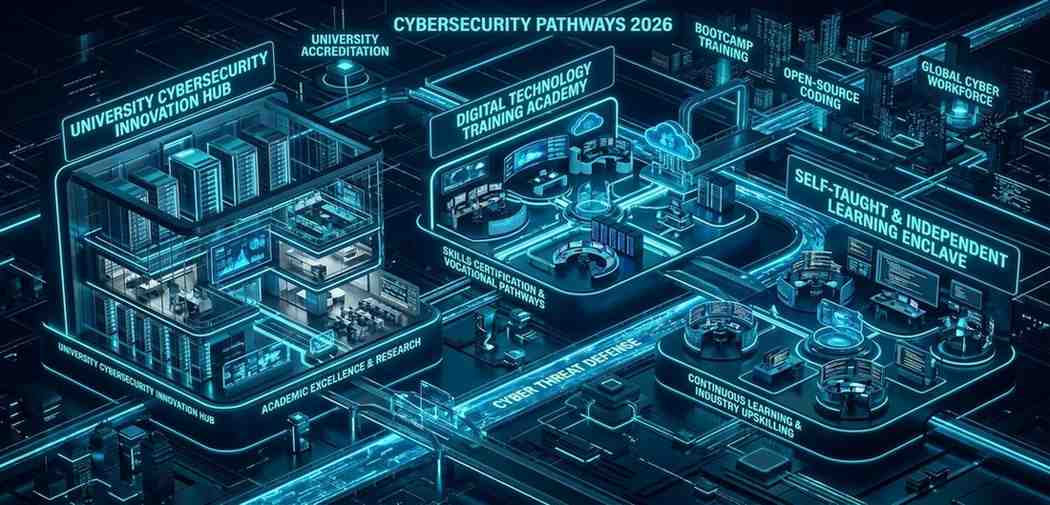
Bootcamp vs. College vs. Self-Study: 2026 Comparison Matrix
To determine which educational training strategy best aligns with your timeline, financial budget, and technical employment aspirations, evaluate our complete comparative workforce analysis below:
| Training Pathway | Average Completion Time | Primary Instructional Focus | Ideal Candidate Profile |
|---|---|---|---|
| University Degree (B.S. or A.S.) | 2 to 4 Years | Computer science theory, algorithm engineering, system governance, managerial accounting | Candidates aiming for structured corporate executive advancement and leadership |
| Intensive Cyber Security Bootcamp | 3 to 6 Months | Hands-on SIEM monitoring, log investigation, vulnerability scanning, alert triage | Career transitioners seeking immediate practical SOC operations preparation |
| Self-Study Certification Track | 6 to 12 Months | Exam-specific operational knowledge (Security+, Network+, CISSP) paired with virtual labs | Disciplined self-starters managing limited budgets and flexible schedules |
To review academic rigor, university dropout percentages, and technical mathematical requirements across degree programs, inspect our foundational evaluation: Is Cyber Security Hard? 2026 Career, Major and Degree Guide.
Securing Cyber Security Jobs No Degree Required: Actionable Plan
You can successfully build an IT career without college credentials by presenting hiring managers with verifiable operational evidence. Applicants pursuing technical employment via non-degree channels achieve professional success by mastering three critical verification milestones:
- Obtain Standard Industry Credentials: Earning baseline functional certifications such as CompTIA Network+ and CompTIA Security+ confirms to enterprise human resources engines that you master core TCP/IP fundamentals and data encryption concepts.
- Document Home Virtual Laboratory Work: Building a personal computing home lab using tools like Oracle VirtualBox, pfSense firewalls, and Security-Onion SIEM allows you to capture actual packet analyses and write professional diagnostic reports for your resume portfolio.
- Master Core SOC Analytical Routines: Familiarize yourself with how defensive team engineers analyze automated intrusion alarms and construct incident timelines during active operational shifts.
To examine exact daily tasks, shift routines, and telemetry platforms utilized by working IT defenders, study our practical workplace guide: What Does a Cyber Security Analyst Do? (2026 SOC Job Guide).
To understand why commercial enterprises spend billions annually hiring defensive technical talent to guard decentralized databases and cloud infrastructures, review our commercial intelligence report: Why is Cyber Security Important? The Real 2026 Corporate Risk Guide.
Frequently Asked Questions: Cybersecurity Degrees in 2026
What classes are required for a cyber security degree?
Standard academic curricula require coursework in networking architecture (TCP/IP communication protocols), Linux and Windows server system administration, fundamental computer programming script logic (Python or PowerShell), database architecture, digital forensic interrogation, and corporate compliance law.
What can you do with a cyber security degree upon graduation?
University degree holders qualify for widespread operational IT roles, including Security Operations Center (SOC) Triage Analyst, Network Security Administrator, Vulnerability Assessment Specialist, Governance Compliance Auditor (GRC), and Junior Penetration Tester across enterprise corporations and federal public agencies.
Are cyber security bootcamps worth the commercial tuition in 2026?
Reputable cybersecurity bootcamps offer significant professional value for individuals transitioning from non-technical professions who require rapid, hands-on software operational proficiency. Prospective candidates should prioritize academies that offer direct interactive training on recognized enterprise SIEM platforms and prepare students to sit for accredited certification examinations.
Where can I view official government workforce definitions for cybersecurity jobs?
You can explore verified technical competence competencies and organizational employment standards directly via the official NIST NICE Cybersecurity Workforce Framework (.gov), which publishes federal guidelines across all specialized corporate security domains.
Reported by CyberUpdates365 Threat & Career Operations Desk
Delivering verified architectural intelligence on enterprise cybersecurity careers, university degree evaluation standards, technical training bootcamps, and SOC defensive workflows. All evaluation frameworks align strictly with United States NIST NICE (National Initiative for Cybersecurity Education) mandates and CISA workforce directives. (Updated July 31, 2026)