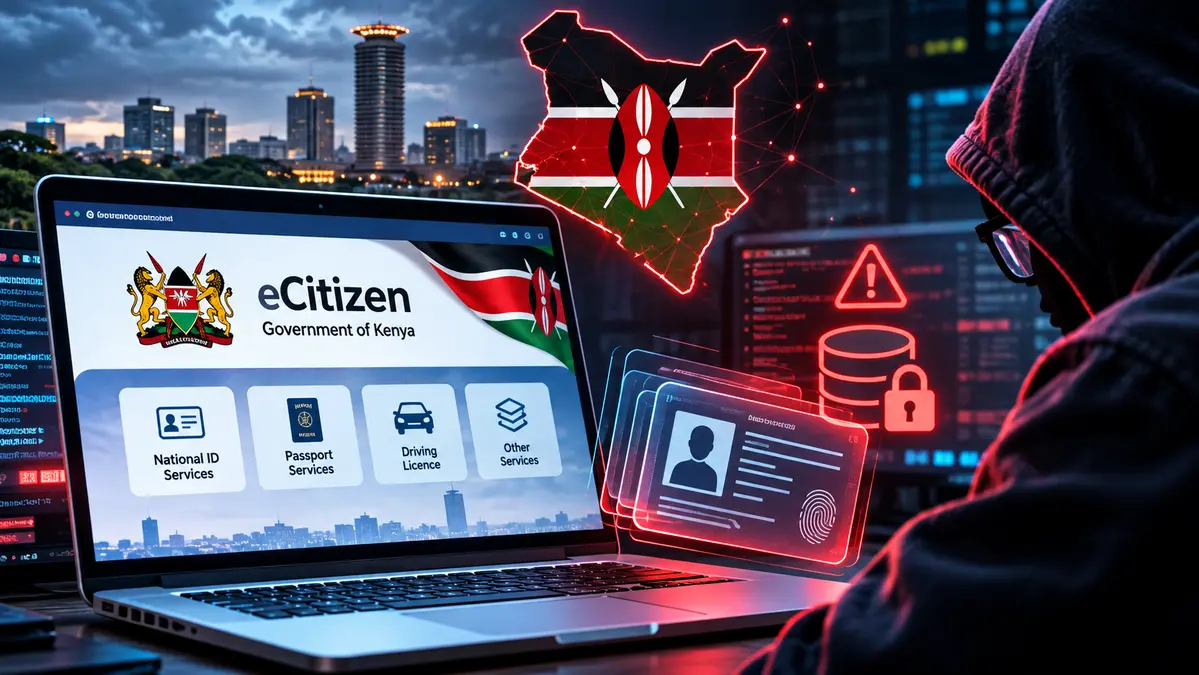
Kenya’s eCitizen data breach claim has raised concerns about the security of government identity records after a cybercriminal group alleged that it stole 740GB of information from the country’s digital services platform. A Kenyan newspaper says it reviewed files associated with more than 32 million people, but government investigators have not publicly confirmed the reported scale or source of the exposure.
The alleged attack has also become the subject of conflicting public statements. Kenya’s State Department for Immigration and Citizen Services said on November 24, 2026, that it was investigating reports of unauthorized access. On November 28, a senior executive at the company behind eCitizen disputed the breach allegations and questioned whether the purported records had been authenticated.
That distinction matters for users. There is credible reporting that purported identity files have circulated, but the number of genuinely affected individuals, the origin of the records and the attacker’s claimed access to connected government systems remain unresolved.
What Is Known About the Kenya eCitizen Breach Claim?
eCitizen is Kenya’s central online gateway for government services, including identity documents, passport applications, business registration, driving licenses and government payments.
A threat actor using the name ByteToBreach claimed responsibility for stealing records from the platform in November 2026. The allegation attracted wider attention after cybersecurity monitoring accounts reported the group’s underground forum posts.
On November 28, Kenya’s Daily Nation reported that files it reviewed appeared to contain information relating to 32,128,394 Kenyans. The newspaper described national identification details, photographs, passport records and other sensitive information among the purportedly exposed files.
The newspaper’s inspection is more substantial evidence than an anonymous forum advertisement alone. However, it does not automatically establish that every record is authentic, that each affected person has had all categories of information exposed, or that the records came directly from a successful compromise of eCitizen infrastructure.
| Issue | Current evidence and status |
|---|---|
| 740GB reportedly stolen | Claimed by ByteToBreach; total theft volume not independently established |
| 32,128,394 identity records | Reported by Daily Nation after reviewing purportedly leaked files; official affected-person count not confirmed |
| Government investigation | Confirmed by Kenya’s State Department for Immigration and Citizen Services |
| Successful breach of eCitizen infrastructure | Disputed by a senior executive of the platform’s technology operator; forensic findings not publicly established |
| Compromise of connected agencies | Claimed as a possibility by the attacker; no separately confirmed intrusions identified in the reporting reviewed |
| Government services | Officials said eCitizen services remained available during the investigation |
What Data Did ByteToBreach Claim to Steal?
ByteToBreach described a collection of roughly 740GB of information divided into three categories:
- 600GB of Know Your Customer (KYC) documents: Identity verification material that could include scans of national IDs, passports or related records.
- 100GB of database content: Alleged structured information from underlying systems.
- 40GB of source code: Alleged application code that could reveal implementation details if genuine.
These figures come from the threat actor’s claims, not a publicly released official forensic inventory.
Daily Nation separately reported seeing records containing national identity numbers, dates of birth, passport copies, passport-style photographs, Kenya Revenue Authority PINs, fingerprints and digital health identification numbers associated with the Social Health Authority.
Those categories do not establish that underlying medical histories were stolen. A health identification number can create privacy and impersonation risks without proving that confidential clinical records were accessed.
It is also important not to describe every record in the alleged collection as already publicly exposed. A reported database containing millions of records and proof that all of those records have been published are different findings.
Kenyan Authorities Investigate as Platform Executive Disputes the Claims
On November 24, Kenya’s State Department for Immigration and Citizen Services acknowledged reports of unauthorized access to eCitizen data and said technical and security teams were investigating with relevant government agencies.
The department said public services remained operational and indicated that additional information would follow when the investigation was complete.
A separate statement on November 28 from David Kiprono, a senior executive at Electronic Citizen Solutions, challenged reports of a successful compromise. Kiprono said the company’s historical security records did not show a successful cyberattack resulting in eCitizen data loss.
He also argued that an advertisement for purportedly stolen files, screenshots of database tables and proof of a verified intrusion represent different levels of evidence.
His statements do not establish that the purported data is false. Equally, a criminal group’s advertisement does not establish that the alleged attack occurred exactly as described.
The unresolved questions are whether investigators can authenticate the samples, determine their source, establish the relevant time period and connect the material to unauthorized access against current eCitizen systems.
How Did the Alleged eCitizen Attack Happen?
According to the attacker’s account and logs described by Daily Nation, the initial access may have involved a vulnerable file-upload function.
ByteToBreach reportedly claimed that this weakness allowed it to deploy a web shell, a server-side script that can give an attacker a way to run commands remotely after obtaining access.
The attacker also alleged access to elements of eCitizen’s identity and single sign-on infrastructure. Such a compromise could pose wider risks where multiple government services rely on shared authentication.
However, no publicly established forensic report reviewed for this article confirms that a particular file-upload flaw was successfully exploited, that a web shell was deployed on a verified production server, or that the central authentication service was compromised.
The Social Health Authority, Directorate of Criminal Investigations and National Police Service were discussed in connection with the alleged risks, but the reporting did not establish separate successful intrusions into their systems.
Security teams should therefore treat the proposed intrusion chain as an investigation lead, not as a fully verified technical reconstruction.
What Risks Could the Alleged Exposure Create for Kenyans?
If the purported records are authentic, the biggest immediate concern is identity-based fraud. Unlike an ordinary password, a national identity number, passport scan or biometric identifier may be difficult or impossible to replace.
Government Impersonation and Payment Scams
Fraudsters could use personal details to make fake government notices more convincing. Messages might falsely demand a payment to restore an eCitizen account, renew a document or prevent an alleged identity suspension.
The publicity surrounding the claim also creates an opportunity for scammers even if the underlying breach remains unconfirmed.
Account Recovery and Identity Verification Abuse
Stolen identity documents could potentially be used during account recovery, fraudulent onboarding or other identity checks that rely too heavily on static personal information.
This is why changing a password is useful but cannot reverse exposure of an identification document or biometric record.
Potential Risks to Connected Organizations
If the attacker’s separate claims about authentication infrastructure were substantiated, organizations using connected eCitizen services would need to investigate possible credential, token or session abuse.
At present, that scenario remains conditional. Organizations should not assume their systems were breached solely because the threat actor named an integration.
What Should eCitizen Users Do Now?
People who use the portal do not need to wait for final forensic findings to take basic precautions against impersonation and account misuse.
- Use the official eCitizen portal directly. Avoid links in unsolicited SMS, WhatsApp messages and emails claiming to provide breach notifications or account restoration.
- Change your eCitizen password if it is reused elsewhere, weak or potentially exposed. Choose a unique password and update other accounts where the same credentials were used.
- Keep one-time codes private. Do not share an OTP, government account password or M-PESA PIN with callers, brokers or anyone claiming to offer urgent assistance.
- Review registered contact details. Make sure the email address and phone number associated with your account are controlled by you.
- Watch for identity-related fraud. Treat unexpected loan inquiries, account recovery notices, SIM-swap messages or payment demands as warning signs that require independent verification.
- Preserve suspicious messages. Retain screenshots, sender information and transaction details when reporting possible fraud through legitimate official channels.
Users should follow official statements for information about notification procedures, confirmed data categories and any additional protective steps. Avoid downloading alleged breach samples to check whether your information appears in them.
What Government Agencies and Service Providers Should Check
Organizations responsible for eCitizen-connected infrastructure can respond proportionately without assuming that every allegation has been proved.
Relevant technical checks include:
- Reviewing application and reverse-proxy logs for anomalous file uploads, unexpected executable content and suspicious administrative activity.
- Checking for web shells, unauthorized scheduled tasks, modified application files and unusual outbound connections.
- Auditing access to identity-document repositories and identifying atypical bulk downloads or database exports.
- Reviewing OAuth and single sign-on clients for unexpected registrations, token activity, excessive permissions or unusual login locations.
- Rotating potentially exposed credentials or integration secrets where credible indicators justify it, while coordinating changes to avoid unnecessary service disruption.
- Preserving forensic evidence and maintaining clear records of which claims have been independently corroborated.
A November 26 advisory from SCIAT AFRICA similarly recommended increased scrutiny of identity verification processes, account recovery, federated authentication and phishing risks while the incident remains under investigation.
CyberUpdates365 Analysis: What Evidence Would Settle the Dispute?
The most important distinction in the Kenya eCitizen story is between reported access to sensitive records and verified attribution of those records to a compromise of the current government platform.
The attacker’s claimed archive size, the newspaper’s review of purportedly leaked records and the operator’s denial all need to be considered separately. None should be silently substituted for the others.
A useful public incident update would clarify the following:
- Whether investigators authenticated the reported file samples.
- Which systems originally held the records and whether those systems experienced unauthorized access.
- Whether the data was recently extracted, collected from another source or assembled from older datasets.
- How many unique individuals were affected and which information categories were involved.
- Whether identity and authentication services were compromised.
- What notifications and remediation steps are being provided to affected people.
For a broader explanation of how to distinguish confirmed disclosures from attacker claims, see CyberUpdates365’s Data Breach Coverage: Evidence, Claims and Response Guide.
For US-based cybersecurity teams, this case also offers a transferable lesson: identity repositories and shared authentication systems can create concentrated risk when many services depend on them. Strong access controls, logging, data minimization and independent evidence review matter even before the final scope of an incident is known.
What Happens Next?
As of November 29, 2026, Kenya’s government investigation had been publicly acknowledged, but the complete alleged data theft and affected-person count had not been established through an official forensic disclosure reviewed for this article.
The central questions are whether the reported files are authentic, where they came from and what users of the platform should do if their information was exposed.
Until those findings become available, the most responsible description is a serious and disputed eCitizen breach claim involving reports of sensitive records associated with roughly 32 million people—not a conclusively established government breach of that scale.
Sources and Verification
- Cyber Security News — Kenya eCitizen Data Breach Report, November 28, 2026.
- Daily Nation — Reporting on purported records relating to 32 million Kenyans, November 28, 2026.
- Citizen Digital — Kenya’s State Department investigation statement, November 24, 2026.
- Nairobi Leo — Electronic Citizen Solutions executive response, November 28, 2026.
- SCIAT AFRICA — eCitizen Breach Claim and Associated Fraud Risk Advisory, November 26, 2026.
Editorial note: CyberUpdates365 has not independently authenticated the alleged stolen files or performed forensic testing of eCitizen infrastructure. Reported data volumes, the attacker’s account of initial access and the number of potentially affected individuals are attributed to their respective sources. Official and operator statements are distinguished from independently verified technical findings.