
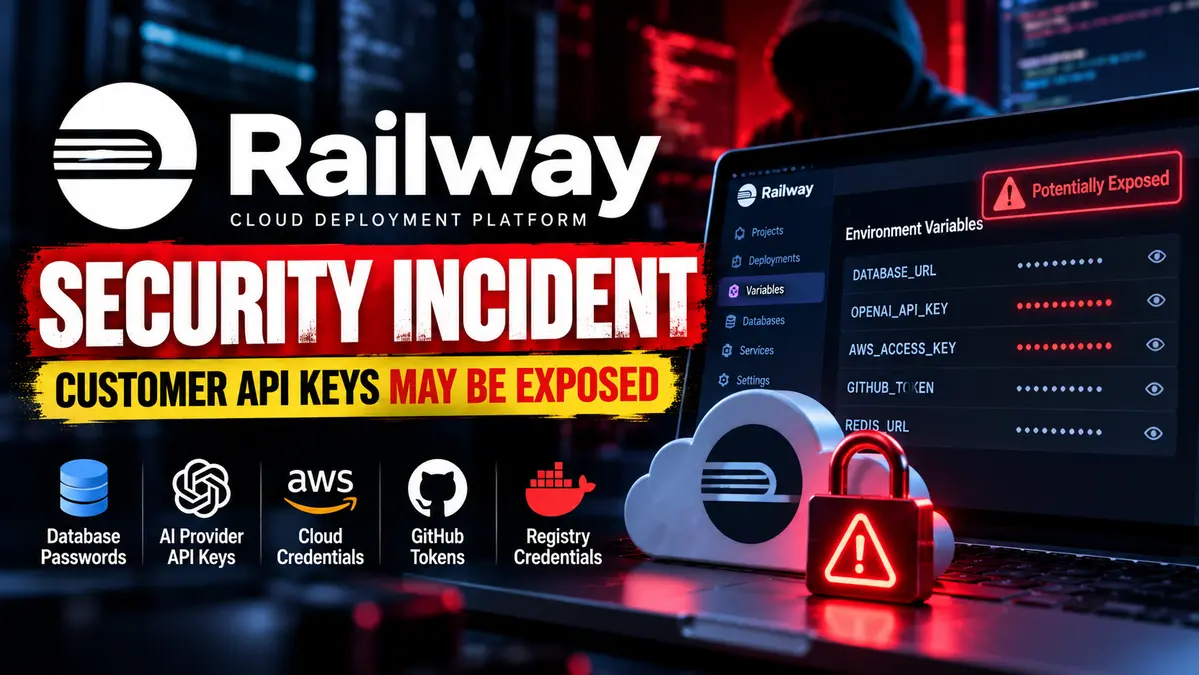
A Railway security incident has prompted urgent credential rotation after the cloud deployment platform warned that an unauthorized party may have accessed customer environment variables, including decrypted secrets used by hosted applications.
Railway disclosed the incident on October 21, 2026, after detecting unusual activity in systems responsible for storing customer configuration values. The company said potentially exposed information could include API keys, database passwords and private container registry credentials.
Although Railway’s preliminary investigation suggests the impact may be limited to a subset of customers, it advised every user to rotate the secrets stored on the platform rather than waiting for confirmation that an individual account was affected.
The response also disrupted application deployments. Railway temporarily suspended builds and began restoring them in stages, starting with Enterprise workspaces.
Railway has not disclosed the number of affected customers, the attacker’s identity or a confirmed initial-access method. It has also not established that every stored environment variable was decrypted or accessed.
For additional guidance on verifying breach claims, assessing exposed credentials and responding to security incidents, see our Data Breach Coverage and Response Guide.
Key Findings From the Railway Security Incident
- Disclosure date: October 21, 2026.
- Affected service: Railway’s customer environment-variable storage systems.
- Potential exposure: Encrypted environment variables and decrypted contents of some variables.
- At-risk secrets: API keys, database passwords, cloud credentials and private registry credentials.
- Customer impact: Initial findings suggest a subset may be affected; the number remains unknown.
- Recommended action: Immediately rotate all Railway-stored secrets and investigate connected services.
- Operational disruption: Builds and deployments were temporarily paused.
- Recovery update: Enterprise builds were available by 03:32 UTC on October 22, with other plans scheduled to follow in stages.
- Automatic resets: Railway invalidated and regenerated storage-bucket credentials and reset GitHub connection credentials.
- Suspected broader objective: Railway believes the activity may relate to attacks against platform companies targeting AI inference providers.
- Unknown: Confirmed initial entry point, affected account count and extent of downstream misuse.
Railway Security Incident: What the Company Disclosed
Railway is a cloud application hosting platform used by developers to build, deploy and operate services without managing all the underlying infrastructure directly.
Applications deployed on the platform commonly depend on environment variables for configuration.
These variables can hold database connection strings, API tokens, application secrets, cloud access credentials and keys used by third-party services.
On October 21, Railway reported anomalous activity involving the systems that store those variables.
Its investigation indicated that an unauthorized third party may have accessed encrypted values and obtained decrypted contents for some of them.
That distinction matters.
Railway did not announce that its encryption algorithm had been broken. The public notice does not explain how readable values may have been obtained.
Possible access to a secret-storage service and successful cryptographic decryption are different technical claims. The available disclosure does not establish the precise mechanism.
Nor does it confirm that every customer’s stored configuration was accessed.
Nevertheless, the potential consequences are significant enough that Railway instructed all customers to rotate their stored secrets as a precaution.
Which Railway Environment Variables Could Be Exposed?
Environment variables often contain credentials necessary for an application to interact with other systems.
For a typical production service, those secrets might include:
- Database credentials: PostgreSQL, MySQL, MongoDB and Redis connection passwords.
- AI provider API keys: Tokens for services such as OpenAI, Anthropic, OpenRouter or xAI.
- Cloud access keys: Credentials for AWS, GCP or other infrastructure providers.
- GitHub credentials: Tokens used for source-code access or private registries.
- Object-storage credentials: S3-compatible bucket access keys.
- Payment service keys: Stripe or similar third-party API credentials.
- Application secrets: Session-signing keys, webhook secrets and service-to-service authentication tokens.
This list represents the kinds of values that customers may store in Railway environments. It does not mean Railway has confirmed that each category was stolen.
Actual exposure depends on which credentials a customer stored, whether those values were among the accessed records and what permissions the credentials carried.
A credential with broad production access could create a larger downstream risk than a narrowly scoped, short-lived token.
That is why the company’s response guidance emphasizes both secret rotation and reviewing connected-service logs for unusual activity.
Why Potentially Decrypted Secrets Are a Serious Risk
When a cloud platform stores customer secrets, protecting them requires more than encrypting values at rest.
Applications must eventually obtain usable credentials to connect to databases, APIs and other services.
If an attacker reaches a point where readable secret values are available, those credentials may be usable outside the original application.
For example, a database password can provide access to a database if the attacker can reach its network endpoint and the associated account permits authentication.
An exposed AI provider token could allow unauthorized API calls and potentially create unexpected charges.
A registry token could permit access to private images or artifacts, depending on its permissions.
However, possession of a credential does not automatically establish that an attacker successfully accessed every connected resource.
Network restrictions, role permissions, token expiration and additional access controls may limit what an exposed secret can accomplish.
The correct response is to revoke credentials proactively and investigate any suspicious activity rather than treating all possible consequences as confirmed breaches.
Railway Links the Incident to Possible AI Provider Targeting
Railway believes the incident may be connected to a broader series of attacks against platform companies intended to compromise AI inference providers.
AI inference providers operate services that process requests to hosted AI models.
Applications commonly connect to these providers using API keys stored in their deployment environments.
An attacker who obtains such a key may be able to submit requests against the corresponding account, subject to its permissions, rate limits and account controls.
That could lead to unauthorized model usage, billing impact or access to resources made available through the compromised identity.
Railway said it had notified upstream providers and asked them to revoke keys proactively.
However, the company has not publicly identified the responsible threat actor or demonstrated that any specific AI provider was compromised through this incident.
It would therefore be inaccurate to present the suspected objective as confirmed evidence of a successful attack against OpenAI, Anthropic or another named provider.
The relevance of AI credentials lies in their value to attackers, not in a verified downstream victim count.
Railway Paused Deployments During the Investigation
The incident also created a significant operational problem for customers.
Railway paused builds and deployments while investigating and restoring its infrastructure.
That meant customers could not immediately roll out new application versions through the affected build pipeline.
The deployment restriction complicated credential rotation.
Updating a secret in the Railway dashboard does not necessarily cause an already running application process to read the replacement value.
Applications commonly load environment variables when a container or process starts.
As a result, a redeployment may be required before the workload begins using a newly issued credential.
Railway’s official status page reported that Enterprise workspace builds had become available by 03:32 UTC on October 22.
At that point, the company said Pro, Hobby, Free and Trial workspaces would regain build access in stages.
This was a recovery snapshot, not a guarantee that the same service status would remain unchanged throughout the day.
Customers should check Railway’s live status page before attempting redeployment or scheduling urgent changes.
Railway Automatically Reset Bucket and GitHub Credentials
Railway took additional steps beyond recommending customer-initiated rotation.
On October 22, the company published guidance confirming that it had invalidated and regenerated S3-compatible storage-bucket credentials.
Each bucket received replacement access credentials, while bucket names, endpoints and stored objects remained unchanged.
Applications using Railway variable references should obtain the replacement values when their services are redeployed.
Applications containing manually copied credentials may require administrators to replace those values explicitly.
Railway also invalidated the GitHub connection tokens it held for connected accounts.
Customers must reconnect GitHub integrations where required.
Importantly, the company warned that GitHub registry tokens removed from Railway can remain valid at GitHub until their owners revoke them.
Deleting a credential from the hosting platform is not equivalent to revoking it at the service that issued it.
Administrators should therefore distinguish between credentials Railway has already invalidated and external credentials that still require independent action.
What Railway Customers Should Do Immediately
Railway’s recommendation is to treat secrets stored on the platform as potentially exposed until the investigation provides a narrower assessment.
For production environments, a structured response can reduce both security exposure and unnecessary application downtime.
1. Inventory Railway Projects and Stored Secrets
Identify all affected workspaces, environments and services.
Review each service’s Variables tab and determine which secrets are stored directly, inherited from shared variables or referenced from other services.
Include development, staging and production environments.
Look for credentials associated with databases, model providers, GitHub, cloud accounts, payment gateways, internal APIs and object storage.
Do not export secret values into unsecured spreadsheets, public support tickets or shared chat messages during the inventory.
2. Revoke API Keys at Their Issuing Services
For credentials issued by external providers, use the provider’s console or supported API to invalidate the existing key.
Generate a replacement with the minimum permissions required by the application.
Where possible, record the last-used timestamp and preserve appropriate access logs before deleting evidence necessary for an investigation.
Do not assume that changing a variable’s value in Railway invalidates the original secret.
The old token may remain usable until the issuing provider revokes it.
3. Rotate Database Passwords
For Railway-managed PostgreSQL, MySQL, MongoDB and Redis deployments, follow the corresponding official recovery guidance.
Railway provides product-specific workflows for regenerating passwords and updating referenced environment variables.
Administrators should identify every service consuming each database credential before rotation.
When a credential is suspected of compromise, revoking the old value takes priority over avoiding every possible moment of application disruption.
Where database logs are available, investigate authentication activity and unusual queries during the relevant period.
4. Review AI Provider Account Usage
Customers storing OpenAI, Anthropic, OpenRouter or xAI credentials should inspect the relevant account’s usage and billing interfaces.
Look for unexplained requests, unexpected model usage, unusual timestamps, rapid increases in token consumption and unknown clients.
Compare suspected activity with the application’s normal traffic patterns.
Railway has published separate guidance for checking unexpected OpenAI, Anthropic, OpenRouter and Grok usage.
An unusual increase in spend can justify further investigation, but spending anomalies alone do not conclusively establish the source of compromise.
5. Review GitHub and Registry Access
Check GitHub security logs, active authorizations, personal access tokens and connected applications.
Reconnect Railway integrations using the company’s published instructions.
Revoke any GitHub registry credentials that were previously stored in Railway and remain valid at GitHub.
Investigate unexpected source-code access, repository changes, package publishing and deployment activity.
6. Redeploy Services After Secret Replacement
When builds are available for the customer’s plan, redeploy services that depend on rotated environment variables.
For a storage-bucket consumer, Railway documents a service-specific redeployment command:
railway redeploy --service uploads-apiThe example service name must be replaced with the actual service identifier, and the CLI must be authenticated to the correct workspace and project.
Administrators can also use the Railway dashboard’s deployment controls.
After redeployment, verify that workloads use new credentials and no longer attempt to authenticate with revoked ones.
How to Investigate AWS, GitHub and Database Misuse
Secret rotation should be paired with an investigation into what an exposed credential could have accessed.
AWS CloudTrail
For an AWS access key stored in Railway, examine CloudTrail activity associated with the affected identity.
Review unexpected API calls, changes to IAM policies, creation of new credentials, changes to logging and unusual resource provisioning.
Correlate activity with known application regions, deployment times and expected services.
Railway has published a dedicated AWS investigation guide recommending key deactivation, replacement, log review and inspection of unexpected charges.
GitHub Security Logs
For connected GitHub accounts, review recent authentication and authorization events.
Pay attention to newly authorized applications, created tokens, SSH keys, unusual repository operations and unexpected access from unfamiliar environments.
Remove or revoke unknown access mechanisms and investigate any suspicious repository changes.
Database Audit Logs
Review successful and failed authentication attempts, unexpected client addresses and changes to privileged database accounts.
If query auditing was already enabled, correlate suspicious activity with the affected credentials.
The absence of detailed database query logs should be documented as a visibility limitation rather than interpreted as proof that no misuse occurred.
How to Verify Recovery After Rotating Secrets
Administrators should not mark incident remediation complete simply because new secrets have been entered into Railway.
The recovery process requires verification across both Railway and connected services.
- Secret revocation: Confirm old API keys and passwords are invalid at the issuing provider.
- Application deployment: Confirm each service has restarted or redeployed with the replacement values.
- Database connectivity: Verify applications connect successfully using new credentials.
- Storage access: Check that bucket operations work with regenerated access keys.
- GitHub integration: Confirm legitimate repository connections and deployment triggers work after reconnection.
- AI API billing: Monitor usage after rotation for unauthorized activity.
- Audit trails: Preserve evidence of unusual access and the remediation timeline.
- Environment coverage: Repeat the checks across production, staging and development where relevant.
Services repeatedly reporting authentication failures after rotation may still be running with an old deployment or a manually copied credential.
In such cases, inspect variable references and deployment configuration before issuing additional secrets.
Organizations should also verify that revoked credentials were not copied into unrelated CI/CD systems, local developer environments or other cloud services.
Confirmed vs Unknown: What the Railway Disclosure Establishes
Confirmed by Railway
- Railway detected anomalous activity affecting systems used to store customer environment variables.
- Its investigation indicated possible unauthorized access to encrypted variables and decrypted contents of some values.
- The company advised all customers to rotate stored secrets.
- Railway temporarily paused builds and deployments.
- Enterprise builds began returning by 03:32 UTC on October 22.
- Railway invalidated and regenerated storage-bucket credentials.
- GitHub connection tokens held by Railway were reset.
- Customers were provided additional guidance for database, cloud, GitHub and AI-provider credentials.
Unknown or Not Established
- The exact number of affected customer accounts.
- Whether all stored environment variables were accessed.
- The method used to obtain plaintext values.
- The initial vulnerability or access path exploited by the attacker.
- The identity of the responsible threat actor.
- The total number of secrets actually used maliciously.
- Whether any specific AI inference provider was successfully compromised.
- The complete incident timeline and final recovery status.
These uncertainties should remain visible as the investigation develops. A precautionary credential reset is not evidence that every credential was stolen.
CyberUpdates365 Analysis
The Railway incident highlights a central risk of modern cloud deployment platforms: application secrets are concentrated in systems that must deliver them securely to running workloads.
Environment variables are convenient because they separate configuration from source code.
However, the same convenience makes centralized secret storage particularly sensitive.
A single application environment may contain credentials for databases, cloud accounts, AI providers and private software registries.
When the security of the secret-storage layer is in question, the impact can extend far beyond one application.
That is why credential rotation must happen at the issuing service, not only inside a deployment dashboard.
The incident also exposes a practical challenge in cloud recovery.
Security teams may need to invalidate credentials immediately while deployment teams temporarily lack the ability to roll out applications using replacements.
Railway’s staged restoration of builds shows how incident containment and service availability can create competing operational demands.
Well-designed recovery procedures should identify critical applications, their credential dependencies and the order in which services must be restored.
The company’s decision to reset bucket and GitHub connection credentials reduces the risk posed by old access material but creates additional work for customers.
Organizations can reduce future recovery complexity by using narrowly scoped tokens, short-lived credentials where supported and reference-based variable management.
Audit logs, service-level usage monitoring and a reliable inventory of secret ownership are equally important.
The suspected targeting of AI inference services also reinforces the value of monitoring AI API consumption as a security signal.
Unauthorized model usage can become a financial and operational concern even when traditional indicators such as ransomware or destructive malware are absent.
Still, the public investigation does not prove that the Railway incident resulted in any specific downstream AI-provider compromise.
The practical lesson is that credential rotation, connected-service investigation and verified redeployment must operate as one coordinated incident-response process.
Research Evidence
- Vendor: Railway.
- Official disclosure: October 21, 2026.
- Potentially accessed information: Customer environment variables.
- Possible plaintext exposure: Some stored environment-variable values.
- Potential credential categories: API keys, database passwords, cloud tokens and registry credentials.
- Initial affected-user scope: Suspected subset; count unknown.
- Official guidance: Rotate all stored secrets and investigate connected services.
- Build disruption: Deployments paused during investigation.
- Enterprise recovery update: October 22 at 03:32 UTC.
- Railway-managed credential resets: Storage buckets and GitHub connections.
- Suspected attacker objective: Access to AI inference providers, according to Railway.
- Confirmed initial access: Not disclosed.
- Named threat actor: Not disclosed.
- Confirmed downstream victims: Not disclosed.
Frequently Asked Questions
Was Railway hacked in October 2026?
Railway disclosed suspicious activity involving its customer environment-variable storage systems and said an unauthorized third party may have accessed encrypted variables and decrypted contents of some values. Its investigation remains ongoing.
What customer information may have been exposed?
Potentially exposed environment variables can contain API keys, database credentials, cloud secrets and private registry tokens. Railway has not published a complete account-by-account exposure list.
Should every Railway customer rotate secrets?
Yes. Railway advised all customers to rotate stored environment variables and private registry credentials as a precaution, even though initial findings suggested the impact might be limited to a subset.
Did attackers break Railway’s encryption?
Railway did not establish that its encryption algorithm was broken. The public disclosure does not explain precisely how some decrypted values may have been obtained.
Were Railway deployments paused?
Yes. Builds and deployments were paused during the response. By 03:32 UTC on October 22, Railway reported that Enterprise builds had resumed, with other plans to follow in stages.
Did Railway reset GitHub and storage credentials?
Yes. Railway said it invalidated stored GitHub connection tokens and regenerated storage-bucket credentials. Customers may need to reconnect integrations, revoke external registry tokens and redeploy services.
Were OpenAI or Anthropic accounts compromised?
Railway suspects the incident may relate to attempts targeting AI inference providers, but it has not established that any named AI provider was compromised through this event. Customers should review usage for unexpected activity.
What should DevOps teams verify after recovery?
Confirm that old secrets have been revoked, applications use replacement credentials, databases and storage services work, GitHub connections are restored and connected-service logs show no unexplained activity.
Final Takeaway
The October 2026 Railway security incident raises concerns about customer environment-variable exposure and the potential misuse of credentials stored in cloud deployment systems.
Railway has advised all users to rotate secrets while its investigation continues, and it has taken additional steps to reset storage-bucket and GitHub connection credentials.
Temporary deployment restrictions complicated recovery, although Enterprise builds began returning on October 22.
The full scope remains unknown. There is no verified public count of compromised customers, stolen secrets or downstream victims.
For Railway customers, the priority is immediate credential revocation followed by connected-service investigation and verified application redeployment.
Could exposed developer credentials turn a single cloud incident into a wider software supply-chain attack?
Railway’s disclosure highlights the risk of secrets used by connected services. Our LiteLLM investigation examines a separate confirmed incident in which stolen developer credentials allowed attackers to poison an official software release.
Read: LiteLLM Supply Chain Attack Compromises Version 1.107.0 →