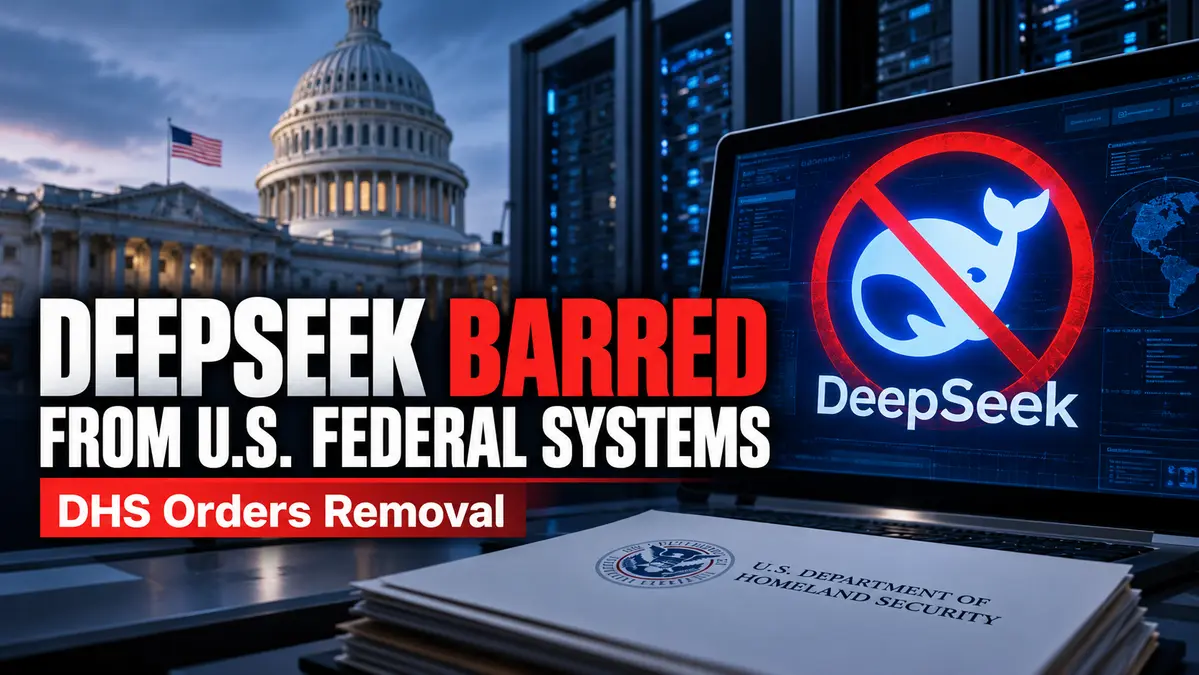
The DeepSeek AI ban has expanded across U.S. federal civilian agencies after the Department of Homeland Security ordered the removal of covered technology developed by the Chinese artificial intelligence company and prohibited its inclusion in new agency procurements.
The directive reaches beyond DeepSeek’s publicly available chatbot. It also covers DeepSeek-affiliated technology and third-party products or services developed using DeepSeek implementations, potentially requiring agencies to review AI capabilities embedded inside software purchased from other suppliers.
The order was filed for public inspection on October 19, 2026, and scheduled for publication in the Federal Register on October 20.
Its scope is important. The action does not prohibit American consumers or private businesses generally from using DeepSeek. It applies to specified federal civilian agency technology and procurement activity.
The notice also does not identify a confirmed government data breach or establish that every DeepSeek deployment has leaked information. It is a government supply-chain restriction adopted through a statutory review process.
The decision highlights a broader problem for organizations adopting AI services: identifying which models, developers and external providers sit behind the applications they use.
For background on these technology and governance risks, see our AI Cyber Threats and Agentic Security Guide.
Key Findings From the DeepSeek AI Ban
- Issuing department: U.S. Department of Homeland Security.
- Official document: Federal Register Document 2026-21447.
- Publication date: October 20, 2026.
- Covered organization: Hangzhou DeepSeek Artificial Intelligence Co., Ltd. and defined affiliates.
- Procurement restriction: Federal civilian agencies must exclude covered DeepSeek products and services from procurement.
- Removal requirement: Covered DeepSeek technology must be removed from federal civilian agency IT systems.
- Third-party scope: The removal direction includes third-party products and services developed using DeepSeek implementations.
- Legal authority: Federal Acquisition Supply Chain Security Act of 2018.
- Review process: Federal Acquisition Security Council recommendation and supporting evidence.
- Public limitation: The notice does not provide a verified list of every affected third-party product or establish a specific data-theft incident.
What the U.S. Government DeepSeek Ban Actually Requires
The Department of Homeland Security’s action contains two distinct requirements.
The first is an exclusion from federal civilian agency procurement. Agencies may no longer acquire covered information technology products and services developed by DeepSeek or its defined affiliates under the terms of the order.
The second requirement concerns technology already present inside government environments.
Agencies must remove covered DeepSeek and DeepSeek-affiliate products, along with covered third-party products and services developed using DeepSeek implementations, from their civilian IT systems.
That makes the decision more consequential than a restriction on future purchases.
A government organization may need to examine both its existing software inventory and the underlying technologies supporting services supplied by outside vendors.
For example, an agency might use an application marketed under a different company name while the application relies on a DeepSeek implementation to generate responses or perform another AI function.
The vendor’s product name alone would not establish whether that technology falls within the order.
Agencies will need to determine what implementation is actually being used and how the relevant procurement rules apply.
The order does not provide a publicly available product-by-product classification covering every commercial AI platform.
Why Third-Party AI Implementations Matter
Modern AI applications rarely consist of a single self-contained product.
A software provider may build its user interface, business logic and data storage while relying on an externally developed language model for part of the service.
That model may be accessed through a hosted API, deployed through a cloud platform or incorporated into a larger application architecture.
The new DeepSeek restriction therefore raises questions that ordinary application inventories may not answer.
An agency may know which AI assistant its employees use without knowing the exact underlying models, providers and implementations used to deliver that service.
It may also have AI-dependent features inside existing productivity tools, development platforms or custom applications.
For federal buyers, this means procurement records and contracts may need to be considered alongside architecture documentation and technical configuration.
Security teams should distinguish the origin of an AI model from where a particular deployment processes data.
For example, a locally deployed model and a model accessed through a hosted service can have different data flows and operational risks, even if they share the same underlying model family.
However, the existence of local hosting should not be treated as an automatic exemption from an order that expressly covers certain implementations.
Agencies must assess the actual wording of the directive and seek appropriate procurement or legal guidance when determining whether a particular product is covered.
Why DHS Took Action Against DeepSeek
The order follows growing U.S. government scrutiny of AI technology supply chains and the national security implications of foreign-developed AI services.
Independent reporting described concerns that sensitive information handled through certain AI services could potentially be accessible outside U.S. government control.
Those concerns include how information is processed, where it is transferred and whether government organizations can verify the security of the technology they deploy.
Reuters also reported concerns involving possible intelligence collection and security weaknesses.
These concerns are the context for the restriction. They should not be presented as evidence that DeepSeek necessarily collected or transferred sensitive records from every government user.
The Federal Register notice frames the action under a federal supply-chain security process.
It does not publicly document a specific exploited vulnerability, identified attacker infrastructure or confirmed theft of government records as the immediate basis for every aspect of the decision.
That distinction matters because a procurement exclusion order and an incident-response advisory serve different purposes.
An incident advisory may describe a discovered compromise and technical containment measures.
A supply-chain exclusion can instead restrict technology following an assessment of risks associated with products, suppliers or their potential impact on federal systems.
Federal Acquisition Supply Chain Security Act: The Legal Basis
The Department of Homeland Security cited the Federal Acquisition Supply Chain Security Act of 2018, commonly known as FASCSA.
The law establishes a mechanism for addressing supply-chain security risks involving products and services used by the federal government.
The Federal Acquisition Security Council supports the review process and can recommend actions concerning technologies considered to present unacceptable supply-chain risks.
According to the notice, the Secretary of Homeland Security acted after reviewing a council recommendation and supporting evidence.
The order identifies Hangzhou DeepSeek Artificial Intelligence Co., Ltd. and affiliates defined under applicable federal acquisition regulations.
For agencies, this creates an acquisition and technology-removal obligation rather than a general public prohibition on all uses of artificial intelligence developed outside the United States.
The specific legal definitions matter when deciding whether a supplier, affiliate or third-party implementation is covered.
Procurement officials should therefore rely on the signed order and applicable federal guidance instead of assuming that every AI product with a similar technical architecture is automatically included.
Is DeepSeek Banned for All Americans?
No. The October 2026 directive is not a nationwide prohibition on private use of DeepSeek.
Its stated scope concerns federal civilian agency information technology and procurement.
The order does not generally prevent individual U.S. residents from accessing DeepSeek services or automatically prohibit every private company from deploying DeepSeek-based technology.
However, organizations supplying technology to affected federal agencies may face practical consequences if their products rely on implementations covered by the removal or procurement restrictions.
Government contractors should evaluate their obligations based on the relevant contracts, systems and agency guidance.
The current order also should not be confused with earlier DeepSeek restrictions involving other federal organizations.
For example, the Intelligence Authorization Act for Fiscal Year 2026 established separate requirements concerning DeepSeek on intelligence-community national security systems, including provisions for exceptions and risk mitigation.
That law addresses a different population of systems and should not be used to claim that the new civilian-agency order has identical terms or exceptions.
What Federal Agencies Should Check Before Removing DeepSeek
The practical challenge for government security teams is discovering where covered technology exists.
An organization cannot reliably complete removal if it knows only which standalone chatbot applications are installed.
1. Inventory AI Applications and Services
Start with the agency’s approved software inventory, AI service catalogue and existing procurement records.
Review installed applications, managed browser extensions, centrally deployed services, developer platforms and internally developed AI projects.
The goal is to identify both visible DeepSeek products and applications that may depend on DeepSeek implementations.
2. Examine AI Model Dependencies
For agency-owned applications, review deployment configuration and documentation to determine which model providers and implementations are used.
Relevant evidence may include model configuration files, API endpoints, service architecture diagrams, container configurations and vendor technical documentation.
A product may support multiple AI models, so teams should verify the implementation configured for the actual production environment.
Do not assume that every supported model is necessarily active or that changing a model’s display name changes the technology underneath it.
3. Review Third-Party Supplier Information
Contact vendors where product documentation does not identify the relevant AI dependencies.
Ask suppliers to explain whether their offerings use DeepSeek implementations and whether those components can be replaced or disabled.
Supplier assertions should be evaluated alongside contracts, architecture information and applicable agency acquisition requirements.
4. Identify Data Flows and Access Permissions
Map what information an AI application processes, where requests are sent and which identities or credentials it uses.
These checks help teams understand the operational impact of replacing a service and determine whether additional security investigation is needed.
A service’s model origin does not by itself establish that data was transferred to a particular country or accessed by an unauthorized party.
5. Plan Controlled Removal and Replacement
Removing a covered application may affect workflows that depend on its APIs, integrations or model behavior.
Agencies should identify service owners, replacement options and operational dependencies before making changes that could disrupt essential functions.
Security teams should coordinate with procurement, architecture and legal stakeholders so that technical remediation aligns with the actual order.
Removal Verification: How Agencies Can Confirm Compliance
A successful inventory is only the starting point.
After covered technology has been removed or replaced, agencies should verify that the changes are effective and appropriately documented.
- Confirm the scope: Compare identified products, suppliers and implementations with the signed order and applicable guidance.
- Verify deployed software: Review endpoint, server and application inventories after remediation.
- Inspect active integrations: Confirm that production applications are no longer configured to use implementations determined to be covered.
- Review procurement records: Ensure purchasing and renewal processes reflect applicable exclusions.
- Validate replacement services: Test functionality, authentication, logging and data handling after migration.
- Check vendor dependencies: Obtain updated technical documentation when third-party products are changed.
- Preserve evidence: Maintain records of inventory findings, scope decisions, changes and completion checks.
- Review recurring changes: Reassess model dependencies when suppliers update their products or introduce new AI features.
These are practical verification measures informed by the order’s scope, not a list of technical steps explicitly mandated in the public notice.
The notice does not provide a universal detection signature, affected software hash or single automated test that proves every system is compliant.
Similarly, blocking only the public DeepSeek website is not sufficient evidence that all covered third-party implementations have been removed.
What the DeepSeek AI Ban Means for Government Contractors
Companies providing software to federal civilian agencies may need to document how their products use artificial intelligence.
A supplier might offer an AI-enabled platform without prominently advertising which language model powers each feature.
That can create uncertainty when a government customer needs to establish whether a specific implementation is covered by a procurement restriction.
Vendors should be prepared to explain relevant model dependencies and support customers with reliable technical documentation.
Where covered technology is present, contractors may need to assess replacement options, service changes and contract implications with the affected agencies.
The order does not establish that every private-sector deployment of DeepSeek must be removed.
Nor does it automatically mean that using an open-weight AI model creates the same data-transfer risk as sending information to a hosted service.
The actual technical deployment, information flows and applicable contractual requirements remain important.
How This Fits Into Earlier U.S. DeepSeek Restrictions
The October 2026 DHS action follows previous efforts to restrict DeepSeek use within parts of the U.S. government.
Some agencies and state governments had already introduced restrictions on official devices or government systems.
Separately, federal intelligence legislation enacted in December 2025 addressed DeepSeek use on intelligence-community national security systems.
The new action extends restrictions within the federal civilian agency environment through an exclusion and removal order.
These measures have different legal authorities and covered systems.
They should not be combined into a claim that every American government system, contractor device or private computer is governed by one identical DeepSeek prohibition.
China’s government criticized the broader restrictions on Chinese AI technology, rejecting the use of national security arguments to limit its companies.
The U.S. position focuses on government security and technology supply-chain risk, while China’s stated position challenges the justification and treatment of its technology firms.
The relevant operational question for U.S. agencies remains the scope and implementation of the published federal order.
Confirmed vs Unknown: What the Order Establishes
Confirmed by the Government Notice
- DHS ordered the exclusion of covered DeepSeek technology from federal civilian agency procurements.
- DHS directed removal of covered DeepSeek and affiliated technology from civilian agency IT systems.
- The removal provision includes covered third-party products and services developed using DeepSeek implementations.
- The action cites the Federal Acquisition Supply Chain Security Act of 2018.
- The Secretary of Homeland Security acted following a Federal Acquisition Security Council recommendation and review of supporting evidence.
- The notice identifies DeepSeek by its corporate name and references applicable federal affiliate definitions.
Not Established by the Public Notice
- That DeepSeek caused a confirmed breach of U.S. civilian agency networks.
- That every DeepSeek deployment transmitted sensitive information to China.
- A complete list of all third-party products covered by the order.
- A universal technical indicator for identifying affected deployments.
- A specific public compliance deadline in the notice summary.
- That the directive prohibits ordinary private-sector or consumer use throughout the United States.
- That every locally hosted open-weight DeepSeek deployment has identical data flows or security risks.
These distinctions are essential when interpreting a supply-chain security order rather than a conventional malware alert or incident disclosure.
CyberUpdates365 Analysis
The most significant part of the DeepSeek decision is the shift from identifying individual AI applications to identifying the underlying technology embedded inside them.
Traditional software inventories usually answer a straightforward question: which product is installed or purchased?
AI-enabled services require an additional layer of visibility.
An agency must often determine which model powers a feature, who developed it, how it is hosted, which provider processes requests and whether a vendor can change that dependency without replacing the entire product.
Those details can affect procurement, cybersecurity risk and service continuity.
The DHS directive illustrates why AI supply-chain documentation is becoming operationally important rather than merely informative.
For government buyers, an incomplete dependency inventory can make it difficult to establish whether a restricted implementation is present.
For vendors, undocumented model changes may create compliance questions for customers even when the visible application interface remains unchanged.
There is also a difference between assessing the risks of a technology and proving that the technology has already caused a particular incident.
The public order supports a government decision to restrict covered products. It does not independently demonstrate a specific compromise involving every DeepSeek implementation.
The practical enterprise lesson is broader than the named supplier.
Organizations should know which AI technologies they operate, what information those technologies process and how changes to model dependencies can be reviewed and controlled.
AI supply-chain security requires visibility into the models behind applications, not just the applications employees can see.
Research Evidence
- Issuing authority: U.S. Department of Homeland Security.
- Official notice: Federal Register Document 2026-21447.
- DHS docket: DHS-2026-0628.
- Filed for public inspection: October 19, 2026.
- Publication date: October 20, 2026.
- Named company: Hangzhou DeepSeek Artificial Intelligence Co., Ltd.
- Legal framework: Federal Acquisition Supply Chain Security Act of 2018.
- Review body: Federal Acquisition Security Council.
- Primary action: Exclusion from federal civilian agency procurement.
- Additional action: Removal of covered technology from civilian agency IT systems.
- Third-party scope: Products and services developed using DeepSeek implementations.
- Publicly identified breach: None established by the notice.
- Nationwide consumer prohibition: No.
- Relevant earlier legislation: Intelligence Authorization Act for Fiscal Year 2026, Section 6604.
Frequently Asked Questions
Has the U.S. government banned DeepSeek AI?
The Department of Homeland Security has ordered federal civilian agencies to exclude covered DeepSeek technology from procurement and remove it from their IT systems. This is a government-specific restriction, not a nationwide ban on private use.
Does the DeepSeek AI ban apply to private companies?
The October 2026 order does not generally prohibit private businesses from using DeepSeek. However, suppliers and contractors serving affected government agencies may need to assess whether their products fall within the order’s scope.
Why did DHS restrict DeepSeek?
The order was issued through a federal supply-chain security review process. Reporting describes concerns about sensitive data, foreign access and security risks, but the notice does not establish a specific data breach affecting every deployment.
Are third-party AI tools included in the DeepSeek ban?
Yes. The removal requirement includes covered third-party products and services developed using DeepSeek implementations. Whether a specific product qualifies depends on its actual implementation and the order’s terms.
Are federal agencies required to remove existing DeepSeek installations?
Yes. The order includes removal of covered technology from federal civilian agency IT systems, in addition to restricting future procurement.
Does the restriction prove DeepSeek stole U.S. government data?
No. The public notice does not establish that DeepSeek stole government information or that every use of its technology resulted in a data leak.
Are locally deployed DeepSeek models automatically exempt?
Not necessarily. A local deployment can have different technical risks from a hosted service, but agencies must assess coverage under the actual wording of the order rather than assuming that local hosting creates an exemption.
What should government IT teams do now?
Review the signed directive, inventory AI products and dependencies, identify covered implementations, coordinate with procurement and vendors, and verify that required removal or replacement work has been completed.
Final Takeaway
The Department of Homeland Security has expanded restrictions on DeepSeek technology across federal civilian agency IT systems and procurements.
The order reaches beyond a branded chatbot to include covered third-party products and services developed using DeepSeek implementations.
It does not impose a nationwide ban on private use, nor does it establish that every DeepSeek deployment has compromised sensitive data.
For government agencies and technology suppliers, the immediate challenge is identifying covered AI dependencies and ensuring that procurement and deployment decisions reflect the applicable order.
The DeepSeek restriction makes one requirement increasingly clear: organizations must understand the AI supply chain behind the tools they deploy.
Do you know which AI models have access to your organization’s data and systems?
The DeepSeek restriction highlights the need for visibility into AI suppliers and dependencies. Discover why identifying AI systems is only the first step toward controlling what they can access and do.
Read: AI Agent Security — Why Visibility Alone Won’t Protect You →