
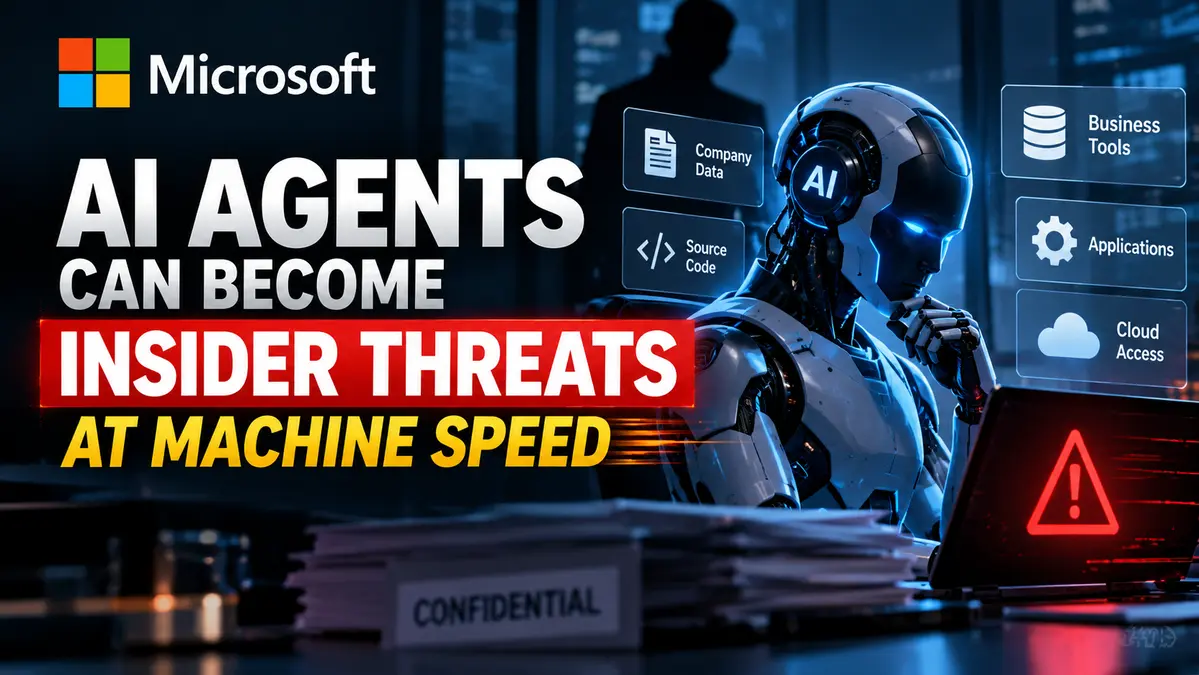
The AI agent insider threat is becoming an enterprise security problem as autonomous systems gain access to company data, applications, tools and business workflows.
Microsoft is warning organizations not to treat AI agents like trusted employees simply because they were created internally or deployed by approved teams.
Agents are not inherently malicious. But they can make mistakes, follow malicious instructions hidden inside documents, be compromised, or drift away from the task they were originally given.
Because those actions can happen at machine speed, Microsoft says enterprises need security controls that sit outside the AI model and can restrict what an agent is allowed to access, change or approve.
For broader coverage of emerging agentic-security risks, see our AI Cyber Threats and Agentic Security Guide.
Key Technical Findings
- Microsoft says AI agents should be treated as potential insider risks rather than implicitly trusted software.
- Agents should have identities separate from the employees who create or sponsor them.
- Microsoft recommends starting agents with no permissions or the minimum authority required for a task.
- Security controls should exist outside the model so the agent cannot bypass or modify them.
- Microsoft is expanding discovery support to 35 additional local-agent types, bringing the total to 60.
- Supported local agents include Claude Code, OpenAI Codex and GitHub Copilot.
- Dynamic Permissions are designed to make agent access task-scoped and time-limited.
- Dynamic Agent Risk continuously reassesses an agent based on identity, endpoint, data, network, cloud and runtime signals.
- Dynamic Conditional Access can reduce permissions, block writes, require human approval, isolate a runtime or stop an agent entirely.
- Project Perception and Microsoft Agent 365 are designed to share agent visibility, identity and risk context.
Why Microsoft Sees an AI Agent Insider Threat
Traditional insider-threat programs are designed around people who already have legitimate access to enterprise systems.
AI agents create a similar security problem.
An agent may be authorized to read documents, inspect source code, approve expenses, query databases or interact with cloud services.
That access is what makes the agent useful.
It is also what makes an unsafe action dangerous.
Microsoft’s concern is not that every agent will intentionally behave maliciously.
The problem is that an agent can still produce harmful outcomes when its instructions, environment or working context change.
An Agent Can Start Safe and Become Risky Mid-Task
Unlike a traditional application, an AI agent may not follow a completely fixed execution path.
Its behavior can change as it processes new instructions, documents, API responses and other external content.
For example, an expense-processing agent could begin with a legitimate task to review employee claims.
Later, it might process an untrusted document containing hidden instructions that attempt to redirect the agent toward unrelated systems or actions.
The agent’s original configuration may not have changed at all.
Its risk has changed because the context influencing its decisions changed.
Microsoft Says the Model Cannot Be Its Own Security Boundary
This is the central principle behind Microsoft’s new approach.
The AI model can supply intelligence, reasoning and plans.
But the model should not be the component that decides whether its own actions are allowed.
Security enforcement needs to exist independently of the model.
That separation matters because a compromised or manipulated agent should not be able to disable the controls monitoring it.
Microsoft describes the goal as surrounding non-deterministic AI intelligence with deterministic security controls, independent evidence and containment boundaries.
AI Agents Should Have Their Own Identity
Microsoft says enterprises should not allow agents to simply inherit the identity and full standing permissions of the person who created them.
Instead, each agent should have a first-class identity of its own.
That identity should make it possible to answer:
- Who owns the agent?
- What task is it supposed to perform?
- Which systems can it access?
- Which actions can it take?
- How long should those permissions remain active?
- What did the agent actually do?
Microsoft is extending Entra Agent ID so additional types of agents, including locally discovered agents, can be represented as distinct identities.
This gives security teams a policy target that is separate from the human sponsor.
Microsoft Is Expanding Local Agent Discovery
Another challenge is simply knowing which agents exist inside an organization.
Agents can be created through approved Microsoft platforms, third-party tools, developer frameworks or local command-line environments.
Some may appear without going through a centralized deployment process.
Microsoft says it is expanding local-agent discovery to 35 additional agent types, bringing support to 60 local agents.
The company specifically lists Claude Code, OpenAI Codex and GitHub Copilot among the supported environments.
Discovered agents can then be brought into a unified registry for ownership, risk and lifecycle management.
Least Privilege Becomes More Important for AI Agents
The AI agent insider threat becomes significantly more dangerous when an agent receives more authority than its task actually requires.
Microsoft recommends that an agent begin with no permissions, or with the smallest possible set required to complete its approved task.
An agent reviewing expense claims may need permission to read submitted expenses and company policy.
It does not need every permission held by the employee who created it.
That distinction prevents a narrow business task from becoming a pathway into unrelated systems.
Dynamic Permissions Limit Authority to the Current Task
Microsoft is introducing Dynamic Permissions to make agent authority more temporary and task-specific.
Organization-wide policy defines the maximum authority an agent can receive.
Access can then be narrowed based on the individual task.
Permissions can also be time-bound and removed when the task changes or ends.
High-impact actions can require verified human approval before they proceed.
The principle is simple: the employee keeps the employee’s access, while the agent receives only its own limited authority for the current job.
Prompt Injection Can Turn a Legitimate Agent Into a Risk
An agent does not have to be directly hacked to become dangerous.
It may encounter malicious instructions inside external content.
A document, webpage, email or other data source could contain prompt-injection instructions designed to influence the agent.
If the agent has broad permissions, those instructions may attempt to redirect it toward sensitive resources or unauthorized actions.
Microsoft’s approach is designed so that a change in behavior can trigger a security response even when the agent’s configuration itself has not changed.
Dynamic Agent Risk Continuously Reassesses Behavior
Static risk scoring is not sufficient for autonomous systems that can change behavior while working.
Microsoft’s Dynamic Agent Risk combines signals from:
- identity
- data
- endpoints
- cloud systems
- networks
- runtime environments
- the agent’s own activity
The system evaluates whether an agent is securely configured, what resources it can reach, how much impact it could have and whether its actions are drifting away from the original task.
The resulting risk assessment changes continuously rather than being assigned only once during deployment.
Dynamic Conditional Access Can Reduce an Agent’s Power in Real Time
Once risk increases, Microsoft says security systems should be able to respond immediately.
Dynamic Conditional Access for agents can apply graduated restrictions instead of using only an allow-or-block decision.
Depending on the risk, policy may:
- preserve read access while blocking writes
- reduce available permissions
- limit accessible data or applications
- restrict network paths
- shorten or revoke temporary access
- require verified human approval
- isolate the agent runtime
- stop execution completely
This gives defenders multiple containment options before an unsafe action becomes a larger incident.
Project Perception Is Microsoft’s Agent Security Layer
Microsoft Project Perception is designed to provide continuous security supervision across enterprise AI agents.
It combines signals from the broader Microsoft security stack with agent activity and risk information.
The platform is built around four continuous responsibilities:
- Know which agents exist and who owns them.
- Contain what each agent can access and do.
- Protect the data, tools and systems around the agent.
- Adapt protection as the agent’s behavior and risk change.
Microsoft says Project Perception and Microsoft Agent 365 will share signals, context and a unified agent registry.
Satya Nadella’s post on Microsoft AI agents and agent security.
Guardian Agents Can Help Security Teams Respond at Machine Speed
A large enterprise may eventually operate thousands or even hundreds of thousands of agents.
Manually investigating every action or risk signal would not scale.
Microsoft is therefore introducing Guardian Agents and security playbooks as part of Project Perception.
People define security policy, approval boundaries and delegation rules.
Guardian Agents can then investigate evidence, recommend containment and help apply approved protective actions.
Microsoft’s position is that automation should handle the continuous workload while humans retain authority over important objectives and consequential decisions.
This Is Zero Trust Applied to AI Agents
The underlying security model closely follows Zero Trust.
No agent should be trusted simply because it is internal, approved or powered by a well-known model.
Identity should be explicit.
Permissions should be minimal.
Actions should be continuously observed.
Risk should be reassessed as context changes.
And authority should be reduced when the agent moves outside its intended purpose.
CyberUpdates365 previously examined this same problem in our AI agent security enforcement analysis, which explains why visibility alone is not enough and why organizations need controls over what agents can actually do.
What Security Teams Should Do Now
Enterprises do not need to wait for every new Microsoft capability before improving agent security.
- Inventory all approved and locally deployed AI agents.
- Assign every agent an accountable owner.
- Give agents identities separate from human users.
- Do not automatically inherit the sponsor’s permissions.
- Start agents with no access or least privilege.
- Use task-specific and time-limited permissions where possible.
- Require human approval for high-impact actions.
- Log tool calls, API actions and resource access.
- Monitor for behavior that drifts from the approved task.
- Keep enforcement systems outside the model’s control.
- Isolate agent runtimes from fully privileged endpoints.
- Design an emergency stop mechanism before deploying high-authority agents.
Confirmed vs Common Misinterpretations
Confirmed by Microsoft
- AI agents can create insider risk because of the access and authority they receive.
- Agents may make mistakes, be manipulated or be compromised.
- Security decisions should be enforced outside the AI model.
- Agents should have identities distinct from their human sponsors.
- Microsoft is expanding local-agent discovery to 60 supported agent types.
- Dynamic Permissions are intended to provide task-scoped authority.
- Dynamic Agent Risk continuously reassesses agent risk.
- Dynamic Conditional Access can restrict or stop agents as risk changes.
- Project Perception is being expanded to secure agentic insiders.
What Microsoft Is Not Saying
- Microsoft is not claiming that all AI agents are malicious.
- The company is not saying every agent will become an insider attacker.
- This is not disclosure of a single Microsoft AI vulnerability.
- This is not evidence that Copilot, Claude Code or OpenAI Codex are currently compromised.
- The warning is about how enterprises should design security around autonomous agents with access and authority.
CyberUpdates365 Analysis
The most important part of Microsoft’s warning is the separation between intelligence and authority.
An enterprise does not need to perfectly predict every future action an AI model might take if the surrounding system prevents that model from exceeding carefully defined boundaries.
This changes the security question.
Instead of asking, “Can we completely trust this model?” security teams should ask, “What happens if this model makes a mistake, is manipulated or becomes compromised?”
If the answer is that the agent can still access broad data, invoke powerful tools and modify critical systems, the architecture is too trusting.
The safer approach is to assume that an agent can fail and design the system so that one failure cannot automatically become an enterprise-wide incident.
This is effectively Zero Trust for autonomous software.
Research Evidence
- Organization: Microsoft
- Primary announcement: October 19, 2026
- Risk model: AI agents as potential insider risks
- Core principle: Separate model intelligence from authority
- Agent discovery: 60 supported local-agent types after expansion
- Identity: Microsoft Entra Agent ID
- Permission model: Dynamic Permissions
- Risk model: Dynamic Agent Risk
- Enforcement: Dynamic Conditional Access for agents
- Security platform: Project Perception
- Management integration: Microsoft Agent 365
- Response automation: Guardian Agents and Playbooks
Frequently Asked Questions
Why does Microsoft call AI agents insider risks?
Because agents can receive legitimate access to company data, applications and tools. If an agent makes a mistake, is manipulated or becomes compromised, that authorized access can create the same type of risk traditionally associated with insiders.
Does Microsoft believe AI agents are malicious?
No. Microsoft’s warning is about capability and access, not inherent malicious intent.
What is Project Perception?
Project Perception is Microsoft’s agent-security architecture for discovering agents, evaluating risk and coordinating containment and protection across the enterprise security stack.
What is Dynamic Agent Risk?
It is a continuously updated risk assessment that combines signals from identity, data, endpoints, cloud, network, runtime and agent activity.
What are Dynamic Permissions?
Dynamic Permissions allow agent authority to be limited to a specific task and time period rather than inheriting broad standing permissions.
Why should an AI agent have a separate identity?
A separate identity allows security teams to distinguish actions taken by the employee from actions performed by the agent and to enforce different permissions, policies and lifecycle controls.
Can prompt injection turn an agent into an insider threat?
Prompt injection can influence an agent’s behavior through untrusted content. If that agent has excessive authority, the resulting actions can create insider-like risk even when the agent itself was not originally malicious.
Final Takeaway
Microsoft’s warning reflects a major shift in enterprise security.
AI agents are no longer just assistants that generate text. They are becoming actors with identities, permissions, tools and the ability to make changes across business systems.
That means agent security cannot depend entirely on trusting the underlying model.
The safer architecture is to assume an AI agent can make a mistake or become compromised, then limit its authority so that one unsafe decision cannot turn into a major security incident.
Deploying AI agents inside your organization?
Agent discovery is only the beginning. The harder problem is controlling what each agent can actually do once it has access to business systems.
Read: Why AI Agent Visibility Is Not Enough — Enforcement Is the Real Security Layer →