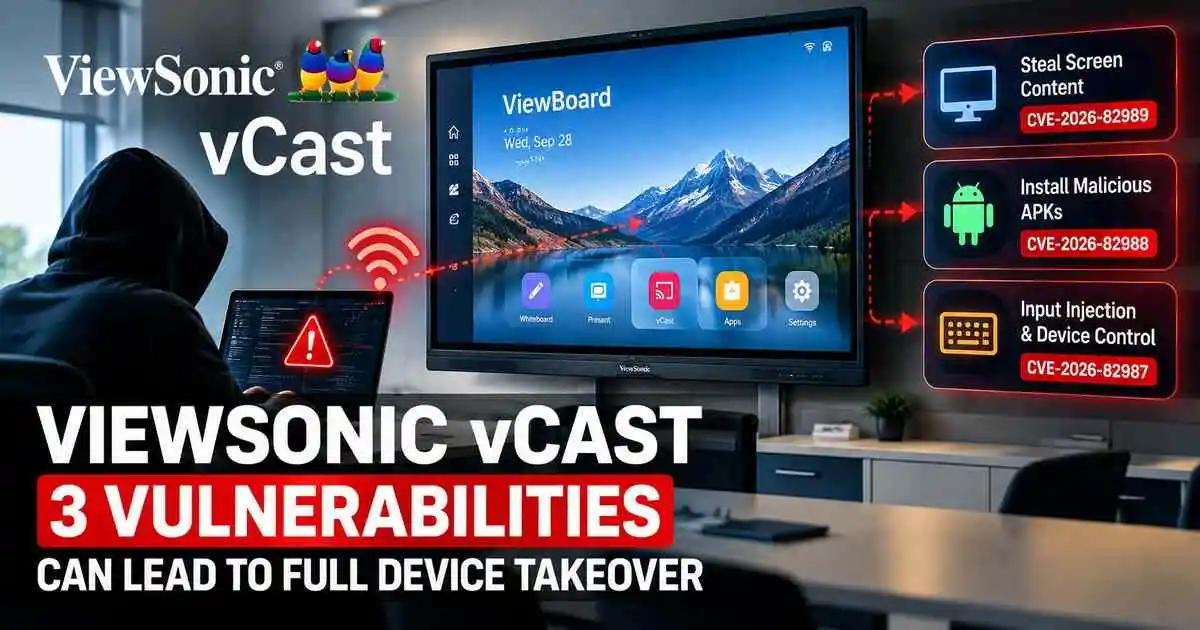
Three vulnerabilities in ViewSonic vCast can be chained by an unauthenticated attacker on the same network to capture displayed content, trigger malicious Android application installation, inject input, and potentially take full control of a ViewBoard device.
The flaws were disclosed by the CERT Coordination Center in vulnerability note VU#234131 and affect ViewSonic’s vCast software used on Android-based ViewBoard smart displays commonly deployed in classrooms, meeting rooms, and enterprise environments.
ViewSonic vCast Vulnerabilities Can Lead to Full Device Compromise
According to the official CERT/CC vulnerability note VU#234131, three unauthenticated weaknesses exist in vCast network services.
CERT/CC says an attacker connected to the same network can chain the flaws to deliver and execute arbitrary code on a vCast-based device without user interaction.
Potential impact includes:
- Unauthorized capture of content displayed on a ViewBoard
- Remote delivery of Android APK files
- Input injection into exposed services
- Persistent installation of malicious applications
- Full compromise of the smart display
- Potential lateral movement into connected network environments
CVE-2026-82989 Exposes ViewBoard Screen Content
CVE-2026-82989 affects vCast’s media streaming service.
According to CERT/CC, a remote attacker can retrieve JPEG images containing ViewBoard screen content by making requests to unauthenticated /snapshot or /screen API endpoints.
This means information displayed on a vulnerable smartboard could potentially be exposed to another device on the same accessible network without requiring authentication.
In schools, meeting rooms, and corporate environments, this could expose presentations, internal dashboards, credentials displayed on screen, or other sensitive information.
CVE-2026-82988 Can Trigger APK Installation
CVE-2026-82988 affects vCast’s Android Package Kit delivery mechanism.
CERT/CC reports that an attacker can provide a malicious APK URL to an unauthenticated download endpoint, causing the ViewBoard device to download the supplied Android application package.
By itself, this mechanism initiates an unprivileged installation flow. However, when combined with the input-injection weakness, the attacker may be able to interact with the installation process and complete the attack chain.
CVE-2026-82987 Allows Unauthenticated Input Injection
CVE-2026-82987 affects exposed vCast network services that accept attacker-controlled input without authentication.
CERT/CC says a remote attacker can inject arbitrary input into service endpoints through unauthenticated HTTP requests.
The weakness becomes particularly dangerous when combined with the APK delivery flaw because input injection can potentially be used to interact with Android installation prompts and other device controls.
How the Three-Flaw Attack Chain Works
The vulnerabilities become significantly more serious when chained together.
Independent researcher Adam Mohammed Zenker, credited by CERT/CC for the disclosure, documented that ViewSonic ViewBoard systems expose multiple vCast and EShare-related network services without authentication.
The researcher’s technical write-up shows how an attacker on the local network can move from passive discovery to screen access and device control. CERT/CC later summarized the coordinated impact as an unauthenticated attack chain capable of delivering and executing arbitrary code.
The general attack sequence is:
- The attacker identifies a vulnerable ViewBoard device accessible on the shared network.
- Unauthenticated media endpoints can expose screenshots of displayed content.
- An APK download mechanism can be instructed to retrieve an attacker-controlled Android package.
- Unauthenticated input controls can be abused to interact with the device.
- Combined exploitation can result in malicious application installation and device compromise.
The researcher’s original technical analysis is available in the vCast ViewSonic RCE chain write-up.
Why ViewBoard Devices Are Attractive Targets
ViewSonic ViewBoards are interactive Android-based smart displays used in educational and enterprise environments.
ViewSonic describes vCast as its wireless casting platform for connecting computers, tablets, and smartphones to ViewBoard and compatible commercial displays. The platform supports multiple wireless display technologies and is preloaded or available on a range of ViewBoard models.
An attacker who compromises one of these devices could gain access not only to information displayed on screen but potentially to a trusted system already connected to an internal network.
That makes classroom and conference-room displays more than presentation devices; they can become part of an organization’s attack surface.
Could Attackers Move Laterally From a Compromised ViewBoard?
CERT/CC specifically warns that an exploited vCast device’s connected network may be exposed to lateral movement risk.
The exact blast radius depends on network segmentation, device privileges, routing, and what other systems are reachable from the ViewBoard network.
Organizations that place smart displays on the same unrestricted VLAN as employee workstations, servers, or management systems therefore face a larger potential impact than environments where display devices are isolated.
Is There a ViewSonic Patch Available?
At the time of CERT/CC’s September 2026 disclosure, CERT/CC said it had been unable to reach ViewSonic to coordinate the vulnerability disclosure.
The vulnerability note lists the vendor status as unknown and states that no ViewSonic vendor statement had been received.
For that reason, organizations should not assume that every currently available vCast build or firmware release contains a security fix for CVE-2026-82987, CVE-2026-82988, and CVE-2026-82989.
Administrators should monitor ViewSonic’s official vCast support page and device-specific firmware channels for future vendor guidance.
What Organizations Should Do Now
CERT/CC recommends reducing exposure while awaiting confirmed vendor remediation.
- Segment ViewBoard devices: Place vCast-enabled displays on isolated networks or VLANs separated from sensitive systems.
- Restrict network access: Limit which hosts can communicate with vCast services.
- Apply firmware updates: Install ViewSonic firmware updates when confirmed security fixes become available.
- Monitor vCast traffic: Look for unusual HTTP requests, unexpected screen-access activity, or suspicious APK delivery attempts.
- Avoid flat networks: Do not place smart displays on unrestricted networks containing high-value endpoints.
- Review classroom and conference-room exposure: Treat smart displays as managed endpoints rather than passive presentation hardware.
No Evidence of Active Exploitation Yet
CERT/CC’s public vulnerability note documents the technical impact and attack chain but does not state that these ViewSonic vCast vulnerabilities are being actively exploited in the wild.
There is also no CISA Known Exploited Vulnerabilities listing cited for these CVEs at the time of publication.
Organizations should therefore treat this as a serious exposure requiring mitigation without describing it as an actively exploited zero-day campaign unless new evidence emerges.
Why This Matters for Schools and Enterprises
Interactive smart displays are frequently connected to trusted internal networks but may not receive the same security attention as laptops, servers, or network appliances.
The ViewSonic vCast vulnerabilities demonstrate how collaboration and presentation devices can become entry points when unauthenticated network services expose sensitive functions.
For broader enterprise vulnerability coverage, see the CyberUpdates365 CVE & Vulnerability Exploits hub.
Organizations reviewing internet-facing and network-accessible infrastructure can also read our coverage of the actively exploited Citrix NetScaler vulnerabilities and the Wireshark 4.6.9 security update.
Security Summary
ViewSonic vCast contains three unauthenticated vulnerabilities that can be chained to expose screen content, download Android application packages, inject device input, and potentially achieve full compromise of ViewBoard smart displays.
CERT/CC has assigned the issues CVE-2026-82987, CVE-2026-82988, and CVE-2026-82989. At the time of disclosure, ViewSonic had not provided a coordinated vendor statement or confirmed security update.
Until definitive vendor remediation is available, network segmentation and strict access controls are the most important defensive steps for organizations operating vCast-enabled ViewBoard devices.