South Korea bank cyberattacks have prompted a nationwide security response after multiple financial institutions reported data breaches affecting customer and employee information.
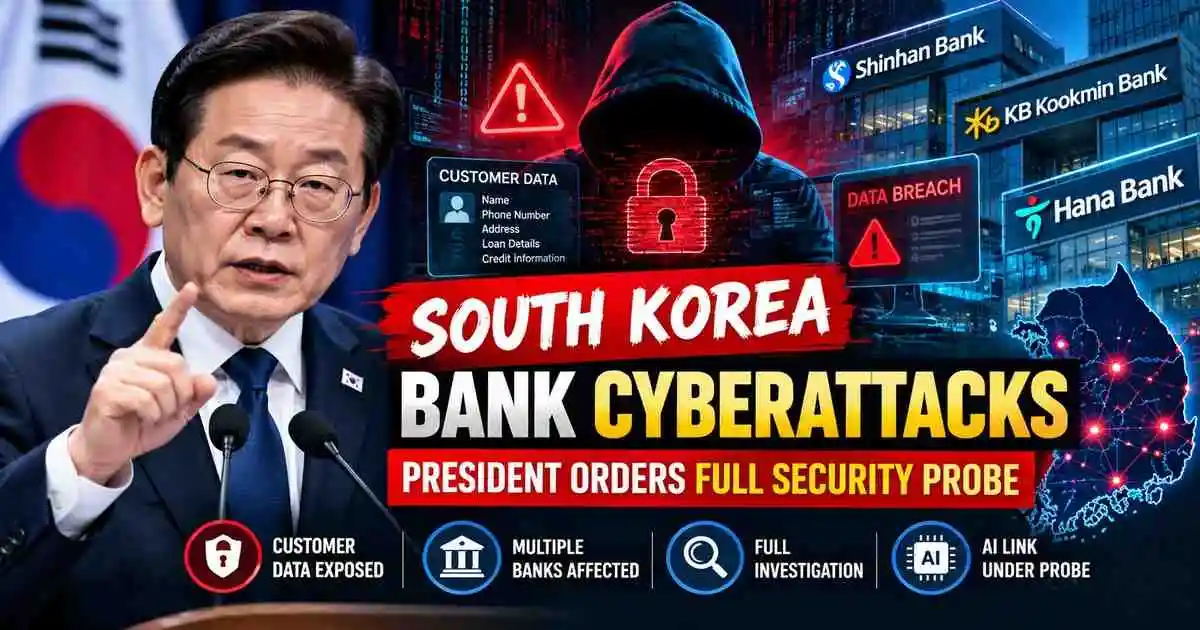
South Korean President Lee Jae Myung has ordered a thorough investigation into a series of cyberattacks and data breaches affecting major financial institutions, as concerns grow over weaknesses in banking-sector security and the possible use of AI-assisted attack tools.
The incidents affected several banks and financial firms, including Shinhan Bank, KB Kookmin Bank, Hana Bank, BNK Busan Bank, Yegaram Savings Bank, and Hyundai Capital.
Customer and employee information was exposed in multiple incidents, prompting financial authorities to order broader security checks across banks, card companies, and other financial institutions.
For broader tracking of large-scale breach incidents and exposed customer data, see our 2026 major data breaches timeline.
Key takeaway: South Korea is treating the recent financial-sector cyber incidents as a serious national security and consumer-protection issue, with the president ordering a full investigation and regulators directing financial institutions to review their security systems.
Why Did South Korea Order a Full Security Investigation?
The presidential order followed a series of cyber incidents reported across South Korea’s financial sector within a relatively short period.
President Lee instructed officials to investigate the incidents thoroughly and strengthen measures designed to protect financial institutions and customer information.
The move followed earlier action by South Korea’s Financial Services Commission, which directed financial companies to review their computer security systems after several banks reported unauthorized access and data exposure.
The growing number of incidents has raised concerns about weaknesses not only in customer-facing banking systems but also in internal platforms, support tools, contractor systems, and other environments that may store sensitive information.
Shinhan Bank Breach Affected About 25,000 Customers
Shinhan Bank disclosed one of the largest incidents reported during the recent series of breaches.
The bank said an unauthorized external party accessed certain services using an abnormal method that bypassed authentication.
Information associated with approximately 25,000 customers was reportedly exposed.
The compromised information included data connected to loan applications, such as:
- Customer names
- Phone numbers
- Annual income
- Approved loan limits
- Other personal and credit information
Some reporting also indicated that resident registration information was included in certain exposed records.
Shinhan Bank said it would compensate customers for confirmed financial losses resulting from the incident.
KB Kookmin Bank Reports Separate Data Leak
KB Kookmin Bank later disclosed a separate incident affecting 119 customers.
The breach involved abnormal external access to a mobile work-support system used by employees.
The exposed information included personal and credit data belonging to affected customers.
Importantly, the bank said the compromised system was separate from its primary internet and mobile banking platforms.
Customer financial transaction information was not reported as exposed through the affected system.
Hana Bank Breach Exposed Customer Information
Hana Bank also reported unauthorized access to an operations-support system.
The bank confirmed that personal information belonging to 89 customers was exposed.
Reportedly compromised information included:
- Names
- Resident registration numbers
- Addresses
- Email addresses
- Phone numbers
- Employer information
Hana Bank also said the affected support system was separate from its main customer transaction infrastructure.
Other Financial Firms Were Also Affected
The recent incidents were not limited to South Korea’s largest commercial banks.
BNK Busan Bank reported exposure involving information belonging to outsourced workers.
Yegaram Savings Bank also disclosed a personal information leak reportedly affecting around 40,000 customers.
Hyundai Capital reported another incident involving information connected to housing loan agents.
The number and variety of affected organizations have increased pressure on financial institutions to review security controls across customer-facing applications, internal support platforms, and third-party environments.
Are AI Tools Behind the South Korea Bank Cyberattacks?
Some public reporting has raised concerns that AI-assisted automation may have played a role in at least part of the activity.
However, investigators have not publicly established that AI was responsible for every incident or that a single attacker carried out all of the breaches.
Reports surrounding the Shinhan Bank incident referenced possible traces of an AI-based automation tool.
Other reporting has also noted similarities such as overlapping network infrastructure or IP addresses across some incidents.
These indicators may help investigators determine whether individual attacks are connected, but they do not by themselves prove that a single threat actor conducted every intrusion or that AI autonomously carried out the attacks.
Important: AI involvement remains under investigation. It should not be presented as the confirmed root cause of all recent South Korean financial-sector breaches.
Why Internal Banking Systems Matter
Several of the incidents highlight an important security issue: highly sensitive customer information may exist outside a bank’s primary online banking platform.
Loan portals, employee-support systems, operational platforms, contractor applications, and other internal tools can still contain large volumes of personal and financial data.
Attackers do not necessarily need to compromise a bank’s main transaction platform to cause serious damage.
A breach of a secondary system may still expose identities, contact details, credit information, employment data, or other sensitive records.
This makes asset discovery, access control, network segmentation, authentication, and monitoring important across the entire financial technology environment.
Financial-Sector Cyber Risk Extends Beyond South Korea
Banking-sector attacks remain a wider concern because financial institutions hold valuable identity, account, and credit information that can be abused for fraud, phishing, and follow-on attacks.
For additional context on threats targeting financial organizations, see our coverage of a U.S. banking cyberattack and federal security alert.
Although the incidents involve different countries and threat scenarios, both highlight why financial institutions need strong controls across customer-facing services, internal systems, and third-party access.
What South Korean Regulators Are Doing
South Korea’s Financial Services Commission instructed financial institutions to conduct broader reviews of their computer security systems following the recent incidents.
Police, financial regulators, and affected companies are also examining the breaches and the methods used by attackers.
The investigations are expected to focus on questions including:
- How attackers initially gained access
- Whether common infrastructure was used
- Whether individual incidents are connected
- How quickly unauthorized activity was detected
- Whether AI-assisted tools played a role
- Which technical or operational controls failed
What Financial Institutions Should Review
The incidents demonstrate why security assessments should extend beyond internet banking websites and mobile applications.
Financial institutions should review:
- Internet-exposed business systems
- Authentication and session controls
- Employee-support platforms
- Third-party and contractor access
- Loan and customer-service portals
- Privileged user accounts
- Logging and anomaly detection
- Incident-response procedures
- Network segmentation
- Data access controls
Organizations should also identify systems that store sensitive customer information even if those systems do not directly process financial transactions.
Why the Breaches Create a Secondary Phishing Risk
Data breaches can create security risks long after the original intrusion has been contained.
Information such as names, phone numbers, employer details, financial information, and loan data may allow criminals to create more convincing phishing and social-engineering campaigns.
Attackers may impersonate banks, government agencies, financial advisers, or customer-support representatives while using leaked information to make fraudulent messages appear legitimate.
Affected customers should therefore remain cautious about unexpected phone calls, messages, emails, login requests, or requests to verify account information.
What Customers of Affected Banks Should Do
Customers who receive an official breach notification should review the information provided by their bank and follow any account-security instructions.
Useful precautions may include:
- Monitoring bank and credit accounts for unusual activity
- Being cautious of unexpected calls claiming to be from the bank
- Avoiding links received through unsolicited text messages or emails
- Verifying requests through the bank’s official app or website
- Changing passwords if the bank specifically recommends doing so
- Reporting suspicious transactions immediately
Customers should never provide authentication codes, passwords, or sensitive banking credentials simply because a caller already knows some of their personal information.
Frequently Asked Questions
What happened to South Korean banks?
Several South Korean financial institutions reported cyber incidents and data breaches that exposed customer or worker information.
Which financial institutions were affected?
Public reporting identified incidents involving Shinhan Bank, KB Kookmin Bank, Hana Bank, BNK Busan Bank, Yegaram Savings Bank, and Hyundai Capital.
How many Shinhan Bank customers were affected?
Shinhan Bank reported that information associated with approximately 25,000 customers was exposed.
Was financial transaction data stolen?
KB Kookmin Bank and Hana Bank said the affected systems in their reported incidents were separate from their main internet and mobile banking platforms. Financial transaction information was not reported as exposed in those specific cases.
Were AI tools used in the attacks?
Possible AI-assisted activity has been discussed in public reporting, but investigators have not confirmed that AI was responsible for all of the incidents.
What did President Lee Jae Myung order?
President Lee ordered officials to conduct a thorough investigation into the recent financial-sector breaches and develop stronger measures to address the security risks.
Why are these breaches serious?
Financial institutions store sensitive personal, identity, employment, credit, and financial information that can potentially be abused for fraud, identity theft, phishing, or other follow-on attacks.
Final Takeaway
The recent South Korea bank cyberattacks show that financial-sector security risks extend beyond public banking websites and mobile applications.
Internal support platforms, employee systems, loan portals, and operational tools can also contain highly sensitive information and become attractive targets for attackers.
President Lee Jae Myung’s order for a thorough investigation reflects growing concern over the scale of the incidents and the need to strengthen cybersecurity across South Korea’s financial sector.
Investigators are still working to determine whether the breaches are connected and what role, if any, AI-assisted attack tools played in the incidents.
Stay Updated on Major Cyber Incidents
Major financial-sector breaches can create risks for organizations and individuals long after the original intrusion.
Follow CyberUpdates365 for verified cyberattack updates, major data breach coverage, threat intelligence, and practical security guidance.
Customer of an affected financial institution? Watch for official notifications, monitor your accounts, and be cautious of phishing attempts that use leaked personal information.
Official and Primary Sources
Yonhap News Agency:
President Lee orders thorough probe into personal data leaks at financial institutions
Financial Sector Security Checks:
Financial regulator instructs firms to examine security systems
Shinhan Bank Breach:
Shinhan Bank data breach affecting approximately 25,000 customers
KB Kookmin Bank Breach:
KB Kookmin Bank customer information leak report
Hana Bank Breach:
Hana Bank customer data leak report