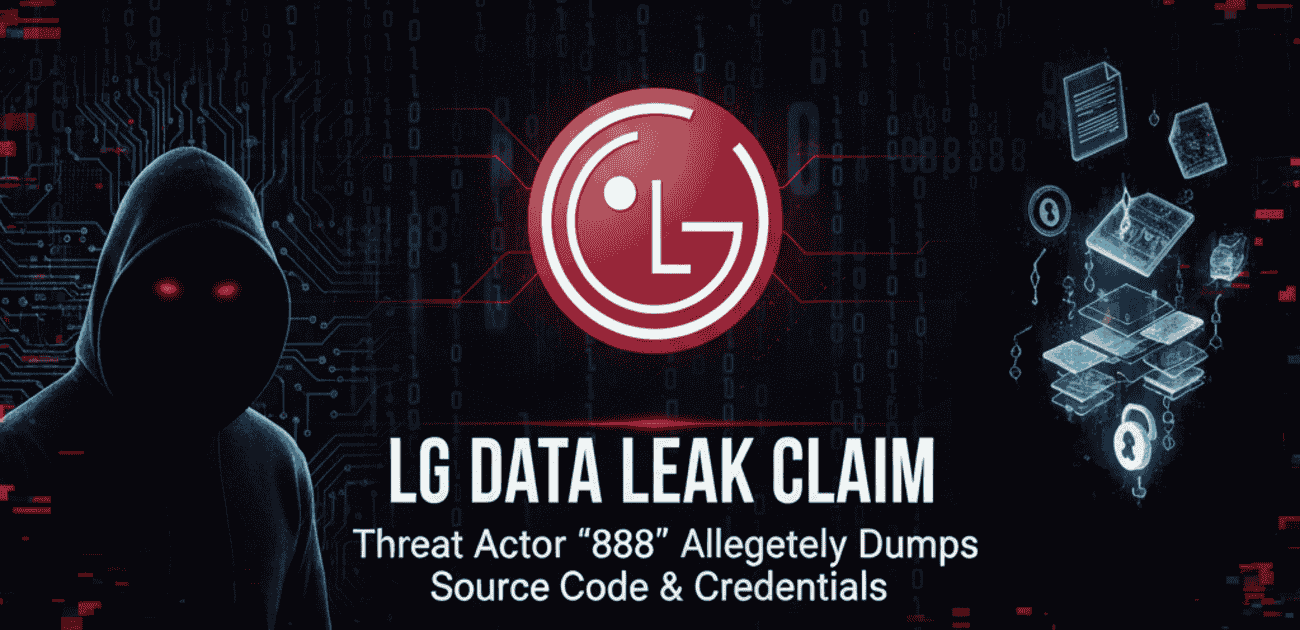
Threat actor “888” claims to have leaked sensitive LG Electronics data including source code repositories, SMTP credentials, and hardcoded authentication details, raising concerns about supply chain vulnerabilities
IMPORTANT NOTICE
This article reports on an alleged data leak claim made by a threat actor. LG Electronics has not yet issued an official statement confirming or denying these claims. The information presented is based on public reports from cybersecurity monitoring platforms. This is NOT a confirmed security breach report. For official updates, visit LG Electronics Official Website and CISA Cybersecurity Advisories.
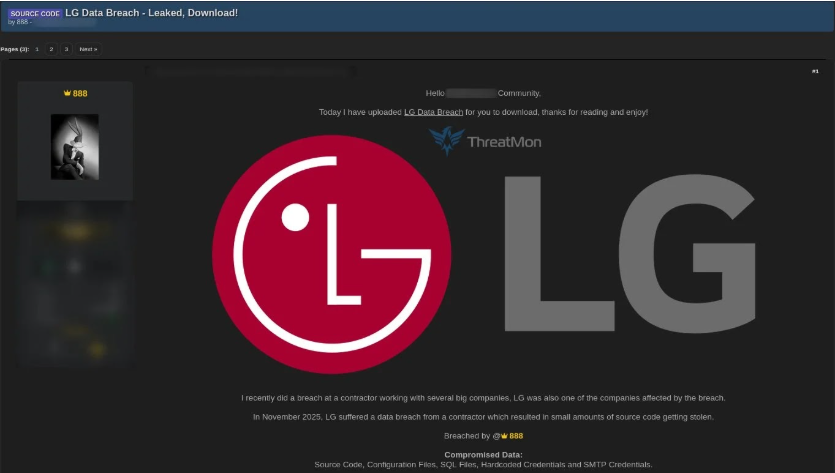
As of November 17, 2025, a threat actor known as “888” has allegedly dumped sensitive data purportedly stolen from electronics giant LG Electronics, raising alarms in the cybersecurity community. The breach claim, first spotlighted on November 16, 2025, allegedly includes source code repositories, configuration files, SQL databases, and critically, hardcoded credentials and SMTP server details that could potentially expose LG’s internal communications and development pipelines to widespread exploitation.
The leak surfaced via a post on ThreatMon, a platform that tracks dark web activity, where “888” shared samples to prove authenticity. Described as originating from a contractor access point, the dataset reportedly spans multiple LG systems, hinting at a supply chain vulnerability rather than a direct corporate hack. Cybersecurity analysts note that hardcoded credentials embedded directly in code for convenience pose severe risks, as they could enable attackers to impersonate LG personnel or pivot to connected services.
Furthermore, SMTP credentials, which manage email routing, might further allow phishing campaigns or spam operations disguised as legitimate LG correspondence. Threat actor “888” is no stranger to high-profile claims, having been active since at least 2024 and targeting entities like Microsoft, BMW Hong Kong, Decathlon, and Shell, often extorting ransoms or selling data on breach forums. In this LG incident, no ransom demand has been publicly confirmed.
KEY FACTS AT A GLANCE
WHAT HAPPENED:
- Threat Actor Claim: Threat actor “888” allegedly dumped sensitive LG Electronics data on November 16, 2025 via ThreatMon dark web platform
- Data Types Claimed: Source code repositories, configuration files, SQL databases, hardcoded credentials, and SMTP server details
- Entry Point: Described as originating from a contractor access point, suggesting supply chain vulnerability
- Platform: Leak surfaced via ThreatMon, a dark web activity tracking platform
- Verification Status: LG Electronics has not yet issued an official statement confirming or denying these claims
WHO’S AFFECTED:
- Primary Target: LG Electronics and its internal systems, development pipelines, and communications infrastructure
- Potential Impact: LG’s IoT devices, consumer electronics, and smart appliances if source code exposure is confirmed
- Supply Chain: Contractor networks and third-party integrations potentially exposed through contractor access point
- Related Incident: LG Uplus (LG’s telecom arm) confirmed a separate breach affecting customer data in October 2025
- Global Users: Millions of LG device users worldwide potentially at risk if vulnerabilities are exposed
IMMEDIATE IMPACT:
- Current Status: Alleged leak claim; LG Electronics has not confirmed the breach as of November 17, 2025
- Security Risks: Hardcoded credentials could enable attackers to impersonate LG personnel or pivot to connected services
- SMTP Exposure: Email routing credentials might allow phishing campaigns disguised as legitimate LG correspondence
- Intellectual Property: Source code exposure could undermine LG’s proprietary technology in consumer electronics and smart appliances
- Investigation Status: Security firms urging organizations to scan for leaked credentials using tools like Have I Been Pwned
TABLE OF CONTENTS
- Latest Update & Threat Actor Claims
- Attack Details & Data Exposure Analysis
- Threat Actor “888” Profile & Previous Activities
- LG Electronics Context & Previous Security Incidents
- Expert Analysis & Industry Impact
- Supply Chain Security Implications
- Critical Security Recommendations
- Emergency Resources & Reporting
LATEST UPDATE & THREAT ACTOR CLAIMS
On November 16, 2025, threat actor “888” posted samples of allegedly stolen LG Electronics data on ThreatMon, a platform that tracks dark web activity. The threat actor claimed to have dumped sensitive data including source code repositories, configuration files, SQL databases, hardcoded credentials, and SMTP server details. The leak was described as originating from a contractor access point, suggesting a supply chain vulnerability rather than a direct corporate hack.
As of November 17, 2025, LG Electronics has not yet issued an official statement confirming or denying these claims. The timing aligns with a turbulent year for the company, as LG’s telecom arm, LG Uplus, confirmed a separate breach affecting customer data in October 2025, amid a wave of South Korean telecom hacks. Experts speculate these incidents may share common vectors, such as unpatched vulnerabilities in cloud integrations or third-party tools. Official Source: LG Electronics Official Website
Significantly, the samples shared include file structures suggesting the presence of gigabytes of proprietary code, which could undermine LG’s intellectual property in consumer electronics and smart appliances if confirmed. The exposure of source code could reveal flaws in LG’s IoT devices, amplifying risks for millions of users worldwide.
ATTACK DETAILS & DATA EXPOSURE ANALYSIS
The alleged data leak encompasses multiple critical components of LG Electronics’ infrastructure, each posing distinct security risks:
Primary Data Types Allegedly Exposed:
- Source Code Repositories: Proprietary code for LG’s consumer electronics, smart appliances, and IoT devices – could reveal vulnerabilities and intellectual property
- Configuration Files: System configurations that could expose network architecture and security settings
- SQL Databases: Database structures and potentially sensitive data schemas
- Hardcoded Credentials: Authentication details embedded directly in code – severe risk for impersonation and lateral movement
- SMTP Server Details: Email routing credentials that could enable phishing campaigns disguised as legitimate LG correspondence
1. Hardcoded Credentials Risk
Cybersecurity analysts note that hardcoded credentials embedded directly in code for convenience pose severe risks. These credentials could enable attackers to impersonate LG personnel, access internal systems, or pivot to connected services. Once exposed, hardcoded credentials are particularly dangerous because they cannot be easily rotated without code changes and redeployment.
2. SMTP Credentials Exposure
SMTP (Simple Mail Transfer Protocol) credentials manage email routing and could allow threat actors to launch sophisticated phishing campaigns or spam operations disguised as legitimate LG correspondence. This could be used to target LG’s customers, partners, or employees with convincing phishing emails.
3. Source Code Intellectual Property
The alleged exposure of source code repositories represents a significant threat to LG’s intellectual property. Proprietary code for consumer electronics, smart appliances, and IoT devices could reveal vulnerabilities, design patterns, and competitive advantages. If confirmed, this exposure could have long-term implications for LG’s market position.
4. Supply Chain Entry Point
The claim that the leak originated from a contractor access point highlights the fragility of global supply chains. A single contractor’s security lapse can cascade into corporate espionage, intellectual property theft, and widespread system compromise.
THREAT ACTOR “888” PROFILE & PREVIOUS ACTIVITIES
Threat actor “888” is no stranger to high-profile claims, having been active since at least 2024. This individual or group has targeted numerous high-profile entities, often extorting ransoms or selling data on breach forums.
Threat actor “888” profile screenshot showing previous high-profile targets including Microsoft, BMW Hong Kong, Decathlon, and Shell. The threat actor has been active since at least 2024, often extorting ransoms or selling data on breach forums.
Previous Targets
- Microsoft: Threat actor “888” has previously claimed attacks against Microsoft, demonstrating a pattern of targeting major technology companies
- BMW Hong Kong: The threat actor has been linked to claims involving BMW Hong Kong, showing a focus on automotive and technology sectors
- Decathlon: Previous claims involving Decathlon, a major sporting goods retailer, indicate a broad targeting approach
- Shell: Claims involving Shell, a major energy company, demonstrate targeting of critical infrastructure sectors
Tactics and Monetization
Threat actor “888” typically employs tactics involving initial access brokers and infostealer malware. The group monetizes leaks through cryptocurrency payments, often extorting ransoms or selling data on breach forums. In this LG incident, no ransom demand has been publicly confirmed, suggesting the data may be sold on underground markets or used for other purposes.
Verification Challenges
The history of threat actor “888” includes numerous high-profile claims, but verification of actual breaches remains challenging. Some claims may be exaggerated or fabricated to gain notoriety or extort payments. Organizations should treat all such claims with caution until verified by official sources.
LG ELECTRONICS CONTEXT & PREVIOUS SECURITY INCIDENTS
The alleged LG data leak claim comes at a time when the company has faced multiple security challenges. Understanding the broader context helps assess the credibility and potential impact of these claims.
LG Uplus Breach (October 2025)
Earlier in October 2025, LG’s telecom arm, LG Uplus, confirmed a separate breach affecting customer data. This incident occurred amid a wave of South Korean telecom hacks, raising concerns about systemic vulnerabilities in the country’s telecommunications infrastructure. Official Source: LG Uplus Official Website
Common Attack Vectors
Experts speculate that the LG Uplus breach and the alleged LG Electronics leak may share common vectors, such as unpatched vulnerabilities in cloud integrations or third-party tools. This pattern suggests that supply chain security and third-party risk management are critical areas requiring attention.
South Korean Telecom Sector
The wave of South Korean telecom hacks highlights broader cybersecurity challenges facing the country’s technology sector. South Korea is home to major technology companies and has been a frequent target of state-sponsored and financially motivated cyber attacks.
LG’s Global Footprint
LG Electronics operates globally, manufacturing consumer electronics, home appliances, and IoT devices used by millions of consumers worldwide. Any confirmed breach affecting LG’s source code or credentials could have far-reaching implications for product security and customer trust.
EXPERT ANALYSIS & INDUSTRY IMPACT
“The exposure of source code could reveal flaws in LG’s IoT devices, amplifying risks for millions of users worldwide. Hardcoded credentials pose severe risks as they could enable attackers to impersonate LG personnel or pivot to connected services.”
– Cybersecurity Analysts
Supply Chain Fragility
The alleged breach claim underscores the fragility of global supply chains, where a single contractor’s lapse can cascade into corporate espionage. This incident highlights the critical importance of third-party risk management and supply chain security assessments.
Intellectual Property Protection
If confirmed, the exposure of source code repositories represents a significant threat to intellectual property protection. Proprietary code contains trade secrets, design patterns, and competitive advantages that could be exploited by competitors or nation-state actors.
Credential Management Best Practices
The alleged exposure of hardcoded credentials serves as a reminder of the importance of proper credential management. Organizations should avoid hardcoding credentials in source code and instead use secure credential management systems, environment variables, or secrets management solutions.
Incident Response Readiness
As investigations unfold, security firms urge organizations to scan for leaked credentials using tools like Have I Been Pwned and to rotate all suspected keys immediately. This proactive approach can help mitigate the impact of credential exposure even before official confirmation.
SUPPLY CHAIN SECURITY IMPLICATIONS
The claim that the alleged LG data leak originated from a contractor access point highlights critical supply chain security challenges facing modern organizations.
Third-Party Risk Management
Organizations increasingly rely on contractors, vendors, and third-party service providers, creating an expanded attack surface. A single contractor’s security lapse can provide threat actors with a pathway into corporate networks, as allegedly occurred in this LG incident.
Access Control and Monitoring
The alleged breach claim emphasizes the importance of strict access controls and continuous monitoring of third-party access. Organizations should implement least-privilege access principles, regularly audit contractor permissions, and monitor for anomalous activity.
Supply Chain Security Assessments
Regular security assessments of contractors and vendors are essential to identify and remediate vulnerabilities before they can be exploited. These assessments should include penetration testing, security questionnaires, and compliance verification.
Incident Response Coordination
When breaches involve third parties, coordinated incident response becomes critical. Organizations should establish clear communication channels and response procedures with contractors to ensure rapid containment and remediation.
CRITICAL SECURITY RECOMMENDATIONS
FOR US BUSINESSES & ORGANIZATIONS
IMMEDIATE ACTIONS (Next 24-48 Hours):
- Credential Scanning: Scan for leaked credentials using tools like Have I Been Pwned (haveibeenpwned.com) to identify if any organizational credentials have been exposed
- Credential Rotation: Rotate all suspected keys, passwords, and API tokens immediately, especially those that may have been hardcoded in applications or configuration files
- Third-Party Audit: Review and audit all contractor and vendor access permissions, identifying any unnecessary or excessive privileges
- SMTP Security: Review and secure SMTP server configurations, implement multi-factor authentication, and monitor for suspicious email activity
SHORT-TERM ACTIONS (Next 30 Days):
- Code Security Audit: Conduct comprehensive code reviews to identify and remove any hardcoded credentials, replacing them with secure credential management solutions
- Supply Chain Assessment: Perform security assessments of all contractors and vendors, verifying their security practices and compliance with your security requirements
- Access Control Review: Implement least-privilege access principles, regularly audit permissions, and remove unnecessary access rights
- Monitoring Enhancement: Deploy advanced monitoring solutions to detect anomalous activity, especially from contractor access points
LONG-TERM STRATEGY (Ongoing):
- Credential Management: Implement enterprise-grade secrets management solutions (e.g., HashiCorp Vault, AWS Secrets Manager) to eliminate hardcoded credentials
- Supply Chain Security Program: Establish a comprehensive third-party risk management program with regular assessments, security requirements, and incident response procedures
- Security Training: Provide security awareness training to contractors and vendors, ensuring they understand and follow your security policies
- Incident Response Planning: Develop and regularly test incident response plans that include procedures for third-party breaches and supply chain incidents
FOR INDIVIDUAL USERS & CONSUMERS
- Monitor Accounts: Regularly monitor your accounts for suspicious activity, especially if you use LG devices or services
- Update Devices: Keep all LG devices and applications updated with the latest security patches and firmware updates
- Credential Hygiene: Use strong, unique passwords for all accounts and enable multi-factor authentication wherever possible
- Phishing Awareness: Be cautious of emails claiming to be from LG, especially those requesting personal information or credentials
- Report Suspicious Activity: Report any suspicious activity or potential security incidents to LG customer support and relevant authorities
FOR GOVERNMENT CONTRACTORS & CRITICAL INFRASTRUCTURE
- Enhanced Third-Party Requirements: Implement enhanced security requirements for contractors, including mandatory security assessments, background checks, and compliance verification
- Continuous Monitoring: Deploy 24/7 security operations center (SOC) monitoring for all contractor access points and third-party integrations
- Incident Reporting: Establish mandatory incident reporting procedures for third-party breaches, with specific timeframes and federal agency coordination
- Supply Chain Security Standards: Adhere to federal supply chain security standards (e.g., NIST SP 800-161, CMMC) and ensure contractors meet these requirements
- Zero Trust Architecture: Implement zero trust network architecture to minimize the impact of compromised contractor credentials
CRITICAL DON’Ts:
- Don’t hardcode credentials in source code or configuration files – use secure credential management solutions instead
- Don’t ignore third-party security assessments – contractors and vendors must meet your security standards
- Don’t delay credential rotation – rotate all suspected keys immediately, even before official breach confirmation
- Don’t assume contractor security – verify and continuously monitor third-party access
EMERGENCY RESOURCES & REPORTING
Report Cybersecurity Incidents:
FBI Internet Crime Complaint Center (IC3):
- Website: www.ic3.gov
- Emergency Hotline: 1-800-CALL-FBI (1-800-225-5324)
- For: Criminal cyber incidents, data breaches, credential theft
CISA Cybersecurity:
- Email: central@cisa.dhs.gov
- 24/7 Operations: 1-888-282-0870
- Website: www.cisa.gov/report
- For: Infrastructure threats, supply chain incidents, vulnerabilities
US-CERT (Computer Emergency Readiness Team):
- Email: info@us-cert.gov
- For: Technical assistance, vulnerability reporting, incident coordination
Free Security Tools & Resources:
- Have I Been Pwned – Check if your email or credentials have been exposed in data breaches
- CISA Shields Up – Cybersecurity resources and guidance for organizations
- NIST Cybersecurity Framework – Framework for improving cybersecurity risk management
RELATED ARTICLES ON CYBERUPDATES365
- BREAKING: Supply Chain Cyber Attacks Surge 250% – CISA Emergency Directive
- BREAKING: AT&T Data Breach Affects 73 Million Customers – FBI Issues Alert
- AI Phishing Attacks Surge 300% in US – CISA Issues Emergency Alert
KEY TAKEAWAYS & FINAL THOUGHTS
The alleged LG Electronics data leak claim represents a significant cybersecurity concern, highlighting the fragility of global supply chains and the critical importance of third-party risk management. While LG Electronics has not yet confirmed these claims, the incident underscores the need for organizations to implement robust security measures for contractors and vendors.
Critical Points to Remember:
- Hardcoded credentials pose severe security risks and should be eliminated through secure credential management solutions
- Supply chain security is critical – a single contractor’s lapse can cascade into widespread system compromise
- Organizations should proactively scan for leaked credentials and rotate suspected keys immediately, even before official breach confirmation
As security firms continue to investigate these claims and urge organizations to scan for leaked credentials, the cybersecurity community remains vigilant. Organizations must prioritize supply chain security assessments and credential management while individuals should monitor their accounts and update devices regularly.
The cybersecurity landscape continues to evolve rapidly, with threat actors increasingly targeting supply chains and third-party access points. Staying informed and proactive is the best defense against emerging threats, whether confirmed or alleged.
Stay Protected with CyberUpdates365
Subscribe for real-time cybersecurity alerts, expert analysis, and actionable security guidance delivered directly to your inbox.
Join 10,000+ cybersecurity professionals and business leaders staying ahead of emerging threats.
Track Every Breach: See our complete Data Breach 2026 Timeline to stay informed on every major incident this year.
Updated on November 17, 2025 by CyberUpdates365 Editorial Team
This is a developing story. CyberUpdates365 is monitoring the situation and will provide updates as new information becomes available. Follow us on social media for real-time alerts.
Have questions about this cybersecurity threat?
Leave a comment below or contact our editorial team at: cyberupdates365connect@gmail.com