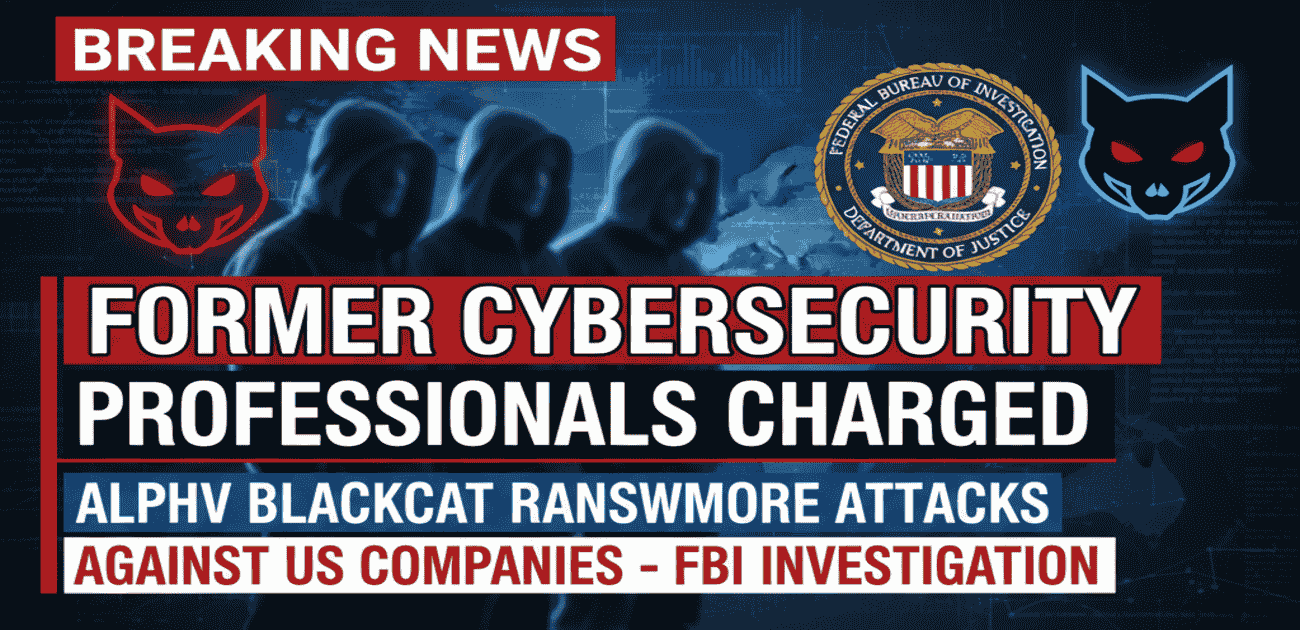
In one of the most consequential federal cybercrime enforcement actions to date, federal prosecutors have unsealed a major indictment charging two former IT security specialists for orchestrating destructive extortion campaigns utilizing ALPHV BlackCat ransomware. The criminal complaint, filed in the United States District Court for the Southern District of Florida, reveals that individuals entrusted with corporate defense actively turned their domain expertise toward digital extortion, compromising critical commercial enterprises nationwide with ALPHV BlackCat ransomware payloads.
According to the official Federal Indictment Document (PDF) (Case No. 25-CR-20443-MOORE/D’ANGELO) and advisories from the U.S. Department of Justice, defendants Ryan Clifford Goldberg, 28, of Watkinsville, Georgia, and Kevin Tyler Martin, 31, of Roanoke, Texas, face severe federal charges. Operating as affiliates within the notorious ALPHV BlackCat ransomware syndicate between May 2023 and April 2025, the conspirators targeted medical device manufacturers, pharmaceutical companies, engineering firms, drone manufacturers, and healthcare facilities across multiple states, resulting in documented extortion demands exceeding $17.5 million.
The Indictment Architecture: How Cybersecurity Insiders Weaponized BlackCat
The operational danger of this conspiracy stems from the perpetrators’ advanced understanding of enterprise perimeter defense. Rather than deploying crude brute-force attempts, the defendants leveraged their inside knowledge of corporate network architecture, endpoint logging blind spots, and Active Directory trust relationships to deploy ALPHV BlackCat ransomware with surgical precision across protected networks.
The structured attack methodology followed a consistent, multi-stage cyber warfare playbook:
| Attack Stage | Adversarial Execution | Target Infrastructure | Enterprise Damage |
|---|---|---|---|
| Initial Infiltration | Harvested admin credentials and unpatched VPN gateway exploitation | Corporate perimeter firewalls and remote access portals | Undetected lateral foothold within corporate subnets |
| Double-Extortion Exfiltration | Systematic exfiltration of proprietary IP and customer records | Internal file shares, R&D databases, and cloud repositories | Irreversible loss of trade secrets and severe regulatory liability |
| Ransomware Deployment | High-speed Rust-compiled ALPHV payload execution | Production servers, hypervisors, and backup storage | Total operational immobilization across manufacturing lines |
| Cryptocurrency Extortion | Tor-routed negotiation portals demanding Bitcoin/Monero | Corporate treasury and C-suite leadership | Multi-million-dollar extortion demands ranging from $300K to $10M |
ALPHV BlackCat Attack Methodology & Technical Analysis
ALPHV, also known simply as BlackCat, emerged in late 2021 as one of the most destructive and technically sophisticated ransomware variants in operation. The ransomware-as-a-service (RaaS) model operates through a structured affiliate system where core developers create and maintain the Rust-based encryption code, while recruited affiliates conduct actual intrusions against targeted corporate networks using ALPHV BlackCat ransomware.
The attack campaign deployed by Goldberg and Martin followed a systematic four-phase operational lifecycle:
- 1. Initial Access: The defendants allegedly gained unauthorized access to corporate networks utilizing compromised employee credentials, spear-phishing campaigns, or unpatched vulnerabilities in internet-facing perimeter devices. Once inside, they performed internal network reconnaissance to map active directory domains, locate backup servers, and identify crown-jewel assets for subsequent ALPHV BlackCat ransomware deployment.
- 2. Systematic Data Theft: Before deploying encryption routines, the attackers systematically exfiltrated terabytes of sensitive corporate data. This double-extortion mechanism created massive leverage, ensuring that even if an organization could restore from backups, the syndicate could threaten public leaks to competitors, regulators, and media outlets.
- 3. Encryption Deployment: The operators deployed ALPHV BlackCat ransomware across internal servers and endpoints. Written in Rust for maximum execution speed and multi-platform compatibility, the payload rapidly encrypted virtual machines, production databases, and administrative shares, forcing victim operations into complete paralysis.
- 4. Extortion Negotiation: Victims were directed to password-protected dark web negotiation portals hosted on the Tor network. Documented ransom demands across the defendants’ operational campaign ranged from $300,000 to $10 million per corporate victim, demanding settlement in Bitcoin or Monero.
Technical Severity Rating: ALPHV BlackCat ransomware is officially classified as a critical infrastructure threat by the Cybersecurity and Infrastructure Security Agency (CISA), with extensive documentation tracking its devastating impact across healthcare and commercial manufacturing.
Documented Attack Case Studies from Federal Court Filings
The unsealed court records in the Southern District of Florida provide verified forensic details of five major corporate intrusions executed during the conspiracy:
Case Study 1: Tampa Medical Device Manufacturer (May 2023)
- Victim Profile: Tampa-based enterprise medical device manufacturing corporation.
- Date of Intrusion: May 2023.
- Operational Impact: Enterprise server infrastructure completely encrypted by ALPHV BlackCat ransomware, halting active manufacturing lines.
- Ransom Demands & Settlement: The syndicate demanded approximately $10 million in cryptocurrency; facing indefinite operational paralysis, the company negotiated and paid $1.27 million to acquire decryption tools.
- Core Takeaway: Even negotiated ransom payments represent catastrophic financial losses, and payment provides zero legal protection against secondary regulatory fines or subsequent extortion threats.
Case Study 2: Maryland Pharmaceutical Corporation (May 2023)
- Victim Profile: Maryland-based commercial pharmaceutical enterprise.
- Date of Intrusion: May 2023.
- Operational Impact: Corporate network compromised, research databases encrypted, and proprietary pharmaceutical drug formulas exfiltrated through ALPHV BlackCat ransomware campaigns.
- Core Takeaway: Pharmaceutical enterprises face compounding regulatory exposure under FDA regulations when intellectual property and clinical drug trials are compromised by ALPHV BlackCat ransomware.
Case Study 3: California Healthcare Clinic (July 2023)
- Victim Profile: California-based specialized healthcare practice.
- Date of Intrusion: July 2023.
- Operational Impact: Electronic health records (EHR) and clinical scheduling databases encrypted by ALPHV BlackCat ransomware, forcing patient appointments to be rescheduled.
- Ransom Demand: $5 million in cryptocurrency.
- Core Takeaway: Healthcare providers face acute life-safety and patient care interruptions, creating extreme pressure to succumb to criminal extortion.
Case Study 4: California Engineering and Architecture Firm (October 2023)
- Victim Profile: Major California infrastructure engineering and design firm.
- Date of Intrusion: October 2023.
- Operational Impact: Computer-aided design (CAD) workstations and proprietary engineering blueprints exfiltrated and locked with ALPHV BlackCat ransomware.
- Ransom Demand: $1 million in cryptocurrency.
- Core Takeaway: Engineering firms face severe intellectual property loss, as stolen designs can be sold to foreign adversaries or competitive entities.
Case Study 5: Virginia Defense Drone Manufacturer (November 2023)
- Victim Profile: Advanced aerospace and drone manufacturing enterprise in Virginia.
- Date of Intrusion: November 2023.
- Operational Impact: Production line servers encrypted by ALPHV BlackCat ransomware, delaying critical manufacturing and procurement deliverables.
- Ransom Demand: $300,000 in cryptocurrency.
- Core Takeaway: Even comparatively smaller extortion demands disrupt critical defense supply chains and trigger mandatory federal compliance reviews.
For an authoritative analysis of systemic defensive frameworks protecting industrial manufacturing and critical facilities from organized syndicates, explore our 2026 Ransomware Protection Guide for Critical Infrastructure.
Federal Legal Proceedings and Statutory Penalties
The indictment filed in U.S. District Court for the Southern District of Florida (Case No. 25-CR-20443-MOORE/D’ANGELO) demonstrates the expanding reach of federal cyber law enforcement against syndicates deploying ALPHV BlackCat ransomware. The prosecution represents a landmark achievement in tracing pseudonymous cryptocurrency flows across distributed blockchain ledgers.
Statutory Charges and Potential Penalties:
- Conspiracy to Interfere with Commerce by Extortion: Maximum penalty of up to 20 years in federal prison per count for deploying ALPHV BlackCat ransomware.
- Interference with Commerce by Extortion: Substantive Hobbs Act extortion counts carrying additional 20-year maximum prison terms.
- Intentional Damage to Protected Computers: Violations of Title 18, United States Code, Section 1030 (Computer Fraud and Abuse Act), carrying up to 10 years imprisonment.
- Monetary Penalties: Fines up to $250,000 or twice the gross pecuniary gain derived from the offenses.
- Asset Forfeiture: Federal prosecutors are pursuing mandatory forfeiture of all real estate, luxury vehicles, computer equipment, and cryptocurrency assets purchased with illicit proceeds from ALPHV BlackCat ransomware attacks.
The FBI Internet Crime Complaint Center (IC3) and the Department of Justice emphasized that cyber investigators possess the forensic capabilities to pierce mixer protocols, dark web proxies, and blockchain obfuscation tools to hold cybercriminals legally accountable.
Expert Opinions & Industry Analysis
Industry leaders and federal agencies have highlighted the profound implications of certified cybersecurity professionals operating as ALPHV BlackCat ransomware affiliates:
“This prosecution represents a significant milestone in federal law enforcement’s ability to track and prosecute ransomware operators, even when they use cryptocurrency to attempt to hide their activities. The case demonstrates that cybersecurity expertise turned toward criminal purposes creates devastating consequences for legitimate businesses.”
— U.S. Department of Justice Official Statement
CISA advisories warn that the RaaS business model significantly amplifies the impact of ALPHV BlackCat ransomware by outsourcing attack execution to skilled operators who know exactly how to bypass commercial endpoint detection tools. When insiders possess professional administrative experience, traditional perimeter assumptions completely disintegrate.
Future Outlook & Long-Term Impact on Enterprise Defense
Short-Term Predictions (Next 3-6 Months):
- Accelerated Prosecutions: Federal law enforcement will unseal additional indictments as blockchain analytics and international intelligence sharing continue to de-anonymize affiliates deploying ALPHV BlackCat ransomware.
- Tighter Background Vetting: Organizations will implement enhanced continuous background screening and behavioral monitoring for IT personnel with elevated administrative privileges.
- Mandatory Backup Isolation: Commercial insurers will universally mandate offline, air-gapped backup validation before underwriting cyber policies.
Long-Term Industry Transformation (2025–2026):
- Legal Precedents for Insider Cybercrime: Strict sentencing guidelines will establish robust legal deterrents for technical professionals abusing specialized knowledge for commercial extortion.
- Zero Trust Universal Adoption: Enterprises will eliminate implicit trust, ensuring that internal security administrators are subjected to the same continuous micro-authentication as external users.
- AI-Driven Behavioral Containment: Security operations centers will deploy automated behavioral models capable of detecting and isolating mass encryption routines linked to ALPHV BlackCat ransomware at microsecond speeds.
Comprehensive Security Recommendations for All Stakeholders
For US Businesses & Commercial Enterprises
- Immediate Actions (Next 24-48 Hours):
- Audit all Active Directory user accounts, revoking stale administrative permissions and enforcing the principle of least privilege.
- Mandate phishing-resistant Multi-Factor Authentication (MFA) across all VPNs, cloud portals, and remote desktop services.
- Verify the physical and logical isolation of corporate backup repositories, ensuring they cannot be accessed or modified from primary networks during an active ALPHV BlackCat ransomware attack.
- Short-Term Actions (Next 30 Days):
- Implement network micro-segmentation, isolating production servers, financial databases, and engineering shares into restricted VLANs.
- Deploy modern behavioral Endpoint Detection and Response (EDR) software with automated network isolation capabilities.
- Conduct comprehensive tabletop incident response exercises simulating active ALPHV BlackCat ransomware deployments.
- Long-Term Strategy:
- Transition enterprise architecture toward a verified Zero-Trust model, requiring continuous identity and device health verification.
- Establish recurring third-party adversarial penetration testing and red-teaming engagements.
- Maintain comprehensive cyber insurance coverage with verified policy endorsements for extortion and business interruption.
For Individual Users & Consumers
- Enable two-factor authentication across all personal email, financial, and cloud storage accounts.
- Utilize a reputable password manager to generate and store complex, unique passwords for every online service.
- Regularly check personal email exposure on identity monitoring platforms such as Have I Been Pwned.
- Maintain automatic software and operating system updates across all personal laptops, tablets, and smartphones.
For Government Contractors & Critical Infrastructure Operators
- Ensure strict compliance with federal standards including the NIST Cybersecurity Framework and Cybersecurity Maturity Model Certification (CMMC).
- Establish automated procedures for mandatory incident reporting to CISA within 72 hours of discovering unauthorized activity.
- Conduct rigorous third-party risk assessments across all supply chain partners and software vendors to mitigate ALPHV BlackCat ransomware risks.
- Deploy 24/7 Security Operations Center (SOC) monitoring to detect anomalous lateral movement across internal subnets.
Critical Security Don’ts: Mistakes That Compound Ransomware Breaches
- Don’t pay ransoms: Never negotiate or transfer funds without immediate consultation with federal law enforcement. Paying ransoms fuels criminal cartels and does not guarantee data restoration.
- Don’t store backups on production networks: Connected network storage is the first target encrypted by ALPHV BlackCat ransomware operators.
- Don’t ignore endpoint alerts: Treat anomalous PowerShell execution, Volume Shadow Copy deletion, and mass authentication failures as active emergencies.
- Don’t rely on shared administrative accounts: Shared credentials eliminate forensic attribution and allow compromised accounts to traverse networks undetected.
Emergency Resources & Incident Reporting Protocols
If an enterprise detects active intrusion indicators or suspicious encryption routines, execute immediate reporting protocols:
- FBI Internet Crime Complaint Center (IC3): File immediate digital crime reports via www.ic3.gov or contact your local FBI Field Office (24/7 Hotline: 1-800-CALL-FBI).
- CISA Central Operations: Report critical infrastructure disruptions 24/7 at
central@cisa.dhs.gov, call 1-888-282-0870, or visit www.cisa.gov/report. - Technical Verification: Reference official advisories via the CISA Known Exploited Vulnerabilities Catalog and the CISA Stop Ransomware Guide.
Frequently Asked Questions (FAQ)
What is ALPHV BlackCat ransomware?
ALPHV BlackCat ransomware is a sophisticated Ransomware-as-a-Service (RaaS) strain written in the Rust programming language. It operates an affiliate distribution model where malicious actors deploy the payload against corporate networks to exfiltrate proprietary data and encrypt critical operating files.
Why is the federal indictment against Goldberg and Martin significant?
This case is historic because the indicted defendants were certified cybersecurity professionals who used their technical expertise to execute extortion schemes using ALPHV BlackCat ransomware, demonstrating the critical necessity of defending against insider threats and enforcing zero-trust access controls.
Should victim corporations pay ransoms demanded by BlackCat affiliates?
Federal law enforcement agencies, including the FBI and CISA, strongly advise against paying ransoms. Paying does not guarantee complete data recovery, funds transnational criminal cartels, and exposes organizations to secondary extortion attempts.
What specific industries were targeted in this indictment?
The federal indictment documents attacks against medical device manufacturers, commercial pharmaceutical companies, healthcare practices, civil engineering firms, and defense drone manufacturing contractors targeted by ALPHV BlackCat ransomware.
Conclusion: The Imperative of Zero Trust in Enterprise Defense
The federal indictment surrounding ALPHV BlackCat ransomware serves as a definitive warning to enterprise leadership: technical expertise alone does not guarantee organizational immunity. When adversaries understand enterprise defense from the inside out, passive compliance checklists are fundamentally obsolete.
By enforcing hardware-backed multi-factor authentication, air-gapped immutable backup storage, least-privilege administrative governance, and automated behavioral containment, modern organizations can build resilient architectures capable of surviving even the most sophisticated insider and external cyber threats.
Reported by CyberUpdates365 Threat Intelligence Desk. Delivering actionable research on enterprise ransomware defense, federal cyber law enforcement directives, and zero-trust engineering.