

Cybersecurity researchers from TU Graz have disclosed a highly sophisticated Remote-Timer-as-a-Service side-channel execution flaw against serverless edge environments. In a controlled production test, this cloudflare workers spectre attack (a modern evolution of the foundational CVE-2017-5753 Spectre flaw) successfully leaked a JSON Web Token (JWT) from a co-located Worker at an astonishing rate of 12 bits per second (at 99.16% accuracy)—nearly 360 times faster than similar attacks demonstrated in 2021.
According to Cloudflare’s official Spectre research response, no actual customer data was accessed and there is no evidence of active exploitation in the wild over the last three years. However, the research exposes fundamental limitations in legacy software-based memory isolation techniques used by cloud providers to run multi-tenant architecture.
How the Cloudflare Workers Spectre Attack Bypassed DyPrIs
Cloudflare Workers execute code from multiple tenants within the same operating-system process to minimize startup latency. To separate these tenants, Cloudflare relies on “language-level isolation” via V8 isolates. Following the original 2021 Dynamic Process Isolation research, Cloudflare defended against side-channel leaks using DyPrIs, a mechanism designed to detect suspicious behavior and isolate the script into a separate process.
However, the 2026 researchers discovered that the production implementation of DyPrIs was insufficient against modern, highly tuned timing attacks. The attackers utilized WebSocket communications as a remote timing source and leveraged Cloudflare’s “Durable Objects” to keep a single Worker isolate alive for up to 20 hours—long enough to execute the leak before DyPrIs could trigger isolation.
Furthermore, the researchers found they could suppress the detection threshold of DyPrIs by flooding the instruction translation lookaside buffer (iTLB) with heavy WebSocket input/output activity, effectively masking the branch-misprediction signals that DyPrIs relies on to detect Spectre behavior.
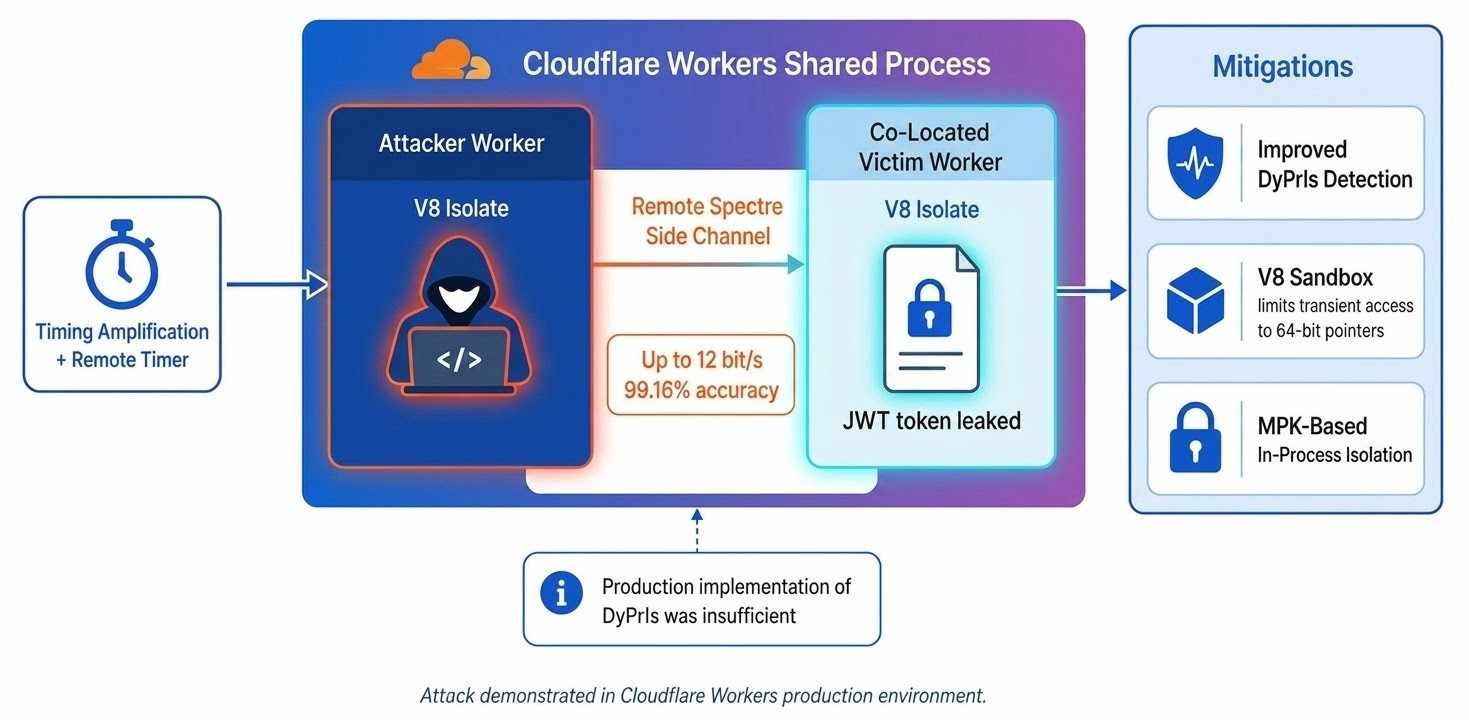
| Metric / Mitigation | Details |
|---|---|
| Leakage Rate | 12 bits per second (99.16% accuracy) |
| Previous Rate (2021) | 120 bits per hour (2 bits/minute) |
| Evasion Technique | WebSocket I/O suppressing iTLB branch-misprediction signals |
| V8 Sandbox (New) | Limits transient access to 64-bit pointers |
| MPK Isolation (New) | Hardware-enforced Memory Protection Keys for Worker heaps |
Cloudflare’s Mitigation and MPK Architecture
In response to these findings, Cloudflare has significantly overhauled its security architecture. Acknowledging that software-level isolation is no longer enough to stop a highly optimized cloudflare workers spectre attack, the company has deployed a multi-layered defense strategy in its production environments.
The core of this new defense relies on integrating the strict V8 Sandbox and MPK isolation strategies. Hardware-assisted Memory Protection Keys (MPK) place individual Worker heaps behind hardware-enforced protection boundaries. Because modern x64 systems only have about 12 keys available, Cloudflare implemented a rotating memory layout that prevents nearby sandboxes from sharing the same key, effectively shutting down cross-isolate memory reads.
Related Resource: Understanding hardware-level exploits and multi-tenant cloud vulnerabilities is critical for modern threat modeling. Learn how to secure your corporate network against complex internal and external threats in our definitive guide to Zero Trust Architecture in 2026. To monitor ongoing enterprise zero-day disclosures, explore our 2026 Enterprise CVE & Vulnerabilities Security Hub.
FAQ: cloudflare workers spectre attack
What is a Spectre attack on Cloudflare Workers?
It is a side-channel timing attack where a malicious Cloudflare Worker abuses the CPU’s speculative execution features to read the private memory of a different, co-located Worker running on the same server, potentially leaking sensitive data like JWTs.
Was any customer data stolen?
No. The attack was a proof-of-concept conducted by security researchers from TU Graz on a controlled victim Worker. Cloudflare confirmed there is no evidence of this attack being used maliciously in the wild.
How did Cloudflare fix the vulnerability?
Cloudflare mitigated the issue by heavily upgrading its Dynamic Process Isolation (DyPrIs), integrating Google’s V8 Sandbox, and implementing hardware-enforced Memory Protection Keys (MPK) to physically isolate Worker heaps.
Reported by CyberUpdates365 Desk
Delivering the latest insights on enterprise security, federal AI directives, and the future of IT infrastructure. Follow us for daily updates on how technology is reshaping the corporate landscape.