If you sleep soundly at night simply because your organization enforced standard multi-factor authentication across your Microsoft 365 tenant, wake up immediately and audit your active user session tokens. Security researchers tracking active cyber warfare operations in August 2026 confirm that three sophisticated Phishing-as-a-Service (PhaaS) platforms—Sneaky 2FA, EvilTokens, and EvilProxy—are aggressively targeting United States enterprises to silently capture live login credentials and authenticated OAuth tokens.
Here is the hard operational reality: standard push notifications, SMS one-time codes, and authenticator app approvals do not protect your infrastructure against contemporary Adversary-in-the-Middle (AiTM) reverse proxies or OAuth device code hijacking. These automated attack suites do not bother cracking encryption algorithms or guessing user passwords. Instead, they force your target employees to complete legitimate MFA challenges directly against Microsoft’s real authentication servers, only to intercept the generated session cookie mid-flight. Once harvested, threat actors achieve administrative cloud account takeover without ever triggering an MFA validation alert.
To defend your corporate network against automated token exfiltration, your SOC team needs immediate visibility into these three attack architectures. Throughout this technical advisory, we break down the operational mechanics, impossible device shift detection heuristics, high-fidelity Indicators of Compromise (IOCs), and defensive zero-trust configurations needed to safeguard your Microsoft 365 cloud environment.
Why Does Legacy MFA Fail Against Modern AiTM and OAuth Phishing?
Legacy multi-factor authentication fails because standard verification challenges confirm only that an authentication event occurred, without validating the specific browser or endpoint receiving the session token. When an adversary positions a reverse-proxy framework or OAuth device code lure between the user and Microsoft, the resulting authenticated cookie or API access token lands directly inside the attacker’s storage environment.
Why are specialized cyber warfare operations heavily targeting US corporate networks with multi-stage relay infrastructure? Because a validated Microsoft 365 session token opens the door to complete corporate data sovereignty loss. Once an attacker imports a harvested Entra ID session cookie into their own local browser session, they gain immediate, silent API access to corporate Outlook Exchange archives, SharePoint documentation vaults, OneDrive files, and financial enterprise communication channels.
Furthermore, established threat groups deploy these unauthorized cloud sessions to execute automated Business Email Compromise (BEC) fraud, wire transfer redirection, and internal lateral movement across connected Azure infrastructure. To understand how these automated platforms breach hardened corporate Perimeters without setting off legacy login alarms, we must examine the specific mechanics driving each individual PhaaS engine.
How Does the Sneaky 2FA Phishing Kit Bypass Turnstile Bot Detection?
Sneaky 2FA operates as an Adversary-in-the-Middle reverse-relay phishing engine that places a Cloudflare Turnstile human verification wall directly ahead of its cloned Microsoft 365 login portal. This automated bot-detection gate blocks security sandboxes and automated email scanning web crawlers from reaching the malicious payload, allowing the underlying credential relay script to harvest passwords and live MFA session cookies.
First observed by Sekoia Threat Detection researchers in late 2024 and expanding massively across North American business sectors throughout 2026, Sneaky 2FA is sold as a licensed commercial product via an automated Telegram bot known as @SneakyLog_bot for approximately $200 per month. Source code analysis reveals that the engine recycles foundational cookie-parsing logic and reverse-proxy modules from the earlier W3LL OV6 phishing kit.
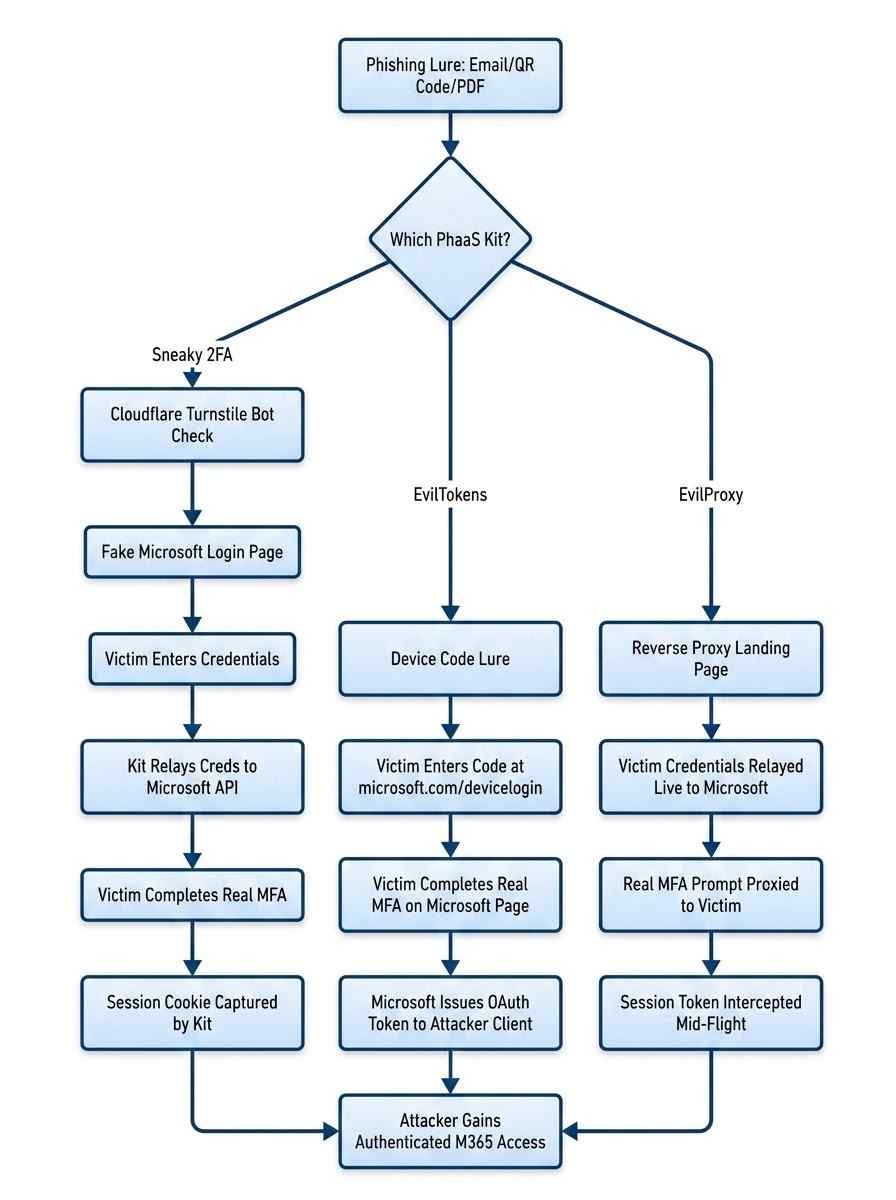
Let’s examine the exact Sneaky 2FA attack progression:
- Lure Delivery: An employee receives a targeted PDF attachment or embedded QR code inside a deceptive financial email (often titled
Final Lien Waiver.pdfor corporate procurement directives). - Turnstile Evasion Gate: Upon clicking the link, traffic routes through an open redirect and hits a Cloudflare Turnstile challenge gate disguised as a benign food recipe website or corporate file gateway. Automated enterprise security scrapers fail the challenge or get silently routed to a Wikipedia page via
href.libased on IP datacenter filtering. - Real-Time Relay: Human victims who clear the check land on a high-resolution clone of the Microsoft authentication window featuring blurred real-world backgrounds of SharePoint or OneDrive. The server automatically populates the target email from URL variables.
- Cookie Skimming: When the employee submits their username, password, and subsequent MFA verification code, the phishing backend relays those tokens live to Microsoft’s genuine authentication API. The moment Microsoft validates the login and issues the authenticated session cookie, Sneaky 2FA captures the token server-side and terminates the victim’s session.
What is the Impossible Device Shift Detection Tell?
The impossible device shift is a behavioral heuristic occurring when an authentication sequence exhibits two entirely different hardcoded browser User-Agent strings within a single login correlation ID. Sneaky 2FA routinely relays initial credential verification using an iOS Safari User-Agent, before immediately submitting the MFA challenge resolution using a Windows Chrome User-Agent within a 10-minute window.
Because no legitimate employee switches operating systems midway through a 30-second login attempt, defensive engineers can construct high-fidelity detection rules inside Microsoft Entra ID audit telemetry by searching for inconsistent User-Agent parameters tied to matching correlation IDs. For comprehensive automated script logic and detection rules to implement across your SIEM, review our open-source defense repositories on the CyberUpdates365 GitHub Threat Intelligence Repository.
What Makes EvilTokens Different From Reverse-Proxy Phishing Kits?
EvilTokens differs fundamentally from traditional phishing suites because it never hosts a cloned login page, never harvests user passwords, and never attempts to intercept browser session cookies. Instead, it abuses Microsoft’s native OAuth 2.0 Device Authorization Grant protocol, tricking corporate employees into authorizing an attacker-controlled application directly on Microsoft’s legitimate cloud servers.
Emerging as a sophisticated PhaaS framework in mid-February 2026, EvilTokens has already breached upwards of 340 enterprise Microsoft 365 environments across the United States and seven international markets. Because this threat engine weaponizes an intentional Microsoft identity authentication workflow originally created for keyboardless hardware like Smart TVs, conference room displays, and IoT sensors, conventional URL filtering systems identify the authentication traffic as 100% genuine.
Here is how the EvilTokens OAuth token exfiltration pipeline unfolds:
- API Initialization: The threat actor’s backend server initiates an automated Device Authorization request against Microsoft’s live OAuth API endpoint after validating target account existence via the
GetCredentialTypequery onlogin.microsoftonline.com. - Code Delivery: Microsoft responds with a valid user verification code (such as
A7D3-K9L2) and an authentication instruction URL pointing to the official Microsoft device login portal (https://microsoft.com/devicelogin). - Social Engineering Lure: The attacker transmits a high-urgency business email or meeting verification notice instructing the victim to authenticate their corporate identity by entering the supplied verification code at the genuine Microsoft web link.
- Direct Token Issuance: When the victim navigates to Microsoft’s verified domain, enters the code, and completes their normal push notification or TOTP challenge, Microsoft’s backend authorization server issues long-lived OAuth access and refresh tokens directly to the attacker’s polling client on Railway cloud server instances. The attacker secures sustained silent access to corporate email, calendar data, and SharePoint files without generating an anomalous failed login event.
To examine broader historical context regarding how unauthorized cloud API persistence feeds modern data theft and extortion operations, read our verified 2026 Major Data Breaches and Cloud Ransomware Timeline.
To build an organizational defense framework against credential theft and phishing, explore our 2026 Small Business & Consumer Cyber Security Defense Vault.
How Does EvilProxy Execute Reverse-Proxy AiTM at Scale?
EvilProxy operates as a commercial turnkey reverse-proxy infrastructure that proxies communication between the victim and legitimate identity providers in real time, serving exact dynamic source code from genuine Microsoft authentication servers. By acting as an transparent inline traffic broker, EvilProxy seamlessly forwards usernames, passwords, and multi-factor push requests before capturing the resulting session cookies mid-transit.
Active since May 2022 and marketed heavily across dark web cybercrime syndicates, EvilProxy remains one of the most mature adversarial frameworks currently operating in North America. Tracked extensively by enterprise research analysts across the MITRE ATT&CK Enterprise Matrix (under designation O-TA-041), this platform frequently executes massive corporate waves targeting C-suite executives, legal directors, and finance managers across Fortune 500 institutions.
Why do automated security scanners fail to identify EvilProxy servers? Because the framework performs deep virtual machine fingerprinting and browser automation heuristics before displaying any login fields. If an enterprise email protection scanner accesses the link, the server terminates the session or drops an innocuous redirect block. When a legitimate human executive accesses the link, the proxy dynamically loads Microsoft’s actual sign-in code, making visual detection entirely ineffective.
A critical behavioral sign of active EvilProxy targeting involves out-of-sequence MFA push requests reaching user smartphones when the employee is not actively engaging in a workstation sign-in attempt, paired with subtle authentication domain variations (such as lmo.msdnmail[.]net instead of standard login.microsoftonline.com routes). For additional architectural hardening against credential harvesting relays, reference our technical analysis of the 1-Click RCE and Terminal Hijacking Vulnerability Fix Guide.
Technical Comparison: Sneaky 2FA vs. EvilTokens vs. EvilProxy
Understanding the subtle architectural variations between these three PhaaS platforms is vital for engineering proactive SOC detection parameters. Below is our verified threat matrix contrasting their deployment mechanisms, interception targets, and primary evasion techniques:
| Threat Attribute | Sneaky 2FA | EvilTokens | EvilProxy |
|---|---|---|---|
| Primary Attack Vector | AiTM Reverse-Relay Phishing Page | OAuth 2.0 Device Code Grant Abuse | Inline Real-Time Reverse-Proxy |
| Targeted Artifact | User Passwords & Session Cookies | OAuth Access & Refresh Tokens Only | User Passwords & Session Cookies |
| MFA Interaction Mechanism | Relayed live to Microsoft; cookie skimmed post-auth | Victim authorizes attacker app; direct token issue | Real MFA proxied inline; token intercepted mid-flight |
| Core Evasion Technique | Cloudflare Turnstile gates, IP blocklists, Wikipedia redirection | Legitimate Microsoft authentication domains, Worker lures | Deep VM detection, browser fingerprinting, dynamic DOM copies |
| Commercial Model | ~$200/month via Telegram (@SneakyLog_bot) | Turnkey Business Email Compromise (BEC) operations platform | Established dark web PhaaS licensing model since 2022 |
What Are the Active IOCs and MITRE ATT&CK Mapping?
To intercept active exploitation attempts across your cloud tenant, enterprise defenders must integrate verified forensic data into endpoint detection systems and network firewalls immediately. Below is the verified Threat Intelligence IOC and MITRE framework correlation matrix for August 2026:
| PhaaS Platform | Indicator / Tactic Type | Technical Value / Pattern | MITRE ATT&CK & Context |
|---|---|---|---|
| Sneaky 2FA | URL Pattern & Path | https://<domain>/[a-zA-Z0-9]{150}/index, /verify, /validate | T1557 (AiTM) — 150-char alphanumeric deployment directory signature |
| Sneaky 2FA | Operator C2 Infrastructure | sneakylog[.]store | 185.125.100[.]81 | 101.99.92[.]124 | T1539 (Steal Session Cookie) — License verification & relay service |
| Sneaky 2FA | Favicon & Image SHA256 Hashes | 5d91563b6acd54468ae282083cf9ee3d2c9b2daa45a8de9cb661c2195b9f6cbf | Base64-encoded spoofed Microsoft branding logos |
| EvilTokens | Core C2 & MailVault Platform | techroboticslabmade[.]com | macmamo[.]com | acb[.]af | T1550.001 (Application Token) — Central BEC Operations platform |
| EvilTokens | Token Replay Subnets (Railway) | 162.220.232.0/22 | 162.220.234.0/22 | 216.126.227[.]101 | T1114 (Email Collection) — Cloudzy and Railway backend relay networks |
| EvilTokens | Automated Exploit User-Agents | python-requests/2.31.0 | kali365-live/1.0.0 | Custom automated Microsoft 365 token extraction scripts |
| EvilProxy | Suspicious OAuth Landing URLs | lmo.msdnmail[.]net/common/oauth2/v2.0/authorize?client_id=... | T1566.002 (Spearphishing Link) — Dynamic reverse proxy endpoints |
| EvilProxy | Compromised Landing Domains | acrobatsign[.]es | adobesign[.]us[.]com | blue-styles[.]cz | T1078.004 (Cloud Accounts) — Executive impersonation infrastructures |
For continuing technical discourse and ongoing updates regarding practical KQL threat hunting queries matching these indicator patterns, collaborate with our defensive engineering staff directly on our Official CyberUpdates365 Dev.to Security Advisory Portal.
How Can US Organizations Mitigate PhaaS Token Theft?
Mitigating advanced PhaaS token theft requires transitioning from vulnerable push-and-SMS MFA toward phishing-resistant cryptographic authentication mechanisms, paired with restrictive Entra ID Conditional Access policies. Because standard multi-factor methods rely on transportable validation artifacts, organizations must implement hardware-bound cryptographic controls that cannot be intercepted or relayed by inline proxy infrastructure.
To achieve immediate architectural resilience against these three threat engines, implement our mandatory C-suite defense checklist:
- Enforce Phishing-Resistant MFA (FIDO2 / WebAuthn): Replace push notifications and one-time codes with hardware security keys (YubiKeys) or FIDO2-certified passkeys. Phishing-resistant WebAuthn protocols bind authentication cryptographically to the specific TLS origin domain; if a user visits a reverse proxy like
lmo.msdnmail[.]net, the passkey refuses to release credentials because the domain signature does not match official Microsoft infrastructure. - Block OAuth Device Code Grant Flows: Configure Conditional Access policies inside Microsoft Entra ID to strictly deny the OAuth Device Authorization Grant workflow for standard corporate staff. Unless an employee explicitly operates keyboardless IoT display hardware, disabling this authentication path completely immunizes your organization against EvilTokens token hijacking.
- Activate Continuous Access Evaluation (CAE): Enable CAE across your Microsoft 365 tenant to enforce real-time session revocation. When a user experiences an anomalous network event—such as an IP address changing from a corporate VPN to a DigitalOcean or Railway datacenter in mid-session—CAE terminates the token instantly, rendering intercepted cookies worthless to the attacker.
- Deploy Sigma Impossible Device Shift Analytics: Integrate correlation rules within your security SIEM to detect conflicting User-Agent strings occurring across identical authentication correlation IDs within a short duration window. Automatically lock Entra ID accounts triggering impossible device shift patterns or displaying logins originating from anonymized hosting ASNs (such as Railway ASN 14061 and Cloudzy).
For deeper insight into federal zero-trust benchmarks and enterprise cryptographic authentication guidelines, review official publications on CISA.gov and the verified security standard documentation within NIST Special Publication 800-63B.
Frequently Asked Questions on PhaaS MFA Bypass Attacks
What is Phishing-as-a-Service (PhaaS) and how does it target Microsoft 365?
Phishing-as-a-Service (PhaaS) is a cybercrime business model where developers lease pre-packaged threat toolkits, reverse-proxy servers, and evasion infrastructure to affiliates for monthly subscription fees. Against Microsoft 365, tools like Sneaky 2FA and EvilProxy provide turnkey Adversary-in-the-Middle reverse proxies that silently capture user session cookies immediately after the victim completes real multi-factor authentication.
Can an authenticator app push notification be bypassed by Sneaky 2FA or EvilProxy?
Yes. Standard authenticator app push notifications and six-digit Time-Based One-Time Passwords (TOTP) are vulnerable to reverse-proxy interception. Because the user inputs the valid code or approves the push on a proxied connection, the real Microsoft authentication server grants a validated session cookie directly through the attacker’s server, allowing the threat actor to steal the token and access the account without needing a password again.
How does EvilTokens steal Microsoft 365 access without hosting a fake login page?
EvilTokens abuses Microsoft’s legitimate OAuth 2.0 Device Authorization Grant protocol. The threat actor requests an authorization verification code from Microsoft and emails it to the employee with urgent instructions to enter it at the official microsoft.com/devicelogin domain. When the employee logs in and completes MFA on Microsoft’s genuine site, Microsoft issues long-lived access and refresh tokens directly to the attacker’s backend servers.
Why does Sneaky 2FA trigger an impossible device shift alert in audit logs?
Sneaky 2FA triggers an impossible device shift alert because the tool hardcodes inconsistent browser User-Agent strings across separate phases of a single login sequence. For instance, the script submits initial login credentials using an iOS Safari User-Agent, then transmits the MFA resolution token using a Windows Chrome User-Agent within the same authentication correlation ID—a behavioral pattern no human user produces naturally.
What is the only guaranteed defensive mitigation against reverse-proxy PhaaS kits?
The only proven mitigation against reverse-proxy AiTM kits and device code hijacking is deploying Phishing-Resistant MFA, specifically FIDO2/WebAuthn passkeys or hardware certificate-based authentication. These cryptographic methodologies verify the exact TLS domain origin before transmitting validation proofs, preventing reverse-proxy frameworks from relaying authentication challenges or stealing active session tokens.
Institutional Security Audit & Verification: This research guide has been technically audited and verified by the CyberUpdates365 Threat Intelligence Unit in alignment with NIST & CISA 2026 cybersecurity frameworks and verified North American intelligence. All technical specifications, software pricing benchmarks, and defense protocols are verified as of August 2026.