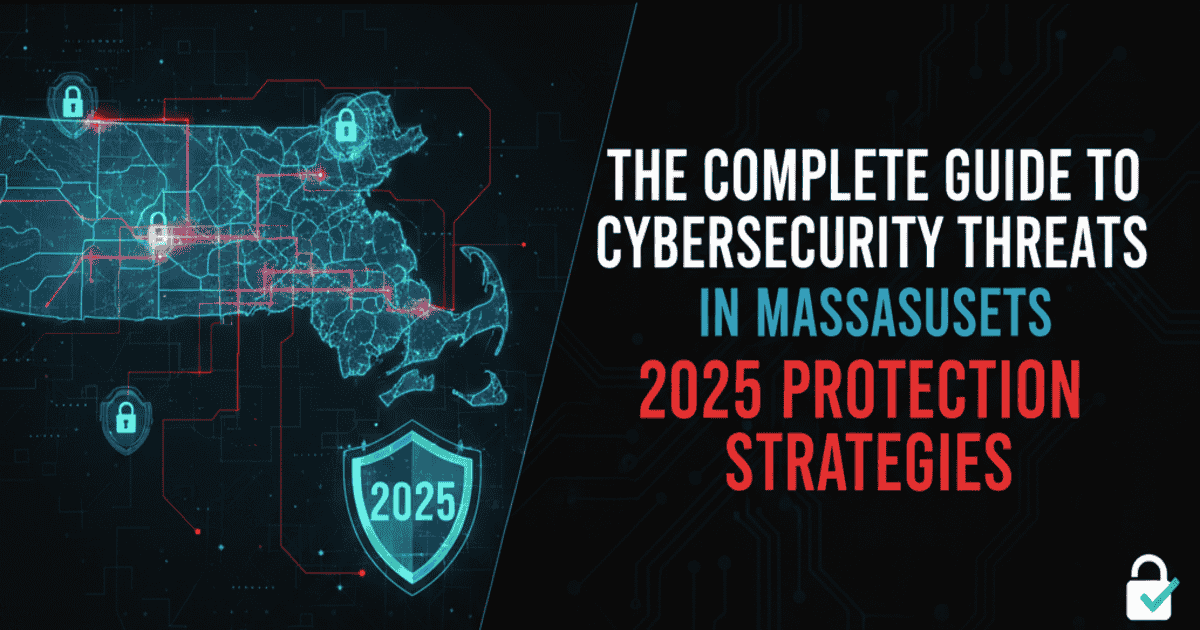
Massachusetts has emerged as one of the most aggressively targeted geographic corridors for enterprise cybercrime in North America. With more than 9,000 technology enterprises, world-class biotechnology corridors in Cambridge and Boston, prestigious research universities, and prominent healthcare networks, the Commonwealth represents a lucrative attack surface for extortion cartels. Analyzing cybersecurity threats in Massachusetts 2025 reveals an urgent need for institutional hardening across commercial and municipal operations.
According to comprehensive threat intelligence advisories from CISA Cybersecurity Advisories and the Massachusetts Attorney General’s Office, state commercial entities face compound risks. Understanding cybersecurity threats in Massachusetts 2025 requires examining multi-tier ransomware, supply chain exploitation, and advanced cloud misconfigurations. Surviving this hostile operational landscape demands rigorous defense-in-depth, strict statutory compliance under 201 CMR 17.00, and tested zero-trust architectures.
Understanding Cybersecurity Threats in Massachusetts 2025
Massachusetts organizations face unique operational challenges due to the dense concentration of high-value targets. The complex landscape of cybersecurity threats in Massachusetts 2025 combines intellectual capital, financial reserves, and critical healthcare systems, creating an environment that attracts sophisticated threat actors ranging from opportunistic ransomware cartels to advanced persistent threat (APT) groups.
Key Statistics and Trends in Massachusetts Cyber Attacks
Threat intelligence reports and state enforcement filings highlight an alarming escalation in cybersecurity threats in Massachusetts 2025 across regional infrastructure:
- Healthcare Sector: Healthcare networks experience a severe surge in double-extortion ransomware operations targeting electronic health records and diagnostic systems.
- Higher Education & Research: Academic institutions report persistent spear-phishing campaigns designed to exfiltrate proprietary laboratory findings and defense contracts.
- Small to Midsize Enterprises: Small businesses suffer devastating operational and financial losses due to automated credential stuffing and business email compromise.
- Financial Services: Boston’s financial district reports continuous automated account takeover attempts and API exploitation.
- Industrial Manufacturing: Advanced manufacturing corridors face indirect supply chain infiltration through unmonitored vendor maintenance portals.
Why Attackers Target Massachusetts
Several structural factors position Massachusetts at the crosshairs of global cybercrime, accelerating cybersecurity threats in Massachusetts 2025:
- Innovation Hub: Cambridge and Boston host the world’s most concentrated biotechnology, pharmaceutical, and artificial intelligence clusters, housing billions in trade secrets.
- Healthcare Concentration: Institutions like Massachusetts General Hospital, Beth Israel Deaconess, and regional medical networks manage massive volumes of Protected Health Information (PHI).
- Prestigious Universities: MIT, Harvard, Boston University, and dozens of research centers collaborate with federal agencies on national defense and scientific research.
- Asset Management Dominance: Boston’s financial services manage trillions of dollars in private equity, mutual funds, and commercial lending reserves.
- Municipal Infrastructure: State and local government systems manage vital utilities, transportation networks, and social services for nearly 7 million residents.
| Economic Sector | Primary Asset Profile | Dominant Threat Vector | Regulatory Mandate |
|---|---|---|---|
| Biotech & Technology | Proprietary algorithms and pharmaceutical patents | Nation-state corporate espionage and cloud token theft | NIST SP 800-171 & CMMC Compliance |
| Healthcare Networks | Protected Health Information (PHI) and medical devices | Double-extortion ransomware and medical IoT hijacking | HIPAA Security Rule & 201 CMR 17.00 |
| Higher Education | Federal research data and student financial records | Spear-phishing and unsegmented campus network pivoting | FERPA and GLBA Safeguards Rule |
| Financial & Legal | Escrow capital, client funds, and corporate M&A archives | Business Email Compromise (BEC) and wire fraud | SEC Cyber Disclosure Rules & FTC Safeguards |
Top 10 Cybersecurity Threats Facing Massachusetts Organizations in 2025
A granular breakdown of cybersecurity threats in Massachusetts 2025 reveals ten primary methodologies utilized by adversaries:
1. Ransomware Attacks
Ransomware remains the single most disruptive aspect of cybersecurity threats in Massachusetts 2025 for commercial continuity. Organized syndicates such as LockBit, BlackCat (ALPHV), and Royal deploy double-extortion tactics, exfiltrating sensitive client records before deploying encryption payloads. In healthcare, these attacks delay patient admissions, redirect ambulances, and corrupt electronic medical records. For an in-depth forensic investigation of hospital downtime, read our analysis on Massachusetts Hospitals Losing $24 Million Daily in Cyberattacks.
- Mitigation Strategy: Deploy air-gapped, immutable backup systems; enforce continuous endpoint detection and response (EDR); execute quarterly tabletop recovery drills; and never pay ransoms without direct consultation with the FBI Boston Field Office (617-742-5533).
2. Business Email Compromise (BEC)
BEC operations inflict catastrophic financial damage through email spoofing and account takeover, representing a persistent component of cybersecurity threats in Massachusetts 2025. Attackers infiltrate legitimate corporate Microsoft 365 or Google Workspace accounts, monitor financial routines, and insert fraudulent payment requests into active billing threads.
- Common Scenarios: Executive impersonation directing urgent wire disbursements, compromised vendor email routing changes, fraudulent attorney directives during real estate escrows, and direct payroll diversion schemes.
- Mitigation Strategy: Enforce strict DMARC, SPF, and DKIM records; mandate multi-factor authentication across all cloud accounts; and establish out-of-band verbal confirmation policies for all financial transfers exceeding $10,000.
3. Phishing and Advanced Spear Phishing
Rather than sending generic spam, threat actors creating cybersecurity threats in Massachusetts 2025 engineer hyper-personalized lures referencing regional institutions. Attackers mimic Massachusetts Department of Revenue notices, Mass General patient alerts, or university collaboration requests to capture single sign-on credentials. To review emergency response workflows, explore our operational report on 500+ Massachusetts Small Businesses Hit by Phishing Campaigns.
- Mitigation Strategy: Implement continuous security awareness training, deploy link sandboxing and email banner warnings, and mandate reporting to
reportphishing@massachusetts.gov.
4. Healthcare Protected Health Information (PHI) Breaches
Healthcare facilities face severe operational exposure within the landscape of cybersecurity threats in Massachusetts 2025 due to unpatched legacy medical telemetry hardware and compromised third-party medical billing vendors. In accordance with the HIPAA Security Rule, healthcare providers must enforce hardware encryption, maintain immutable audit logging, and execute strict Business Associate Agreements (BAAs).
5. Third-Party Supply Chain Intrusions
Adversaries recognize that direct attacks on fortified enterprises are challenging, so they exploit third-party suppliers and MSPs. This form of cybersecurity threats in Massachusetts 2025 allows attackers to pivot across network bridges into the primary corporate core. For comprehensive infrastructure defense architectures, review our foundational 2026 Ransomware Protection Guide for Critical Infrastructure.
6. Cloud Workload Misconfigurations
As state enterprises migrate workloads to AWS, Azure, and Google Cloud, misconfigurations amplify cybersecurity threats in Massachusetts 2025. Publicly accessible S3 storage buckets, unencrypted databases, overly permissive IAM roles, and shadow IT services operating without IT visibility allow attackers to drain cloud data within minutes.
7. Insider Threats (Malicious and Negligent)
Trusted employees, contractors, and departing personnel present acute security challenges. Negligent handling of private data, sharing passwords, or malicious exfiltration of intellectual property prior to joining competitors can inflict severe organizational damage. Implementing User and Entity Behavior Analytics (UEBA) and automating offboarding access revocation is mandatory.
8. IoT and Operational Technology (OT) Device Exploitation
Massachusetts manufacturing facilities, laboratory environments, and smart building systems operate thousands of unsegmented IoT and OT devices. Programmable Logic Controllers (PLCs), HVAC automation, and environmental monitoring devices often run legacy firmware with default passwords. Review federal industrial security directives in our report on CISA Critical Advisories for Massachusetts Industrial Systems.
9. Mobile Endpoint and Remote Work Vulnerabilities
With hybrid work models firmly established, corporate data frequently traverses unmanaged personal smartphones and home Wi-Fi networks. Smishing (SMS phishing), malicious mobile applications, and unencrypted local caching expose corporate tokens. Mandatory Mobile Device Management (MDM) enrollment with containerized storage and remote wipe capabilities is essential.
10. AI-Powered Synthetic Attacks
Threat actors deploy artificial intelligence to scale cybersecurity threats in Massachusetts 2025 with machine-speed execution. Generative voice cloning replicates executive speech during phone calls, automated scanners discover zero-day vulnerabilities in public web applications, and LLMs draft grammatically flawless spear-phishing messages tailored to specific corporate departments.
Massachusetts-Specific Cybersecurity Regulations: 201 CMR 17.00
Organizations handling Commonwealth consumer records and defending against cybersecurity threats in Massachusetts 2025 must comply with 201 CMR 17.00, one of the nation’s most stringent data protection statutes:
Core Statutory Mandates:
- Written Information Security Program (WISP): Every business must design, implement, and maintain a comprehensive written program detailing administrative, technical, and physical safeguards against cybersecurity threats in Massachusetts 2025.
- Mandatory Encryption: Personal information stored on laptops, portable storage media, or transmitted across public networks must be cryptographically encrypted.
- System Access Controls: Implement unique user IDs, robust password policies, least privilege permissions, and automated session timeouts.
- Vendor Oversight: Execute contractual agreements requiring third-party service providers to implement equivalent security protections.
- Continuous Monitoring & Auditing: Regularly audit networks, maintain firewall protection, deploy current security software patches, and review system access logs.
Data Breach Notification Requirements
Under the Massachusetts Data Breach Notification Law, any organization that experiences unauthorized access to personal records must execute statutory notifications:
- Attorney General Notification: Formally notify the Massachusetts Attorney General and the Office of Consumer Affairs and Business Regulation (OCABR) within 72 hours of discovery.
- Affected Resident Notification: Provide written notice to affected individuals as soon as practicable, not exceeding 45 days.
- Credit Monitoring Provisions: Offer complimentary credit monitoring services for at least 18 months (or 42 months if the breach involves consumer reporting agencies) if Social Security numbers are exposed.
Comprehensive Protection Strategies: Immediate, Medium, and Long-Term
Effectively insulating an organization from cybersecurity threats in Massachusetts 2025 demands a phased, multi-layered defensive strategy:
Immediate Measures (Implement This Week)
- Enforce Multi-Factor Authentication: Mandate phishing-resistant MFA across all corporate email, VPN, and administrative portals.
- Deploy Email Protections: Configure strict DMARC, SPF, and DKIM records alongside automated external sender warning banners.
- Verify Backup Immutability: Confirm that data backups are physically or logically air-gapped and execute live restoration tests to neutralize cybersecurity threats in Massachusetts 2025.
- Remediate Public Vulnerabilities: Patch internet-facing services within 48 hours of security advisory publication.
Medium-Term Improvements (Next 30 Days)
- Endpoint Detection & Response (EDR): Deploy behavioral EDR software across all workstations, servers, and virtual cloud machines.
- Privileged Access Management (PAM): Restrict administrative credentials and mandate time-limited, audited session access.
- Phishing Simulations & Training: Conduct regular workforce simulation campaigns to build active skepticism against social engineering.
- Formalize WISP Documentation: Audit internal operations against 201 CMR 17.00 to eliminate regulatory compliance gaps.
Long-Term Strategic Improvements (Next 90 Days)
- Zero-Trust Architecture: Enforce zero-trust network access (ZTNA), deprecating legacy VPNs in favor of context-aware micro-segmentation.
- Security Information & Event Management (SIEM): Centralize log aggregation and automated threat correlation across cloud and on-premise infrastructure to monitor cybersecurity threats in Massachusetts 2025.
- Third-Party Vendor Risk Auditing: Mandate annual SOC 2 Type II or ISO 27001 certifications for all external cloud software providers.
- Executive Board Governance: Establish recurring cybersecurity risk reporting to board leadership and audit committees.
Incident Response Protocol: First 24 Hours to Full Restoration
When an incident occurs, executing a disciplined incident response protocol determines whether a breach results in minor containment or catastrophic operational paralysis:
Phase 1: Detection, Triage, and Containment (Hours 0-24)
- Activate Response Teams: Convene the designated incident response committee, including executive leadership, legal counsel, and technical leads.
- Isolate Infected Segments: Sever network connectivity to affected VLANs, revoke compromised cloud session tokens, and disable compromised active directory accounts to halt cybersecurity threats in Massachusetts 2025.
- Preserve Forensic Telemetry: Capture memory dumps, preserve firewall connection logs, and avoid rebooting systems to ensure digital evidence remains admissible.
- Notify Statutory Authorities: Contact the FBI Boston Cyber Task Force (617-742-5533) and report critical infrastructure events to CISA (1-888-282-0870).
Phase 2: Eradication and Evidence Analysis (Days 2-7)
- Engage external digital forensics and incident response (DFIR) specialists to reconstruct attack timelines.
- Identify the root cause entry vector, purge persistence backdoors, and validate that intermediate command-and-control channels are fully dismantled.
- Notify insurance carriers to coordinate forensic expenses, legal representation, and crisis communications.
Phase 3: System Restoration and Post-Incident Hardening (Days 7+)
- Restore critical enterprise workloads from verified offline immutable backups in clean staging environments.
- Rebuild compromised endpoints from known golden master images before reintroducing them to production subnets.
- Conduct comprehensive post-incident reviews to patch exploited vulnerabilities and update organizational response playbooks.
Cyber Insurance for Massachusetts Businesses: Underwriting Requirements
Given the rising frequency of digital extortion and complex cybersecurity threats in Massachusetts 2025, commercial cyber insurance is indispensable. However, underwriting syndicates have instituted rigorous technical prerequisites before binding coverage:
Essential Policy Coverage Components:
- First-Party Protection: Business interruption losses, digital asset restoration costs, ransomware extortion negotiations, and crisis PR management.
- Third-Party Liability: Customer breach notification expenses, credit monitoring services, regulatory defense fees, and class-action legal liability.
Mandatory Underwriting Prerequisites:
- Hardware-enforced multi-factor authentication (MFA) across all employee and administrative access points.
- Enterprise-grade Endpoint Detection and Response (EDR) deployed on 100% of corporate endpoints.
- Immutable, air-gapped data backups tested at least semi-annually.
- Documented and tested incident response procedures aligned with NIST frameworks.
- Documented compliance with state privacy frameworks, including 201 CMR 17.00.
Your 30-Day Cybersecurity Improvement Plan
This structured 30-day roadmap provides Massachusetts organizations with an actionable schedule to harden digital infrastructure against cybersecurity threats in Massachusetts 2025:
Week 1: Assessment and Quick Wins
- Days 1-2: Conduct comprehensive asset discovery across all physical hardware, cloud workloads, and user accounts.
- Days 3-4: Enforce multi-factor authentication across all corporate email and remote access portals.
- Day 5: Configure DMARC, SPF, and DKIM email authentication records to eliminate domain spoofing.
- Day 6: Review password complexity standards and mandate enterprise password manager deployment.
- Day 7: Audit and test backup restoration procedures, confirming offline immutable storage integrity.
Week 2: Technical Controls
- Days 8-9: Deploy behavioral EDR software across all workstations and servers.
- Days 10-11: Audit network firewall rules, isolating guest Wi-Fi and establishing network micro-segmentation.
- Days 12-13: Run automated vulnerability scans and patch critical common vulnerabilities and exposures (CVEs).
- Day 14: Configure centralized log ingestion into enterprise SIEM infrastructure to detect emerging cybersecurity threats in Massachusetts 2025.
Week 3: Policies and Training
- Days 15-16: Review and update the corporate Written Information Security Program (WISP) for 201 CMR 17.00 compliance.
- Days 17-18: Formalize the corporate Incident Response Plan, designating incident commanders and external counsel contacts.
- Days 19-20: Develop interactive security awareness curriculum covering social engineering and deepfake scams.
- Day 21: Launch initial workforce training sessions and initiate randomized phishing simulations.
Week 4: Testing and Governance
- Days 22-23: Execute secondary vulnerability assessments to verify patch effectiveness.
- Days 24-25: Analyze phishing simulation results, scheduling mandatory refresher training for non-compliant personnel.
- Days 26-27: Finalize statutory compliance documentation and establish third-party vendor review schedules.
- Days 28-29: Conduct an executive tabletop exercise simulating double-extortion ransomware.
- Day 30: Present the finalized cybersecurity posture roadmap to executive leadership and the board of directors.
Massachusetts Cybersecurity Resources and Official Contacts
Organizations can access extensive state and federal resources to support cyber defense operations against cybersecurity threats in Massachusetts 2025:
Federal Agencies:
- CISA 24/7 Operations Center: 1-888-282-0870 |
central@cisa.dhs.gov - FBI Boston Cyber Task Force: 617-742-5533
- FBI Internet Crime Complaint Center: www.ic3.gov
Massachusetts State Resources:
- Massachusetts Attorney General’s Office: Data Breach Notification Reporting | Consumer Hotline: 617-727-8400
- Massachusetts Emergency Management Agency (MEMA): 617-727-2200
- Office of Consumer Affairs and Business Regulation (OCABR): Consumer and business data guidance
Information Sharing Communities:
- MS-ISAC: Multi-State Information Sharing and Analysis Center for public sector entities.
- InfraGard Boston: FBI public-private security partnership.
- NECCSA: New England Chapter of the Cloud Security Alliance.
Frequently Asked Questions (FAQ)
What are the primary cybersecurity threats in Massachusetts in 2025?
The primary threats include double-extortion ransomware targeting healthcare and manufacturing, Business Email Compromise (BEC) wire fraud, cloud workload misconfigurations, third-party software supply chain infiltration, and AI-powered synthetic voice cloning attacks.
What is Massachusetts 201 CMR 17.00?
201 CMR 17.00 is a mandatory state regulation requiring any commercial entity owning or licensing personal information of Massachusetts residents to implement a comprehensive Written Information Security Program (WISP), complete with encryption, multi-factor authentication, and strict access controls.
How quickly must a data breach be reported in Massachusetts?
Massachusetts statutory law mandates that organizations notify the state Attorney General and affected individuals as soon as practicable, without unreasonable delay, upon discovering unauthorized access to personal information.
Can an organization negotiate or pay ransoms during a cyberattack in Massachusetts?
While Massachusetts law does not explicitly prohibit extortion payments, federal authorities strongly discourage paying ransoms. Paying funds encourages further criminal targeting and does not guarantee complete data recovery. Organizations confronting cybersecurity threats in Massachusetts 2025 should immediately engage the FBI Boston Field Office (617-742-5533) before considering payment.
Conclusion: Building Resilient Digital Infrastructure
Defending against evolving cybersecurity threats in Massachusetts 2025 is no longer an optional operational expenditure—it is a fundamental business imperative. As threat cartels deploy automated exploit pipelines, synthetic media, and multi-tier extortion tactics, enterprise resilience depends upon continuous vigilance.
By enforcing zero-trust access controls, maintaining air-gapped immutable backups, achieving full statutory compliance with 201 CMR 17.00, and cultivating an organizational culture of active security awareness, Massachusetts organizations can protect critical assets, safeguard client trust, and ensure long-term commercial continuity.
Reported by CyberUpdates365 Threat Intelligence Desk. Delivering actionable research on enterprise cybersecurity, statutory data compliance, and critical infrastructure resilience.